
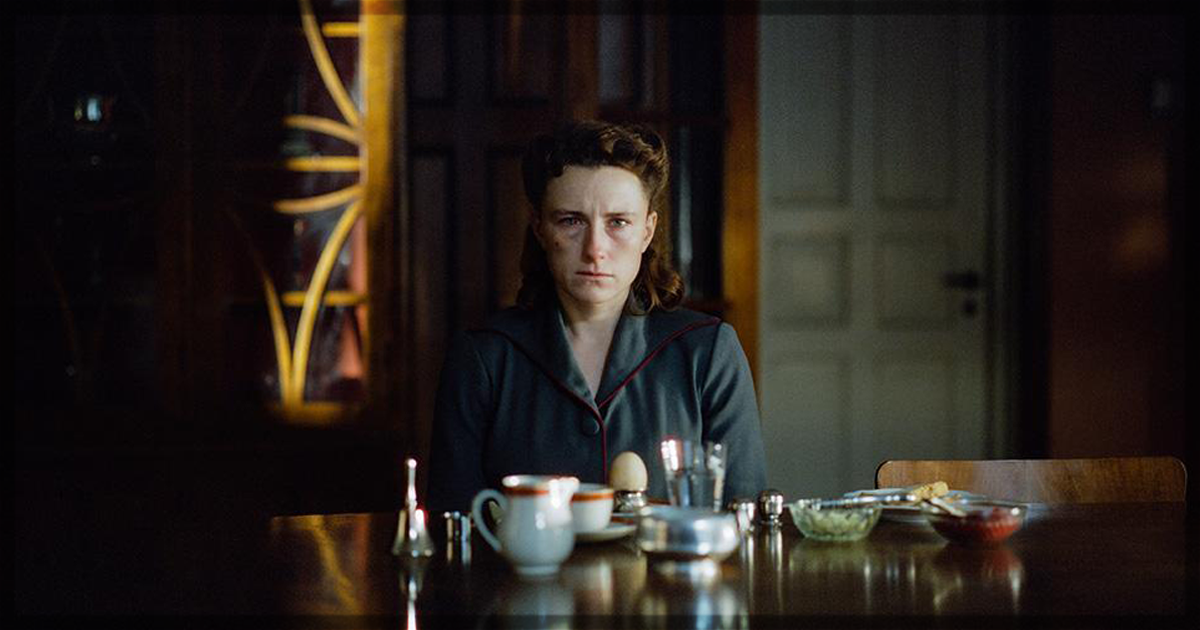
Films festivals normally only reward a movie one single prize. If your movie wins, say, best actress, then it can’t also win the main festival award. But the jury led by Maggie Gyllenhaal at this year’s Venice Film Festival broke that rule for Woman Unknown: its lead actress Mathilde Arcel won the Volpi Cup for Best Actress while the film itself, directed by May el-Toukhy, won the Golden Lion. This was a great decision. Its excellence is based around what it doesn’t show, which gives Woman Unknown a subtle and highly unusual power.
It’s shortly after the end of the Second World War and in Copenhagen things are starting to return to normal. A wealthy factory owner named Christian (Carsten Bjørnlund) and his young daughter Leonora live in a large apartment with two servants, Esther the cook (Marina Bouras) and Marie the nanny (Ms. Arcel). But Marie is not going to be the nanny for much longer; she is going to marry Christian. There’s no jealousy expressed by the other servants in the building at Marie’s achievement in bagging the boss, but perhaps they can tell she will simply be doing another kind of work. For propriety’s sake she still has her own bedroom but she sleeps with Christian every night. Unfortunately the sex is so painful she needs painkilling drops from her doctor in order to stand it. But the doctor is gone, taken away by the resistance who are meting out justice to Nazi collaborators, or those who have been accused of collaborating. Another doctor in the office insists on examining Marie, so we learn her secret. Christian, clearly, has no idea. But the man from her hometown who she bumps into on the tram, Karl (Thorbjørn Hedegaard), well, he knows all about it. Including who else was involved.
Ms. el-Toukhy, who co-wrote the script with Maren Louise Käehne, has made a movie virtually impossible to review without spoilers. Suffice to say: we learn what Marie’s secret is, but we never learn why it happened. The point becomes that Marie is badly upset by meeting Karl and horrified later to find him chatting with Esther in their kitchen. His knowledge of her secret is a smiling threat to her fancy life. As Marie tries to figure out what to do, we realise that we are watching two different movies. Perhaps Marie is a victim, an unfortunate young woman who has fled her home to escape an awful past. But perhaps Marie is a villain, a wicked young woman who has fled her home to escape the awful things she has done. Both are equally possible. Are her choices the panicked thrashings of an innocent thrown into the river to drown, or the calculated schemes of a bad person who will do absolutely anything to survive? Either way, her choices have consequences.
To say that Woman Unknown is a fascinating cinematic experience is a major understatement. The movie is calm and quiet, with Jasper Spanning’s camera generally maintaining a polite distance. Well, a polite distance that never loses its focus on Marie. Ms. Arcel is in every scene bar one – that being the one focused on the woman with the huge green eyes, which is the exception that proves the rule – meaning we inhabit this world only as she does. We watch Marie find the photograph that little Leonora keeps in her pillowcase and what she does with that photo. We observe Marie make friendly chitchat with the single mother across the hall (Sofia Nolsøe) and then how she talks about the neighbor with Esther. It’s a difficult role that must not drop a single hint about how we ought to perceive Marie, and Ms. Arcel walked that tightrope without ever setting a foot wrong. Eventually we realise true love might not be what has brought Christian and Marie together. It seems the rigid and demanding Christian has bought an attractive dinner companion to raise his daughter and sleep with him, and in return for her acquiescence and hard work Marie will receive a nice apartment to live in, warm and pretty clothes to wear and three meals a day served on bone china. Protection, and plenty of money. This might be what she needs, but it might not be what she deserves.
In 1977 (so, deep in the Soviet era), Ukrainian director Larisa Shepitko won the Golden Bear at the Berlinale for The Ascent. This brilliant film is about a Belarusian during the Second World War who decides to live at any price, only to discover once it’s too late that the price was the loss of his soul. There is a specific moment at the end when he witnesses the murder of his fellow prisoners who chose to keep their souls, including a child, and realises that he has lost more by staying alive than they did with their deaths. We understand why he did what he did, but the movie has no sympathy for his choice. Woman Unknown is just as brilliant due to its choice of keeping Marie’s reasons to herself. We are forced to judge her actions without knowing their context. Does that make our judgement impartial, or does it make it blind? By refusing to tell us whether we should have any sympathy for Marie, Woman Unknown has guaranteed audiences will puzzle over it for quite some time. Are any of Marie’s choices justifiable? Is it OK to do a bad thing if that bad thing means you survive? Is it better to die a martyr than live as a traitor? What if you were forced into doing the bad thing? Does that matter? Where do we draw the line, and why do we draw it? The real magnificence of Woman Unknown is how utterly it makes us wonder, and that makes it a wonderful film.
Woman Unknown recently played at the Venice Film Festival.
Learn more about the film at the Venice site for the title.
You might also like…

‘Shaun the Sheep: The Beast of Mossy Bottom’ is a Sweet Treat (Film Review)