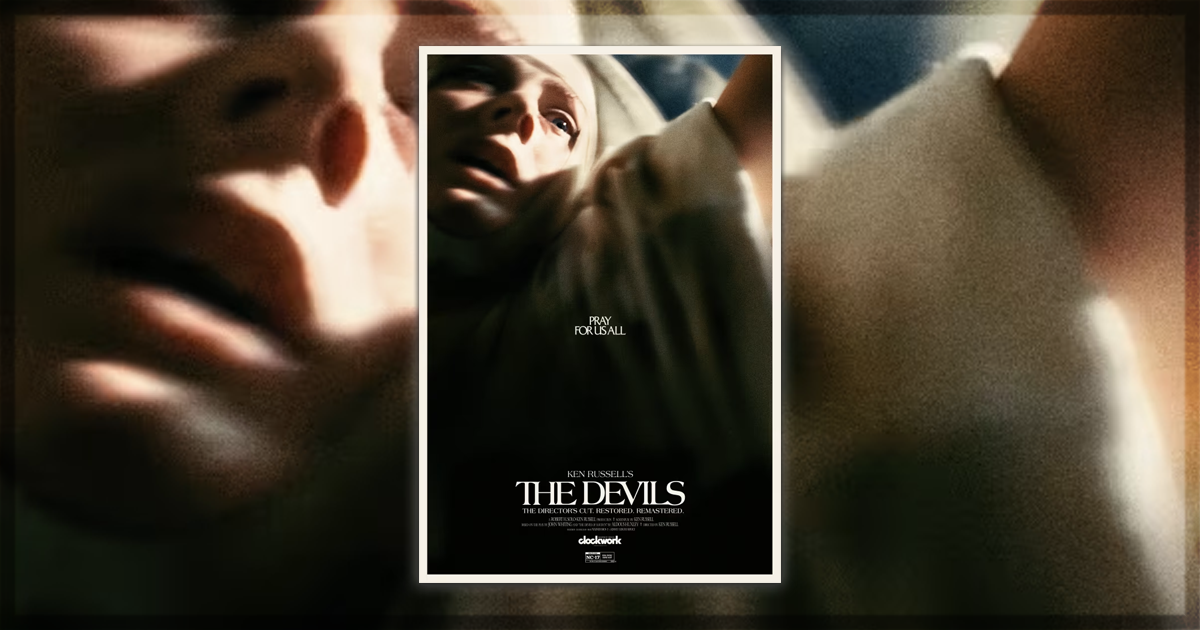
The fact one of the most important movies of 2026 is the remastered director’s cut of a very controversial movie made in 1971 is one of the most incredible things to happen in recent cinematic history. Ken Russell’s The Devils (marketed as such to differentiate from the original 1971 version) has two things going for it: it is an exceptionally beautiful film, and it has not lost one iota of its power to shock. It is about power and religion, which means it’s really about sex, and the ways in which power, religion and sex feed off each other. It uses sexually explicitness to address these issues in ways that remain completely shocking, which means the fact this movie has been remastered and re-released is almost as shocking as its existence. There will never be another movie, or another moment, like this.
It’s the 1630s and a town called Loudun is unusual for three reasons. It is fortified with large external walls, and more on the set design later; inside those walls Catholics and Protestants live together peacefully, unusual in France at this time; and the governor has recently died. Therefore in unofficial charge is a priest named Grandier (Oliver Reed, whose magnificent handsomeness here is not dimmed at bit by the prominent facial scars he received from being stabbed in the face in a bar fight in 1964). He is notorious throughout the town for being so attractive that, as an unseen laughing woman says, he is “a man worth going to hell for.” His sincere belief in God has not slowed down his sexual activities for a second, most prominently with a wealthy woman called Philippe (Georgina Hale) and a devoutly religious young woman named Madeleine (Gemma Jones in her first film), who he secretly marries. This is a genuine love match that Grandier sees as completely compatible with his priestly duties, and that Madeleine believes will help both of them get closer to God.
Right there is enough for a dozen other films but we have just gotten started. Also in the town is a closed convent full of young nuns who were originally wealthy families’ unwanted daughters, and they are not happy about it. Their abbess is Jeanne of the Angels (the uncommonly beautiful Vanessa Redgrave), who also hates her position and is therefore extra cruel to the others. She also has the kind of spinal defect that has hunched her head permanently to one side. There’s a barred windowseat as the only access point to the closed convent, though of course there are windows all around, which is how Jeanne has spied Grandier and become obsessed with him. Like, really obsessed. One-handed obsessed, if you see what I am saying.
But having no governor in Loudun means no taxes are being paid, so the king (Graham Armitage) sends a baron (Dudley Sutton) to restore normal order, though without knocking down the walls. Grandier asserts his authority and puts a stop of this, which means suddenly a lot of people are unhappy with him. When Jeanne gets a new confessor who isn’t Grandier, out of spite she ends up claiming that Grandier has bewitched her. In this time and place this accusation is taken completely seriously, so a witchhunter priest named Barre (Michael Gothard) is sent for. The fact that Grandier and Jeanne have never actually met doesn’t matter a bit to this kind of satanic possession; as we all know anything is possible. Since Jeanne doesn’t change her story Grandier’s denials are taken as further signs he is possessed. Barre’s methods of exorcism are acts of public torture, but as a result the nuns realise that if they also claim to be possessed they can do what they want. So they tear their clothes off and do exactly that: what they want. Only then does all hell break loose.
Under the wrong director the heightened fervour of the setting would be just ridiculous. Fortunately somehow Mr. Russell (who passed in 2011) managed to get the tone so right the fevered, restless feelings of the characters are transmitted to the audience. We understand why they are all keyed so high, and why they cannot separate their desires from their beliefs. Not that they want to anyway. This means, somehow, that the combination of the sex stuff and the religious stuff is not actually offensive. (With the caveat that since I’m an atheist this is easy for me to say.) What we see is wild, and goes about as far as is humanly possible to go, but we believe the characters all genuinely believe what they are saying and doing, and therefore the movie is easy indeed to watch. (A mate of mine, a working actor at the time, knew some of the background actors on the movie and according to him none of them ever had so much fun. Even without that second-hand gossip, you do get the sense from almost everyone onscreen that they were thrilled to be there.)
The famous and famously gay indie director Derek Jarman began his movie career as the production designer. The indoor sets are almost all black and white, with the feeling of tile or bricks, providing a sense of sanitised reality. The city’s external walls are also white brick, gleaming over the usual mud and mayhem below. But nowhere are there clean vertical lines like you might see in a cathedral. Instead all is criss-crossed with horizontal lines, the kind which hold us down on earth. Shirley Russell (Mr. Russell’s first wife, who passed herself in 2002) designed the costumes with a sharp eye for class. The simple black and white habits of the nuns make it very easy for us to focus on their persons, while Madeleine’s dresses reveal her shoulders in ways that clearly drive the nuns wild with jealousy. Grandier’s religious finery – sometimes heavily embroidered in heavy gold, at other times so brilliantly red he moves through the white-and-black stage sets like a mouthful of blood – emphasizes both his professional and personal power without a word being said. Barre’s costume design is the only one that feels more ‘seventies,’ but the inspiration for his style was clearly also vampire hunter Van Helsing, down to the sunglasses.
At no point is that said aloud, of course; Mr. Russell (who adapted the screenplay from a play by John Whiting that was itself based on the non-fiction book by Aldous Huxley) was far too smart to tell instead of show. The Devils is about power, whether from the church or the state, asserting itself over the human body, and how people who defy or resist are punished. Whether that’s Grandier refusing to confess under torture to consorting with the devil, or Jeanne of the Angels realising her disability means this life is all she’ll be allowed, or the nuns themselves seizing their chance to let their bodies’ needs be expressed, there are consequences to refusing to surrender your body to the desires of others. And because this is done to such an extreme, both in the desires and the attempts to assert control, the point is very clearly and beautifully made.
It is astonishing to realise that all the main characters here bear the names of real people. There really was a priest named Grandier and a nun named Jeanne of the Angels in a town called Loudun in France in the 1630s. There really was a trial, the records of which have come down to us, for us to either fill in the blanks or repurpose the story for our own meaning. But even in the anti-establishment time of the early seventies, The Devils went too far. The movie was edited down for its release, which did not dampen the outrage and the censorship.
Some of the most controversial footage thought lost, until critic Mark Kermode discovered it in the Warner Bros. vault. The director’s cut was restored and screenings were held in London back in 2002 (which I unfortunately missed), but it took from then to now for Warner Bros. to allow the movie to be remastered and given this major re-release. This clean and bright new version was the hottest ticket at this year’s Cannes Film Festival (which I also unfortunately missed). Since ownership of Warner Bros. has changed since then, this release has happened at the last possible moment, and it’s impossible to know if the movie will ever be allowed on streaming or released on physical media. So right now is when Ken Russell’s The Devils is playing in American cinemas and then elsewhere in the world, and this chance to experience it as Mr. Russell intended may well never happen again. Therefore to see Ken Russell’s The Devils is to assert the power of your own body and your own mind. That’s a lot to say about a movie, but it’s not often a movie so perfectly finds its own moment.
Ken Russell’s The Devils recently played at the London Film Festival. It is now in theaters.
Learn more about the film at the official site for the title.
You might also like…