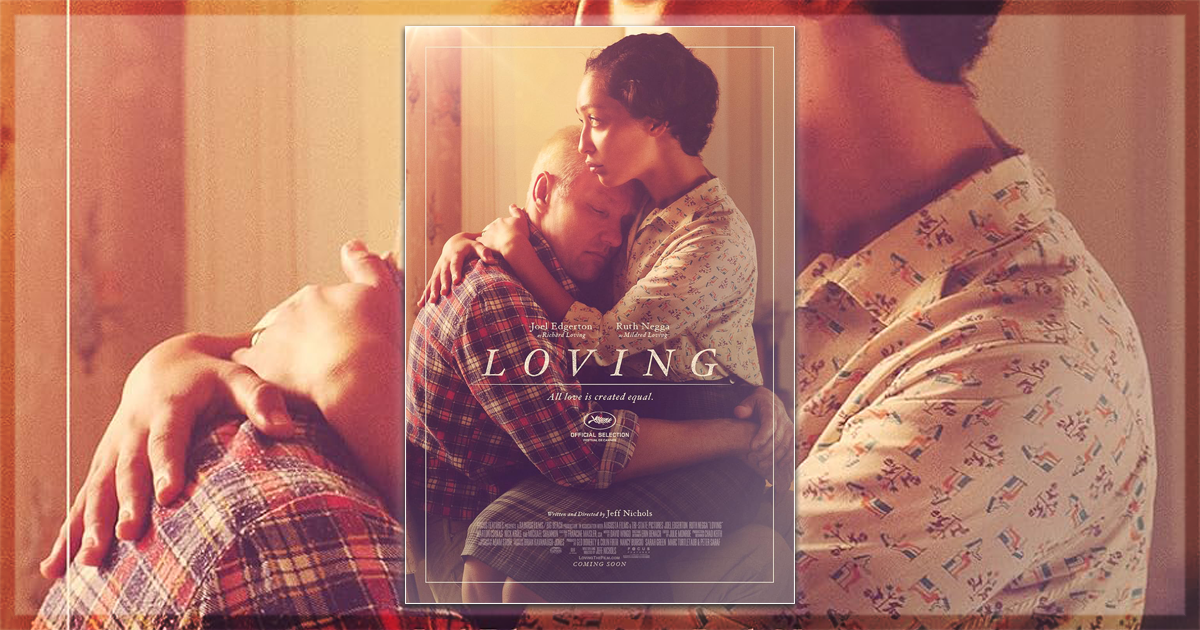
In recent American indie cinema, a fascinating name to study is Jeff Nichols. Since his debut in 2007 with Shotgun Stories, Nichols has examined the deep roots of the rural United States. Despite a few films in his catalog, his projects typically take place in the American South and rural heartland. In The Bikeriders, set in Chicago, the director aims for accents and reconstruction of period details. One of those projects is Loving, his 2016 film that competed for the Palme d’Or at the Cannes Film Festival.
A Quiet Rebellion: Defying the Racial Integrity Act
Set in 1958, the film follows the interracial couple, Richard (Joel Edgerton) and Mildred Loving (Ruth Negga), who live in the state of Virginia. Raised among the Black population of Caroline County, Richard is a mechanic who used to race sports cars. He and Mildred have known each other since childhood and fell in love. In the state of Virginia, interracial marriage is still a crime because of the segregationist laws. Therefore, white individuals are prohibited by law from marrying Black or mixed-race people. In this sense, there is institutional racism guaranteed by law, under the belief that miscegenation compromises the future of a white-dominated society. Despite all of the laws, Richard and Mildred cross the state lines and marry in D.C., where interracial matrimony is legal. Yet, they are jailed in Caroline County for their marriage, considered a crime there. Throughout the fight of the civil rights organizations, Richard and Mildred defy the segregationist laws and take their case to the American Supreme Court.
Domestic Devotion Over Courtroom Drama
In a sense, Nichols‘ Loving is a portrayal of an era, as it reminisces about the dark history of America’s segregation wounds, while those wounds resurface. However, the filmmaker constructs a love story rather than a civil rights fight as its central thread. In the first two acts, the Arkansas-based director constructs the love between the central characters as a feasible reason to fight the system. Consequently, Edgerton and Negga are the prominent aspects of the film; their relationship guides us as we understand the drama of their lives. Despite being considered a danger to the White American way of living, the couple only wants to build a home in the acreage they grew up in. Richard wants to raise their children in the same place he was, and grow old where he was born. Hence, the segregation robs them of the freedom stated in the American Constitution.
The Biggest Flaw of Loving: Centering the White Lens Over Ruth Negga’s Brilliance
Yet, the film has a more fascinating core when it dives into the studies of the effects of the segregation, the separation of Black Americans from the society. Still, Nichols analyzes it through the lens of Richard, the white man, despite the grounded casting of Edgerton, an actor who specializes in the portrayal of the poor and suffering working-class man. At the same time, on the other side of the couple, there is a marvelous performance by Ruth Negga, a top-class actor, who rarely has the chance to lead. In recent years, Negga has been the face of the works she is in, such as Passing and the TV show Presumed Innocent. Although she usually has plenty of talent around her, she always steals the show, which is the case here, as well. Hence, the lens pointed towards the wounds of the white man does not provide as much emotional baggage as the suffering of Mildred. The scenes where Mildred is by herself at the D.C. house, taking care of their children, bring a different energy to the film, a sensibility that Edgerton does not have by himself.
Structurally, the narrative is almost a biographic picture, per se. It attempts to convey the sense of the daily routine of that couple, the one that does not bend to the racist American rules of the 50s that follow the American society until today. There is a fascinating element of their meetings with lawyers, the couple avoiding taking it to the ultimate resource, hopefully awaiting the solving of their situation at home. There are a few miscastings, such as Nick Kroll as Bernie Cohen, the legendary civil rights lawyer of the ACLU (American Civil Liberties Union), who helped the Lovings with their case, which diminishes the impact of the dramatic scenes. Yet, the director finds a balance with his usual mates, such as Michael Shannon, who gives life to Grey Villet, the LIFE magazine photographer who snapped the historical picture of the couple watching TV. Nichols finds the beauty of this story in the small acts, the scenes that showcase the pure naturalistic acting of Ruth Negga.
Final Thoughts – Restrained Craft and a Brilliant Performance from Negga
Hence, Loving is not a film that utilizes the most of Nichols’ style, despite the usual tropes: countryside story, and the setting in the 1950s and 1960s. There is an emotional loss throughout the biopic structure that it assumes. Still, Ruth Negga delivers another brilliant performance, a common occurrence in her filmography.
Loving is now available to stream or purchase at Prime Video.
Learn more about the film at the IMDB site for the title.
You might also like…