
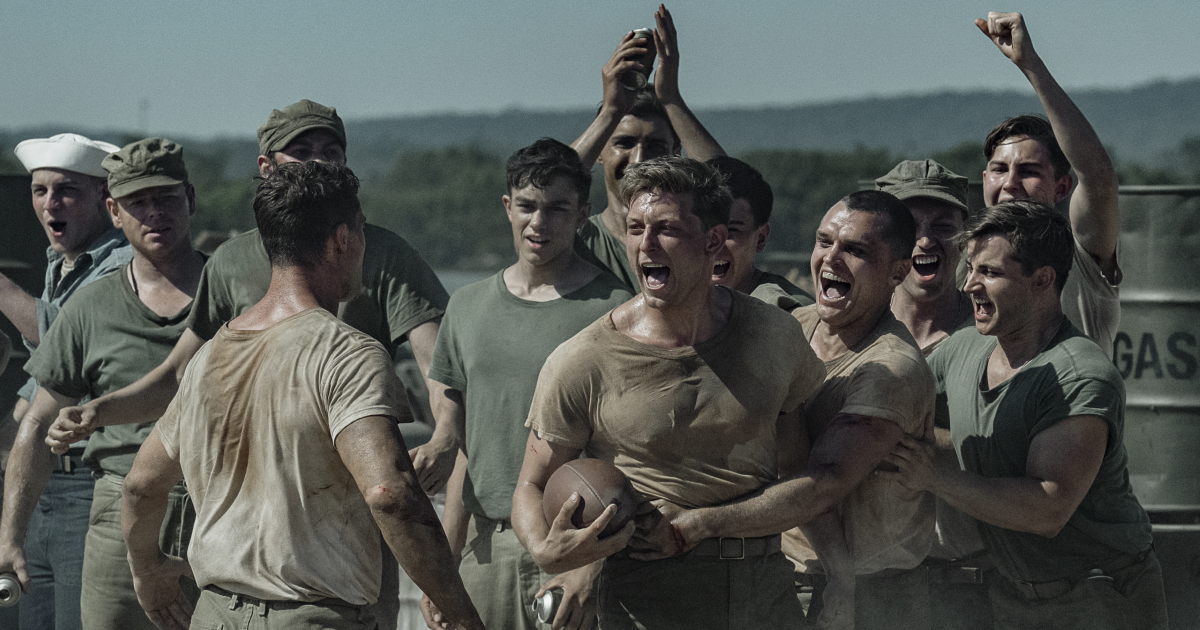
A movie called The Mosquito Bowl makes a promise with its title alone. It’s named after a real football game, played in the Pacific by Marines who had been college stars just a couple of years earlier, so you’d assume that game sits at the center of the story. Hold on to that thought. On paper, the people behind it fit the material. Peter Berg has built much of his career on football and on true stories of American servicemen, and I liked his Deepwater Horizon quite a bit. He co-wrote the script with Mark L. Smith (The Revenant).
Pearl Harbor pulls four of the best college football players in the country off the field and into the Marine Corps. John McLaughry (Nicholas Galitzine, Red, White & Royal Blue) is a level-headed Brown star with a girlfriend waiting back home. Bob Bauman (Bill Skarsgård, Barbarian) and Dave Schreiner (Tom Francis) are former Wisconsin teammates. Tony Butkovich (Ray Nicholson, Novocaine) is “Touchdown Tony,” a record-breaking scorer with swagger to spare. Before shipping out for the invasion of Okinawa, they get to play the sport that made them one more time, with the battle of their lives waiting on the other side.
The Mosquito Bowl‘s war sequences are as brutal as they come. They’re bloody, relentless, merciless, and often gory enough to put off some viewers. This is an extremely violent film, and in those moments it’s also powerful and devastating. Berg’s combat direction is pretty good overall. The sound design does a great job of immersing you, especially when it suffocates the sound after an explosion goes off near the characters in the foreground. Jacques Jouffret’s (Gran Turismo) cinematography captures both the warm spirit of the football scenes and the viciousness of the war.
The problem is the people in the middle of all that. None of the four leads gets a proper arc, and the movie’s attempts to make us care are shallow and abrupt. One character randomly drops a line about how he should’ve married his girlfriend and left her with “one in the oven.” Another suddenly mentions that he’s a dad, and the timing makes the purpose of that line painfully obvious. These moments don’t sit well, at all. They feel forced, and they work against the respect the film wants to show these men, since it rarely seems to care about any of them individually.
That makes the cast’s work more impressive. The performances are good-to-great across the board. I believe all four as football players drafted into a war, and I believe in their solidarity. Nicholson is my “man of the match”, while Skarsgård and Francis are really good company even with so little to play. Pat McAfee is the very obvious exception. The former NFL punter’s turn as a drill instructor is an extremely out-of-place casting choice. As for Galitzine, I’ve seen some people blame him for the emotional anchor not holding. I don’t think his performance is the issue, though. His restraint and presence are still praiseworthy… the writing just doesn’t give McLaughry enough to earn that role.
Which brings me back to The Mosquito Bowl. The title, not the movie. The game itself is extremely sidelined. It’s short, and the film drops it almost immediately to move on to another climactic war set piece in the third act. It doesn’t feel special at all, just like any other bonding scene in the movie — and there are major changes to how it actually went in real life. Naming your film after a sequence and then treating it like a pit stop is an admittedly strange choice.
What does work is the collective bond. The camaraderie you find in sports is something I appreciate tremendously, and The Mosquito Bowl captures it well whenever these guys are together. The few bits of humor come from that same place, and they hit solidly. I also love the message underneath it: American football is a violent sport that causes injuries and real hurt, but it’s still infinitely better than any type of war.
There’s a sharper idea in there, too. Football taught these men everything the Marines wanted from them: from aggression and discipline to playing for the guy next to you. The war simply points those same instincts at another human being. The game is the last time their violence has rules and a whistle that ends it, which is exactly why it deserved more room. Beyond that, the story is formulaic, and it doesn’t bring anything new or vital to what most of us already know about WWII.
I’ve also seen the movie criticized for giving the Japanese side no screen time or writing, and while I obviously understand, I don’t fully agree. Not every war film must cover both sides. This idea that every single movie must be fair, impartial, and show every detail is a bit silly. Not every film needs to be Oppenheimer. Similarly, a story about men bonding through sport at war doesn’t require well-developed female supporting characters. Would the movie be better had it done that? Very likely. That said, if Berg chooses to stay with the American side, he should stay there. Throwing in executions of Japanese soldiers and decontextualized shots of seppuku feels like a borderline jingoistic creative choice.
I wouldn’t call the ending unearned because I do believe in these men as a unit. It’s the individual pieces that keep this from going beyond “okay” when it could have been much, much more memorable.
Final Thoughts on The Mosquito Bowl
The Mosquito Bowl works fine as a formulaic war flick, but it had the potential for much more. Peter Berg’s combat sequences are brutal, bloody, and relentless, and the sound design and cinematography do great work. The camaraderie built through football is its strongest element, along with a message I personally love about the sport being infinitely better than war. Ray Nicholson is the standout, Bill Skarsgård and Tom Francis are really good company, and Nicholas Galitzine’s restraint deserved better writing. The characters lack any real arcs, and the forced attempts to make us care about them individually fall entirely flat. The story is as generic as they come, the title game is weirdly sidelined, and the decontextualized Japanese executions feel superpatriotic. I believed in these men as a group. I just wish the movie had bothered to get to know any of them.
Rating: C+
The Mosquito Bowl released in theaters on October 30th.
Learn more about the film, including how to watch it, at the official website for the title.
You might also like…
