
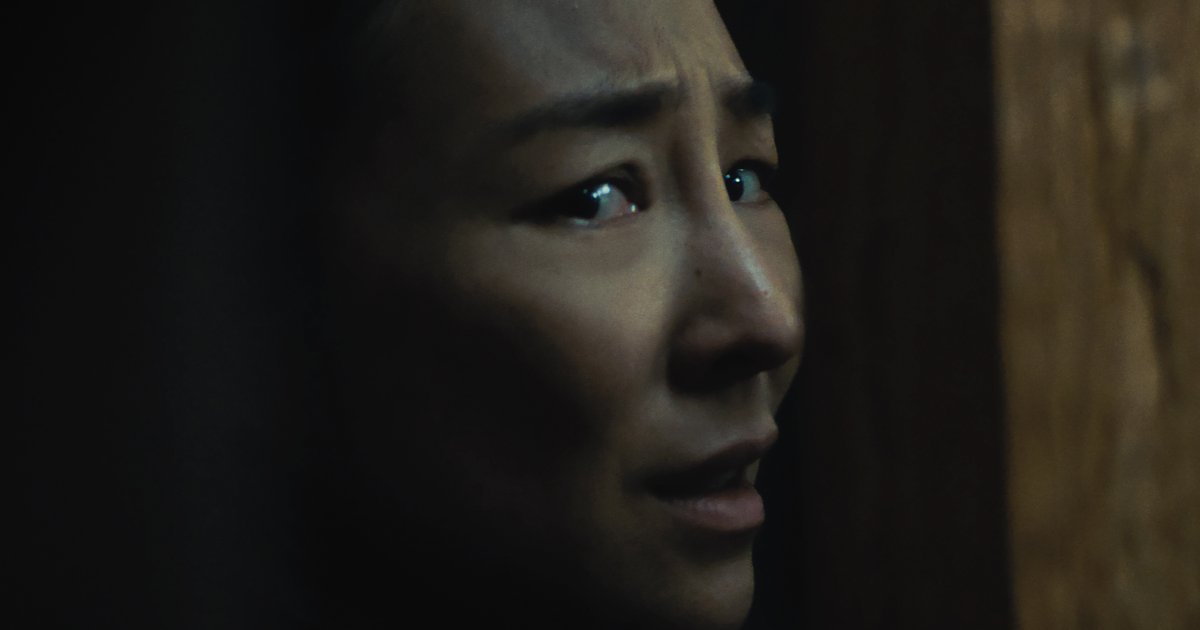
I confess I went into The Last House with a strange kind of curiosity that had nothing to do with horror and everything to do with career pivots. Louis Leterrier has spent the better part of two decades making things go fast and loud — muscle cars, magic tricks, superhero origin stories — so watching him trade all of that horsepower for four people locked inside a single house felt like its own kind of gamble. I wanted to see whether the same instincts that made Now You See Me zip along so breezily could hold up when the canvas shrinks down to four walls and a family.
I’ll admit the pairing of Greta Lee (Past Lives) and Wagner Moura (The Secret Agent) is what actually sold me, though. Two actors who’ve built entire careers on quiet, interior work suddenly asked to carry a sci-fi survival premise felt like an interesting bet, and given Netflix’s spotty track record with this exact genre cocktail, I went in hopeful but not exactly naive about how these things tend to shake out.
The setup itself is disarmingly ordinary: an average family, on an average day, in an average house, discovers that every exit has sealed itself shut, with no explanation offered and no way back outside. What begins as a single strange morning stretches into days, then far longer, as electricity fails, supplies dwindle, and the parents are forced to keep their two children fed, safe, and — increasingly — sane, all while something unclear and unsettling waits just beyond the windows. It’s a premise built on a single, elegant question: what happens to a family when the place meant to protect them becomes the thing they can’t escape?
That question, unfortunately, is where the movie’s biggest problem lives. For the first hour, there’s a bizarre absence of urgency running through nearly every scene — the family, and even the neighbors around them, treat a genuinely terrifying, life-threatening situation with a shrug that never earns itself. It’s a solid half-hour to forty-five minutes in before anyone on screen seems to register the gravity of what’s happening to them, and that disconnect makes the opening stretch feel less like slow-burn tension and more like a film unsure of its own stakes. Eventually, The Last House does find its footing: rationing food, purifying water, MacGyvering tools out of household junk, all the practical survivalist beats that should have been present from minute one finally click into place, and the movie catches a spark of real momentum precisely when it starts treating its premise seriously.
It’s a shame that spark doesn’t extend to the film’s thematic ambitions, because there are clearly bigger ideas being gestured at here. There’s a loose Man-versus-Nature undercurrent and some vague pollution-adjacent subtext, but none of it gets interrogated beyond the surface — the movie raises questions about ecological reckoning without ever sitting with them long enough to say anything. Even more frustrating is what’s missing entirely: this is a story about a hyper-connected modern family suddenly stripped of every piece of technology they rely on, and yet The Last House never once digs into what that specific severance — no phones, no internet, no outside world — would do to two kids raised inside it. That felt like the most obvious, richest vein of material available, and the script walks right past it.
Where the film does earn real credit is in its back half, once the true nature of the threat comes into focus. I won’t detail what that reveal is, only that it’s handled with more competence than the setup suggests it will be — some specific design choices and the visual effects are genuinely a pleasant surprise, and there are a handful of tension-driven, shadow-and-hide sequences in the third act that are legitimately effective, tense in a way the earlier hour never manages to be. This isn’t a haunted-house flick dressed up in sci-fi clothing, either; whatever’s keeping this family trapped is unambiguous by the time the credits roll, which is more than I expected.
Performance-wise, Lee and Moura do the heavy lifting the material needs, even when the script occasionally undercuts them with clunky dialogue and some noticeably rough ADR work in a handful of scenes. Lee in particular sells the quiet resourcefulness of a mother improvising survival out of nothing, while Moura carries the weight of a man watching his usefulness get tested in real time. The younger cast holds up its end too — Graham (Noah Alexander Sosnowski, Section Eight) and Ruth (Riley Chung, The Hunger Games: The Ballad of Songbirds and Snakes) both bring a grounded sincerity to roles that could have easily tipped into stagey knowingness.
The technical craft is where this production earns its loudest applause, and deservedly so. Production designer Kevin Jenkins (Clash of the Titans), reuniting with Leterrier after previously building his world on that movie, constructed an actual functioning house rather than a patchwork of green-screened sets, and it shows in every frame — you can feel the practicality of these sequences in a way that CG trickery never quite replicates. The decision to shoot the first half on 35mm before shifting to digital as the story’s timeline stretches is a nice touch too, though I’d stop short of calling it transformative; it reads more as a clever flourish than something that fundamentally changes how the film hits. Less successful is the visual language in the back stretch, where cinematographer Pål Ulvik Rokseth (22 July) and the editing lean hard into shaky, chaotic handheld work that muddies more than it heightens, particularly compared to the couple of genuinely well-composed sequences Leterrier does manage to carve out of the house’s confined geography.
However, the ending is where The Last House loses whatever goodwill its third act had rebuilt. The central problem resolves itself in a manner so quick and inconsequential it barely registers as a climax, and the final few minutes practically beg for a sequel — dropping plot threads and open questions less because the story demands them and more because the franchise math does. It’s a conclusion more concerned with keeping a door open for future installments than with actually closing this one out on its own terms, and that’s a frustrating note to end on for a movie that had, by that point, finally started to work.
Final Thoughts on The Last House
The Last House is a film of two very different halves — a sluggish, oddly toneless first hour that squanders a genuinely intriguing premise, followed by a back stretch that finally locates the tension and craft the setup always promised, only to rush its way to an ending more interested in sequel-baiting than resolution. Greta Lee and Wagner Moura are doing real work here, and the fully built, physically degrading house is a legitimate technical achievement that elevates every scene shot inside it, but the script never digs past the surface of its own ideas, leaving genuinely rich thematic territory — isolation, technological dependency, what security actually costs a family — almost entirely unexplored. It’s a divisive movie, one that’s likely to frustrate as many people as it entertains, and it’s easy to see why Netflix sat on the embargo until the last possible moment.
Rating: C+
The Last House releases on Netflix on August 7th.
Learn more about the film, including how to watch it, at the official website for the title.
You might also like…