I’ve always supported the idea that entering a movie theater without the weight of preconceived expectations is one of the greatest and rarest luxuries. In the case of The Housemaid, I didn’t read the source material, nor did I seek out details about the premise, allowing my interest to be guided solely by the names involved. Whether it’s director Paul Feig (Bridesmaids), a filmmaker whose work I generally appreciate for his ability to balance humor with distinct character dynamics, or Amanda Seyfried, who has undoubtedly become one of my favorite actresses in recent years — even more so after her phenomenal performance in The Testament of Ann Lee.
The Housemaid also features Sydney Sweeney (Anyone But You), an actress who, while never truly poor in her choices, has had a hit-and-miss track record in my personal perception, never quite blowing me away. Finally, Brandon Sklenar (It Ends with Us) was an enigma, someone about whom I hadn’t formed any opinion. It was with this mixture of confidence in certain talents and reservations about others that I dove into this domestic thriller.
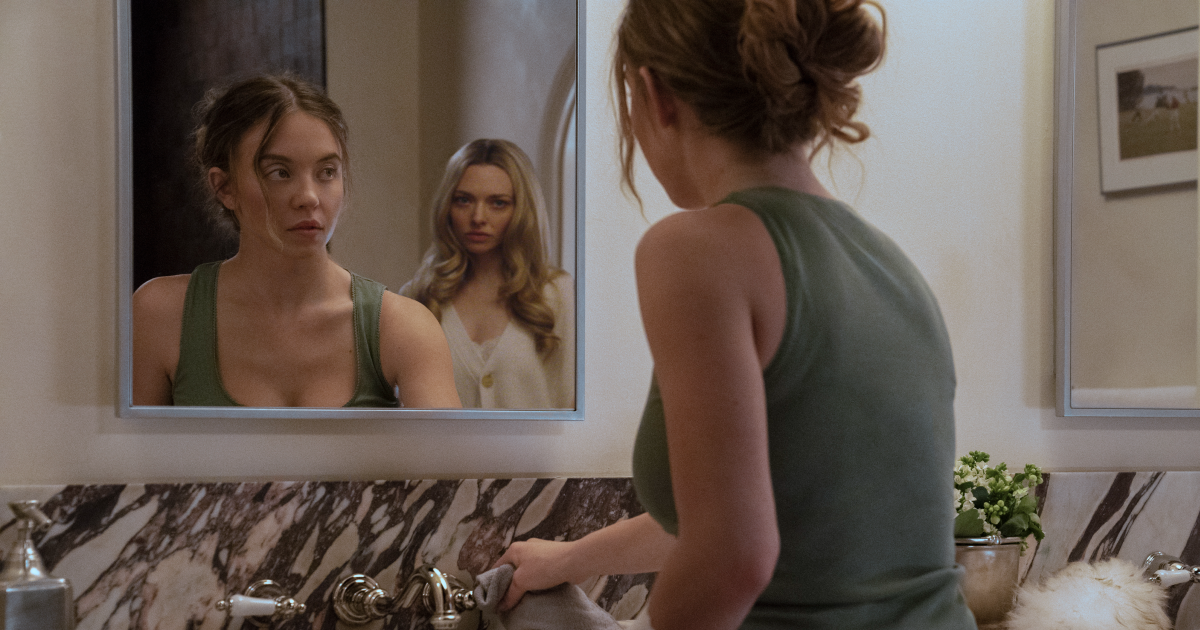
Written by Rebecca Sonnenshine (The Boys), The Housemaid follows Millie (Sweeney), a young woman with a difficult past who tries to rebuild her life by accepting a job as a live-in maid at the luxurious residence of Nina (Seyfried) and Andrew (Sklenar) Winchester. What seems like the ideal opportunity for stability quickly transforms into a game of psychological manipulation, where the appearances of a perfect suburban life hide secrets that threaten to consume everyone involved in the mansion.
The film establishes itself quickly through a theme that fascinates me: the architecture of secrecy. The Winchester house functions almost as a living character, a physical extension of its inhabitants’ psychological states. It’s interesting to note how cinematographer John Schwartzman (Jurassic World) moves away from the dark, muddy tones that plague many modern thrillers, opting for bright and vibrant visuals that contrast with the story’s grim content. This visual contrast serves to reinforce the idea of the fallacy of a perfect image — the more illuminated and immaculate the surface appears, the deeper and more putrid the foundation where secrets are kept. Millie enters this setting not just as a worker, but as a utility, someone perceived by her employers as a disposable tool rather than a human being with her own agency.
This is where The Housemaid begins to explore dehumanization through labor and class dynamics. Millie represents the desperation of those existing on the margins of society; due to her criminal record, she becomes the perfect victim in the eyes of those who hold power, since her word is always worth less than that of those residing at the top of the social hierarchy. This vulnerability is the engine that drives the suspense, creating constant tension over who’s actually in control. The movie suggests that, in a world where appearance is the only currency, truth is merely a construction that can be molded by those who have the resources to finance it.
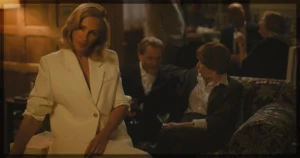
Regarding the performances, Seyfried is, without a doubt, this film’s greatest asset. Her presence is magnetic, unsettling, and gifted with an expressiveness that fills every frame. The actress seems to have been the one who best understood the assignment, throwing herself fearlessly into a purposefully over-the-top and campy performance that’s entirely justified by the narrative’s unhinged nature. There’s an almost perverse joy in how Seyfried embodies this character, turning what could’ve been a stereotype into a force of nature that dictates the pace of every scene she’s in.
On a somewhat opposite note, Sweeney appears here in a less inspired mode for much of the runtime. In the first two acts of The Housemaid, the actress seems to be on autopilot, offering reactions that are far too contained for situations that clearly demand a more intense emotional response. Fortunately, the third act provides her with denser material, and Sweeney finally manages to step up her game, embracing the script’s madness with an energy that was missing until then. Sklenar was the biggest surprise for me. I didn’t expect to find such solid dramatic chops, but the actor manages to print a necessary ambiguity onto his role, serving as an ideal counterpoint to the two protagonists.
The same can’t be said for the supporting characters. The gardener Enzo (Michele Morrone, 365 Days) and Andrew’s mother, Evelyn (Elizabeth Perkins, Big), are drastically underutilized — the former, in particular, should’ve had a much more significant role in the house’s web of mysteries, functioning as a silent witness to class injustices, but ends up relegated to an almost irrelevant plane, which takes away some weight from the resolution.
Narratively, The Housemaid suffers from some tonal inconsistencies and pacing issues that are felt mostly in the second act. There’s a certain redundancy in some sequences that seem to repeat the same tension points without moving the story forward organically. For a seasoned viewer in these realms of domestic suspense, the twists will be, for the most part, predictable. The movie doesn’t try to reinvent the wheel, but rather to execute it with as much style as possible. When predictability sets in, execution becomes the vital element, and here, Feig leans heavily on the narration. While the exposition is sometimes heavy-handed, this component manages to be interesting enough by showing us — literally — the how and why instead of just explaining what happened.
Where The Housemaid truly triumphs is in its willingness to embrace the absurd. By the time we reach the third act, all restraint is thrown out the window in favor of a catharsis of chaos, blood, and violence that works beautifully if the viewer is willing to accept the premise’s less serious tone. It’s pure entertainment, a controlled madness that reminds us of the pleasure of seeing characters pushed to their absolute psychological limits. This exploration of the victim-victimizer cycle is what gives the movie some substance, questioning to what extent survival justifies cruelty and how trauma can transform someone into the exact reflection of what they feared most.
Final Thoughts on The Housemaid
The Housemaid leans on the undeniable talent of an Amanda Seyfried in her prime and Paul Feig‘s ability to create a crowd-pleaser that knows its limitations. Although it doesn’t avoid clichés and occasionally gets lost in narrative redundancies, its vibrant aesthetics and explosive finale make up for the flaws along the way. A deliberately chaotic domestic thriller, where the power struggle and the deconstruction of social appearances reveal that the true terror lies in what we choose to ignore in broad daylight.
Rating: B-
The Housemaid is now playing in theaters.
Learn more about the film, including how to buy tickets, at the official website for the title.
You might also like…