Seven years after the controversial The Rise of Skywalker, Star Wars returns to the big screen with the faint whimper of a broken lightsaber. In the years since the conclusion of the Skywalker saga, Star Wars has continued largely through Disney+ streaming shows. The best of these is Andor by a vast country mile, but arguably the most popular is The Mandalorian, an episodic adventure show that started off promisingly, but quickly descended into shallow, regressive nostalgia in season 2 – CGI Luke Skywalker was a jumping the shark moment if ever there was one – before stagnanting in season 3. The Mandalorian and Grogu, the bland feature film followup, makes tofu seem spicy.
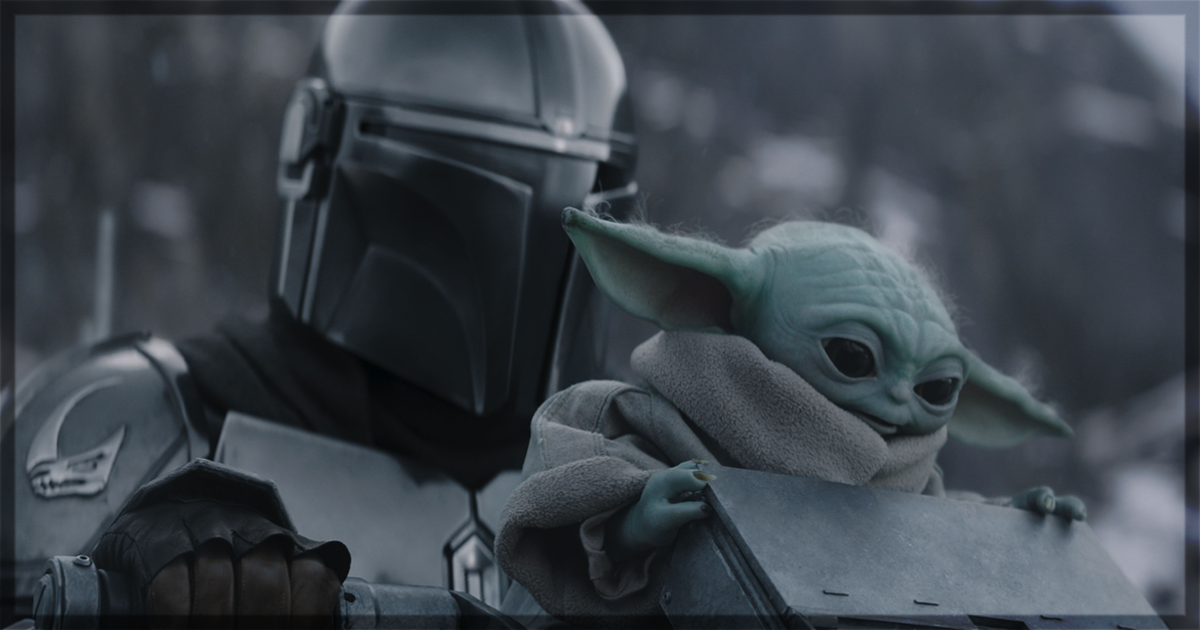
The premise of the show followed a Mandalorian warrior named Din Djarin (Pedro Pascal). A bounty hunter styled in similar getup to fan favourite Boba Fett, the Mandalorian – nicknamed Mando – travels the galaxy with a mysterious force-sensitive child, Grogu, who is the same species as the character Yoda. At first their adventures concerned the identity of Grogu and the lore of Mando’s home planet of Mandalore. Now they are hunting the last remnants of the Empire for the New Republic – remnants that will eventually merge into the First Order, but that’s another, better set of films.
After a wonky but reasonably entertaining opening action scene, The Mandalorian and Grogu are given a new assignment – to find an elusive Imperial warlord. To get intel on this, they must do a favour for a pair of Hutt gangsters known as the Twins. Siblings to the infamous Jabba the Hutt, they request that Mando locate and return Jabba’s son Rotta (Jeremy Allen White) to them, as he has been abducted and brought to the planet Shakari by the criminal underworld. As Mando reluctantly attempts to complete his mission, twists and turns occur, with the titular relationship feeling increasingly like an afterthought.
Candidly, the film has a straight-to-streaming quality that feels detached from the space opera scale of previous Star Wars movies. The editing is mostly mundane shot reverse shot techniques; the set design consists largely of flat, beige adjustments to environments you’d find on Earth, and the special effects fluctuate between engaging practicality and revolting CGI. The slapdash nature of the narrative is somewhat understandable in fairness. The show was at its best when it was episodic and self-contained, away from wider Star Wars references. But there was still a sense of growing character development throughout these adventures that is noticeably absent here.
Even as you watch it, the overwhelming sense of inconsequentiality sinks in. Putting aside the fact that the godawful animated Clone Wars movie already had a premise involving the rescue of Jabba the Hutt’s son, the film plays like a conveyor belt of plot points. Mando and Grogu hop from one planet to the next, their actions feeling like the ticking off of a checklist rather than a streamlined, meaningful story. Smatterings of creativity or enjoyable sequences occur periodically – an action scene involving stop-motion battle droids, and an alien food vendor (voiced by Martin Scorsese of all people) springs to mind. But the momentum of the film is constant stop and start, rather than a steady crescendo to excitement or payoff. It comes across as director Jon Favreau and team trying to cram the entire contents of a season 4 into 2 and a bit hours rather than a cohesive narrative.
References to previous entries in the Star Wars saga feel included to glue the cracks in the reduced scale and mechanical presentation. For the first act, Mando is joined by Zeb Orrelios (Steve Blum), an alien character who is uncannily animated and won’t mean anything to anyone who hasn’t watched Star Wars Rebels. Rotta the Hutt is about as niche a callback as you can get, but his entire character arc – wanting to prove himself as more than Jabba’s infamy – is not only frequently recited to us through dialogue, but has already taken place offscreen by the time he appears. He’s a static character made duller by Jeremy Allen White’s monotone delivery and the clumsy sound mixing. The bounty hunter Embo from The Clone Wars shows up too, and while his costume design is impressively spooky, he goes unidentified, the script seemingly assuming that audiences already know who he is. There’s even a real life dejarik fight, which the dialogue vocally mentions multiple times before and while it’s happening.
Perhaps they’re nostalgic dopamine hits for some, but they actively take away from Mando and Grogu’s dynamic, which is what gravitated so many to the show. So much is stuffed into the storyline that both Mando and Grogu feel like pieces on a narrative chessboard rather than complex, identifiable characters. Their surrogate father-son relationship was a core strength of the show, serving as the thematic and emotional backbone, even after the show lost its appeal. By contrast, the film is so visually barren and so full of meandering plot-points that the titular characters come across as hollow shells of their former selves. Pedro Pascal’s vocal performance (his character is helmeted for all but one sequence) lends gravitas to the role, as do the physical efforts of stunt doubles Brendan Wayne and Lateef Crowder, but there’s virtually no development for Mando’s or Grogu’s characters.
There is one genuinely great segment that properly utilises their connection. During a crisis point, Mando is left incapacitated, forcing Grogu to fend for himself. In a 15-minute stretch that’s mostly silent, save for one exchange with another alien character, Grogu tirelessly works to keep Mando safe, despite his limited size, experience and strength in the Force. It’s a wonderful portion of the film that calls attention to the theme of mortality, and the ways that the parent-child dynamic eventually evolves with time. The old look after the young and eventually the young look after the old in return. The sentiment is delivered with the subtlety of a sledgehammer, but it’s still a beautiful sequence that taps into the central connection that made the show so popular. Had this been its own episode in a theoretical season 4, it would’ve been outstanding stuff.
Sadly, it’s not enough to save the film from its sheer hollowness. Trundling along with conveyor belt routineness, rather than the grand immersion of even the weakest Star Wars films, its character development and sense of momentum is as dreary as its visuals. Whatever you think of the films or projects by George Lucas, Rian Johnson or Tony Gilroy, they were at least engaging, stylishly crafted stories with character development and emotional and thematic resonance in abundance, even if one didn’t like the end results. There’s the occasional fun action scene, and bursts of imagination, within this film, but they are too few and far between to stay in our memory banks for longer than the length of the picture.
If we’re being ruthless then The Mandalorian and Grogu is technically a better film than Attack of the Clones and The Rise of Skywalker, which both had their fair share of issues. But those two movies were at least engaging spectacles. They were visually impressive and held a number of sequences and moments that stayed with you for better or worse. There was arguably an audacity to them, even if it was for the wrong reasons. The Mandalorian and Grogu, despite its fun moments, is almost entirely lifeless – the remains of a straight-to-streaming season that never was. Whatever else past Star Wars films were, at least they weren’t boring.
2 stars
Star Wars: The Mandalorian and Grogu is now available to rent or stream at your retailer of choice.
Learn more about the film at the IMDB site for the title.
You might also like…