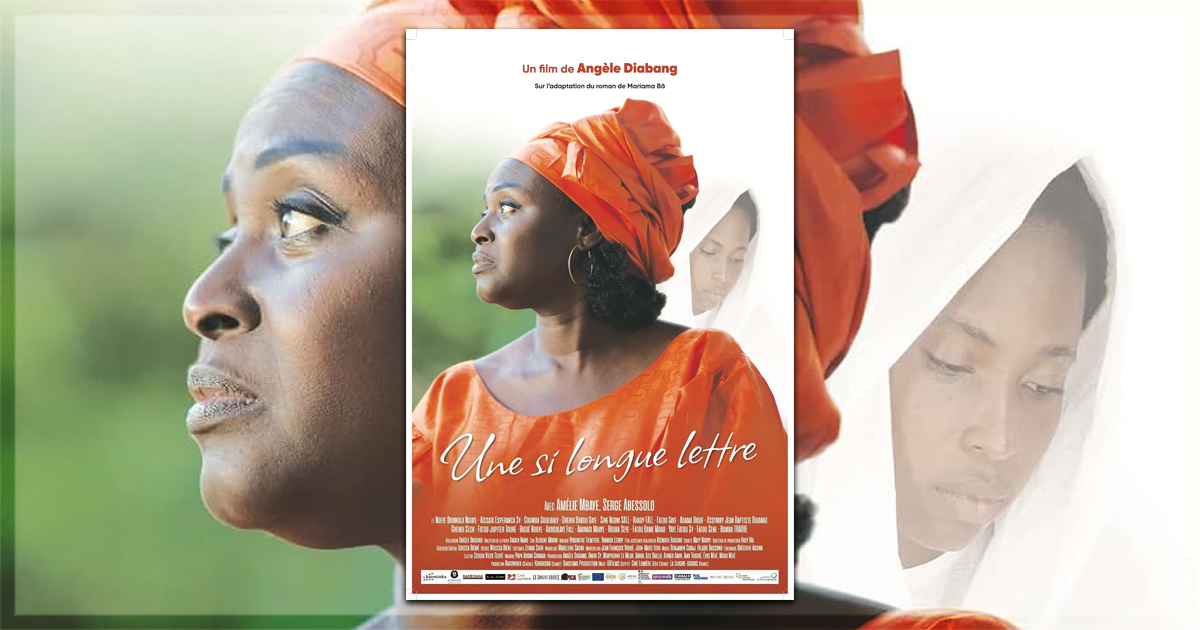
The Un Certain Regard Jury for the 2026 Cannes Film Festival was announced in April, and included three women: French actress Leïla Bekhti as jury president as well as Italian director Laura Samani and Senegalese director-producer Angèle Diabang. It’s clear Ms. Diabang was chosen because her movie So Long a Letter, which she wrote and directed, was a smash hit across French-speaking Africa in summer 2025. But So Long a Letter was only released in France shortly after that jury announcement, though it is still playing in cinemas. But to the best of my research this is its first professional review in either French or English. Considering that the movie is an adaption of the 1979 novel by Mariama Bâ, itself a major feminist landmark in African literature, this is an enormous oversight. Fortunately my French is good enough for me to report that So Long a Letter deserves every ounce of its success. It is both a defiant riposte to misogyny and institutional mistreatment of women, but also a tribute to how female solidarity is the best way to counteract that. You don’t need to know a thing about Senegal to appreciate the story here, but you do need the firm belief that women deserve respect.
The story has been moved to the present day, as 50-year-old Ramatoulaye (Amélie Mbaye), the principal of an elementary school, has been married to nationally renowned lawyer Modou (Serge Abessolo) for 25 years. Life is comfortable, and happy. They have four children, a son around 12 and three older daughters in high school. A housekeeper completes the family, and everyone switches between French and Wolof when they talk to each other. Ramatoulaye has two best friends, Aïssatou (Coumba Coulibaly) and Farmata (Ndeye Ndiaye). Farmata tells fortunes with her cowrie shells and bosses everyone around, though Ramatoulaye generally ignores her advice. Ramatoulaye and Aïssatou confide everything to each other, and Ramatoulaye tells Modou their letters to each other are the salt of her life. Then there are four big shocks. The first is that Aïssatou’s husband takes a second wife; polygyny is legal both in Senegal and in Islam, the religion to which everyone here belongs. Obviously the new wife is much younger, too. To her great credit Aïssatou refuses to put up with this and immediately leaves, both her marriage and the country, emigrating to Canada. As Ramatoulaye reels from the betrayal done to her best friend as well as her absence, the imam shows up on her doorstep with more bad news. Not only has Modou himself taken a second wife, the new wife is Binetou (Aïssata Sy), their oldest daughter Daba’s best friend.
Now there is some sympathy for Binetou, whose mother Aminata (Khadia Ndiaye Fall) is the worst kind of gold-digger, prepared to discard Binetou’s education and future potential instantly for the status marriage to Modou, even a second marriage, will provide herself. But the entire movie is entirely on Ramatoulaye’s side. She is blindsided, both by the news and the fact that Modou lacks the courage to tell her himself. She knows for a fact that Modou loves her, as she loves him, and she cannot understand why he’s chosen to be this selfish. She is also furious that Binetou, who was so often in the house she was treated as another daughter, has repaid her kindness this way. But there’s nothing Ramatoulaye can do; the fact she finds Modou’s choice immoral and repugnant is just too bad. It’s legal, their religion approves of it, and many other women have to deal with more than one co-wife. And while Modou remains her husband he gets to call the shots.
Modou buys a new house for Binetou (and her mother) and moves in there, meaning without his income things become tough for Ramatoulaye and her children. She doesn’t always handle it well; when she catches her younger two daughters sneaking a cigarette she gives them both a beating, shrieking that they’ll start drinking alcohol and becoming prostitutes next. (Moms are the same the world over, it seems.) But when Modou does come around all three daughters turn their backs to him and literally physically shield their mother from interacting with him directly. A date night for Modou and Binetou after the birth of their child is also deliberately ruined by Daba, who is out dancing in the same club and extremely happy to cause a scene. Right is on her side, both as a daughter and as a woman. It’s really refreshing to see that even as Ramatoulaye tries to figure out what to do about Modou’s awful behaviour, she never fails to appreciate the support from her friends and her daughters. Binetou’s major mistake here was choosing a relationship instead of that automatic solidarity.
We follow Ramatoulaye as she works through her hard feelings about her new reality, and Ms. Mbaye does a fantastic job of showing how Ramatoulaye is always having to calculate the best way to get both what she needs and what she wants from a world run by men. Her good-natured generosity is something everyone takes for granted, but Ramatoulaye is very clear: she has been taken advantage of, and there are limits. Amath Niane’s cinematography is bright and straightforward, staying on Ramatoulaye’s face when she must stand up for herself to Modou, to the imam, or to the other men who come out of the woodwork to cause her more headaches. The music’s tendency to swoony melodrama provides the emotional clues. But the message is always this: polygamy is wrong, women deserve equal treatment to men in relationships, and anyone who doesn’t understand this, starting with a husband, is a waste of time. It’s lovely to see a movie from anywhere in the world that only cares about its heroine’s feelings, and it’s nice to know So Long a Letter reached its audience through acts of solidarity. But watching So Long a Letter is not your feminist duty. This is a really good movie about lives which are rarely depicted onscreen, made with care by auteurs who know what they’re about. That makes So Long a Letter a pleasure from start to finish.
So Long a Letter (Une si longue lettre) has played at a number of film festivals.
Learn more about the film at the IMDB site for the title.
You might also like…