
A lot of people will find Possible Love hits much too close to home for them to like it, but this is what makes Possible Love one of the best films of the year. It is extremely knowing about gender issues, class issues, friendship, sexual attraction, the value of paying attention, and what it means when someone plays the clarinet as you sing karaoke. Above all it understands the importance of information, when to share it and when to reveal it, and the fact that some truths stay hidden is what makes it such a tantalising watch.
A few years ago an autoparts factory in South Korea went on strike to try to prevent job losses in a restructure. The strike was violently broken up by the police, the strikers all lost their jobs, and there were further consequences. As the movie opens Mi-ok (Jeon Do-yeon), her husband Ho-seok (Sul Kyung-gu) and their strange little son Cheol (Jeong Seop) are on their way to attend the funeral of one of Ho-seok’s former colleagues. The colleague committed suicide, and while Mi-ok is happy to see their former social circle even in these circumstances, it takes a very long time for Ho-seok to get out of the car. When he does a biting little argument between him and Mi-ok follows, not helped when Ho-seok realises a stranger, Ye-ji (Cho Yeo-jeong) is quietly filming them. Mi-ok flees outside to compose herself, and instead has a surprisingly flirtatious moment with a stranger named Sang-woo (Zo In-sung).
It transpires that Ye-ji is a documentary filmmaker who has been given a grant to make a film about the plight of the modern worker. She has decided to focus on the workers of Ho-seok’s factory, and when she and Mi-ok later meet for a coffee Ye-ji realises she has found her subject. Mi-ok, who works for a much smaller factory but whose involvement in the strike slowly becomes clear through flashback, is the kind of self-effacing woman nobody pays much attention to. In front of Ye-ji’s camera she blossoms. It also becomes clear that Sang-woo is Ye-ji’s husband, a man with a high-powered job and significant inherited wealth, who supports Ye-ji’s film career every way but with money. Ho-seok says nothing. He was a respected welder within the factory, heavily involved with the union and a key member of the strike. Since the strike he has been drinking too much, checked out emotionally, refusing to see old friends, refusing even to tell Mi-ok how he is feeling. But there is something about Ye-ji’s camera that he doesn’t dislike, and he certainly never interferes with the friendship that springs up between the women.
This friendship quickly becomes solid enough Mi-ok risks suggesting to Ye-ji that it’s tactless for her to wear designer clothes when she attends the group therapy sessions for the laid-off workers. Ye-ji agrees with some embarrassment but doesn’t change her wardrobe, and you start to wonder if she actually owns anything from a department store. Mi-ok is proud of the family’s little house, which has a small front garden containing a concrete picnic table. Ho-seok rescaped the garden and built that table himself to provide his factory colleagues with a cheap place to socialise, but since it was finished right before the strike action began it’s never been used except to dry the laundry. Sang-woo picks up the tab for dinner and drives Ye-ji wherever she needs to go. He works remotely, often in English. He helps Cheol with his tae kwon do and keeps an eye on Mi-ok. And then, maybe without even realising this is what they are doing, everybody pushes their luck.
Director Lee Chang-dong, who co-wrote the script with Oh Jung-mi, intertwines issues of class, entitlement, anger, responsibility, power dynamics within marriage, capitalism, and personal success in ways which feel unbelievably organic and absolutely like real life. It’s deeply rare to see a movie know its characters so thoroughly – Mi-ok and Ye-ji tell each other why they chose their husbands, for example – and every scrap of this information is necessary for the extraordinarily powerful ending. Kim Ji-yong’s cinematography largely acts like a documentary camera, holding back from too many close-ups and instead always positioning people within the room. Not always, of course; sometimes we are outside the car as Ye-ji happily curls up in the seat coming home from dinner. Sometimes we follow Ho-seok as he behaves in strange and bitter ways towards others.
But there’s a funny little flashback scene when Ho-seok, as a young man in military uniform, drags Mi-ok out of the factory where she worked at the time (and of course this is a callback to An Officer and a Gentleman without any other visual references to that; a movie doesn’t contain multiple references to Three Colors Blue without knowing its place in cinematic history). Yet most of the flashback scenes, of the drama around the strike action and the violence with which it was broken up, are not as charming. But we can see why Mi-ok chose this man, and we can see why she still loves him in spite of the very tough time they’re going through. The frustrations of badly-paid work, at the whim of bosses who don’t care whether you thrive or starve, have shaped Mi-ok and Ho-seok’s entire lives.
And yeah maybe they could have studied harder in school, or made different choices. But Ye-ji didn’t have to be pragmatic. She could study abroad in the USA and attract Sang-woo’s attention by virtue of being the only other Korean on their course. She can experiment with her movie career and receive financial support she doesn’t really need, almost certainly because she doesn’t really need it. Does she deserve everything she has, especially when Mi-ok deserves so much more than she has? And Sang-woo, well. With him deserve doesn’t come into it. He oozes privilege and entitlement, but he is so generous and calm it’s not obvious he is using his power to provide himself with more power and more money. Until the vicious little scene towards the end – and once you have seen it, you will know exactly which one – that makes it perfectly clear more money and more power will never be enough.
This is all an extremely long way to say that Possible Love is one of the smartest movies about the current moment that’s been made in a very long time. Mr. Sul has the most difficult part, by which is meant the least appealing one, but by the end we understand why his silence has been the right choice for him, and just how much he is hurting. Ms. Cho has the most interesting part in that the final twist makes it impossible know if her careless privilege is an act or a cruel choice made by someone else. Mr. Zo (who made an enormous impression earlier this year at the other end of the class spectrum in Hope) has the least showy but the most central part, in that it’s his actions – or lack of actions – that matter most.
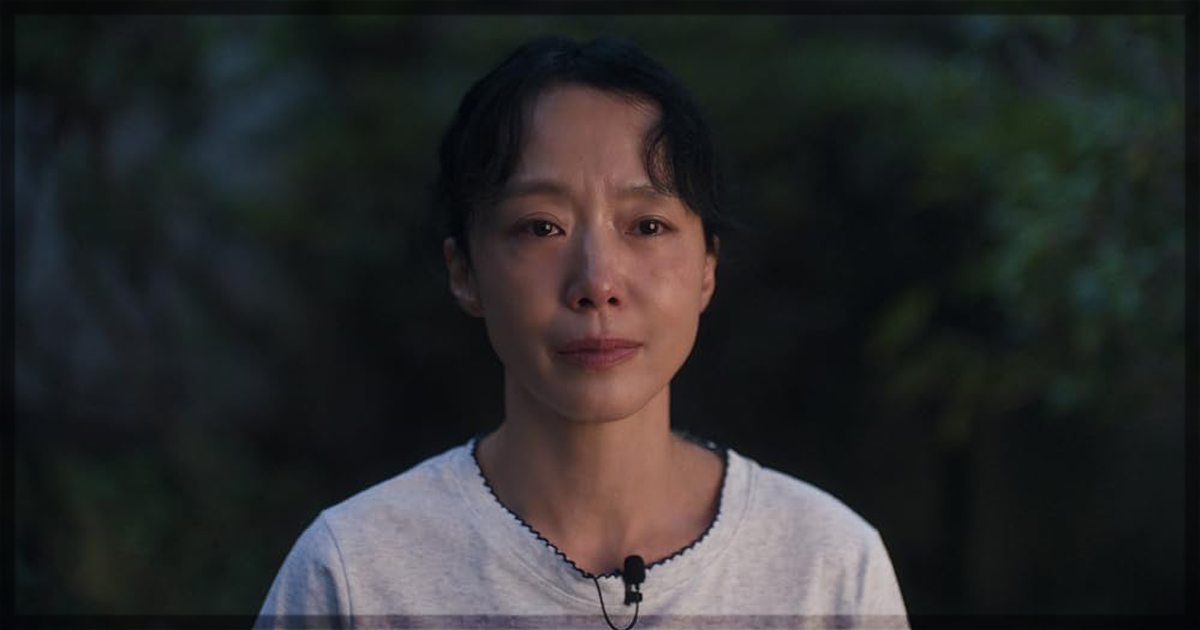
But the movie belongs to Ms. Jeon, who shows us how Mi-ok comes to understand the power of her voice, the power of her decisions, the power of her choices, and how her lack of money has not actually diminished that power. The only thing that diminishes her power is the refusal of people with money to acknowledge that money is not the only power there is. A lack of money has hampered her choices, sure. That’s life within capitalism! But it has not hampered her self, which is why Ye-ji wants to make an entire movie about her. What Mi-ok has cannot be bought and it possibly cannot even be taught, and this drives everyone who wants what she has for themselves crazy. And the ways in which Possible Love observes Mi-ok feeling empowered about her own choices – for possibly the first time in her life – is an absolute triumph. Possible Love is so smart it might actually be wise. Who knew that was a compliment a movie could deserve?
Possible Love is now streaming on Netflix.
Learn more about the film at the IMDB site for the title.
You might also like…

The Body Keeps the Score in ‘Ken Russell’s The Devils’ (LFF 2026 Film Review)