It is a pleasant surprise that the two lead performances of Coward shared the Best Actor prize at this year’s Cannes. In the announcement, the jury mentioned that is because these performances change how masculinity is normally portrayed onscreen. But what the performances in Coward do is meet the current moment of how masculinity is allowed to think about itself, in ways which strict gender roles and ideas of machismo do not support. There have been plenty of movies including soldiers like the ones in Coward, but in almost all of those, characters like the heroes here were the comic relief. So this award has been given not just because of the excellence of the performances. It’s because at the moment we can see the performances for what they truly are.
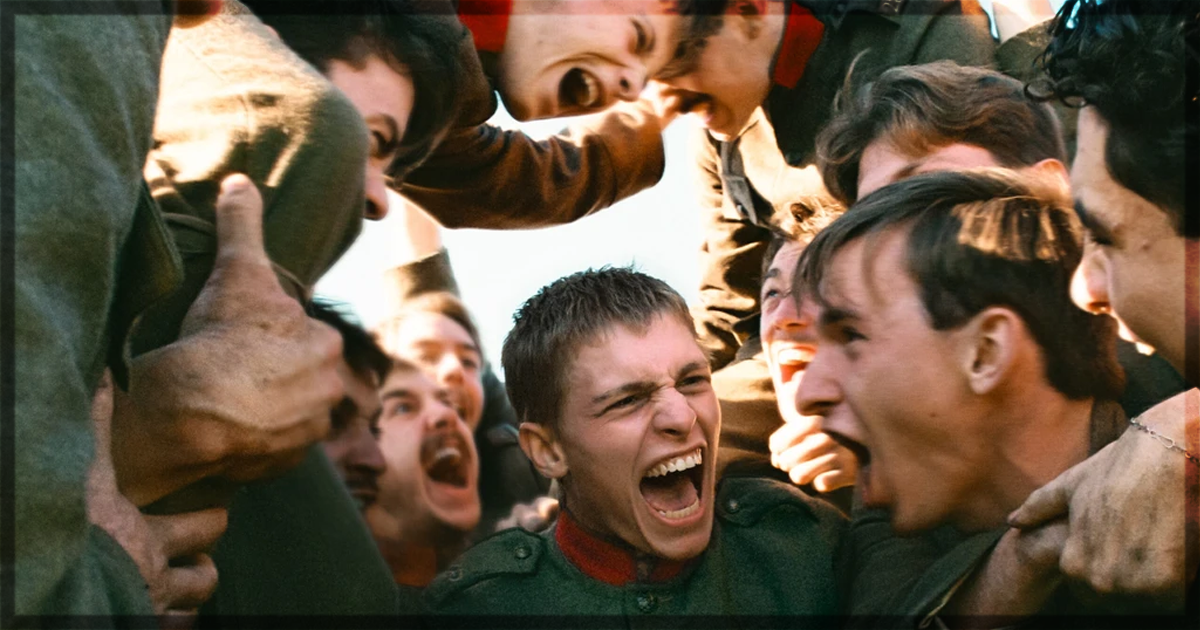
It’s the middle of World War One and a group of fresh Belgian recruits arrive at the front. One of them is Pierre (Emmanuel Macchia, in his first film), who is both taller and quieter than the others. The new recruits – there are about twelve of them, and Pierre’s tent-mate is new father Jacobs (Willem De Schryver) – begin rotating through the unpleasant gruntwork of the battlefield: clearing corpses, carrying shells and walking into no-man’s land to recover the wounded, using blankets as stretchers. Everything stinks, death is constantly in the mouth, and it’s hard to stay optimistic when your days are spent burying other young men exactly like you. The camp also contains a small group of soldiers recovering from various injuries who are therefore excused from gruntwork to focus on morale. Instead these men work on drag shows or the song-and-dance routines that provide other soldiers with light relief. Several of them maintain their mustaches, of course. When they learn about Jacobs’ baby, they burst into the mess hall so their leader Francis (an extraordinary Valentin Campagne) can act out giving birth as all the other soldiers cheer them on. The ‘baby’ is an empty mortar shell, and Jacobs is so moved by the gesture that he starts sleeping with the shell in his arms. Pierre finds himself drawn to the charismatic Francis, and Francis is very kind to the ‘tall rookie.’ A secret romance may well be on the cards. But there’s no escaping the war and its consequences.
Slowly it becomes apparent that director Lukas Dhont, who cowrote the script with his usual collaborator Angelo Tijssens, is using the pressure these soldiers experience on the battlefield as a very different metaphor. The movie’s opening discussion is about men deserting or going AWOL, because there is nothing worse than being a coward. Of course this conversation happens before Pierre and his comrades have seen one second of combat. As the new reality of their lives sink in their ideas about cowardice begin to change. Slowly the theme becomes whether it is better to be true to oneself regardless of the consequences, or if you should hide your true nature and act against your own wishes in order to be accepted by everybody else. Some of this is about the pressure on soldiers to fight. Some of this is about homosexuality at a time when being openly gay was very rarely possible, and certainly not where Francis and Pierre came from. The remarkable sequence in the hospital ward, in which Frank van den Eeden’s spinning camera focuses not on the performance but on the devastated faces and bodies of the soldiers, shows what one set of the consequences can look like. The fact that several of the patients are in full screaming meltdown because of the noise is just one part of the horror; Flavia Cordey’s sound does a remarkable job of focusing the attention. In the face of such relentless brutality neither Francis nor Pierre can hardly imagine they will survive the war. But if they could survive together, the question is whether the ends would justify the means.
The twenty-year-old Mr. Macchia has been crowned the new prince of cinema because of his remarkable ability to express complicated sentiments without talking much. The barely older Mr. Campagne has the so-called flamboyant part, which also involves a great deal of song, and plays Francis without a whisper of contempt. It remains unusual to see men portraying this style of homosexuality without telegraphing an ounce of disgust about it, though this is beginning to change. In his first major role Mr. Campagne carries the movie with an ease actors twice his age would struggle to manage, and does so with a wide-eyed finesse that’s both calculated and incredibly sincere. The scene in the loft of the barn has a depth to it that is entirely the result of Mr. Campagne’s skill. We see him calculating Francis’ decision, we see Francis’ happiness at the result and we feel that Francis was prepared for all possible outcomes, but decided to trust his gamble would pay off. The later scene where Francis, in full drag and extensive make-up, works a room of drunken high-ranking soldiers while singing makes his emotional intelligence very, very clear. The combination of Mr. Macchia and Mr. Campagne’s performances makes Coward an unmissable film.
It’s not perfect, not least in that it has the common modern problem of three endings instead of sticking with the first and best one. Military personnel, who can be much more accepting of homosexuality than civilians appreciate, will also struggle with the ways in which the metaphors of bravery and self-acceptance are addressed. But in the face of these two exceptional performances, who cares. Coward’s portrait of young men has already had a big impact, and the work here in support of acceptance and kindness will change the lives of more than these two gifted young men.
Coward recently played at the Cannes Film Festival.
Learn more about the film at the Cannes site for the title.
You might also like…