
Before I even sat down to watch The Voice of Hind Rajab, its real-life story had already flooded my soul. Contrary to my personal tendency to go into screenings with little to no familiarity with the respective film, this time, my prior knowledge was complete. My curiosity and, frankly, my expectations rested precisely on Kaouther Ben Hania — the Tunisian director nominated for an Oscar for Four Daughters — to guide us through the process, the how, and the why of this tragedy escalating in the middle of Gaza.
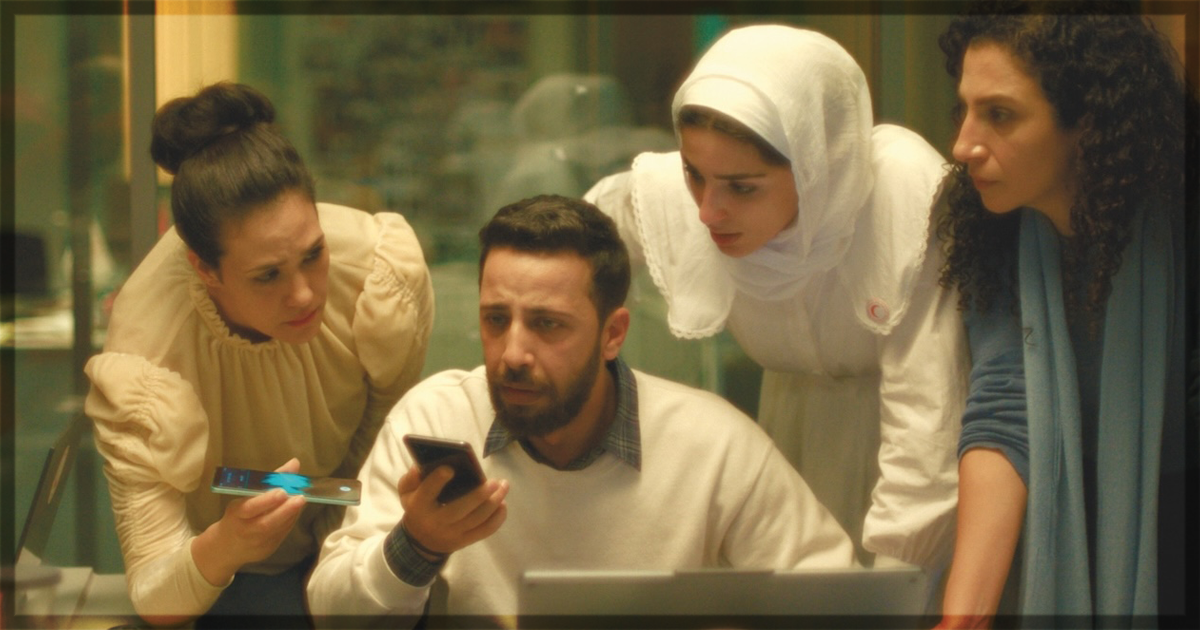
Hania, who also wrote the screenplay, presents a movie that resides on the threshold between dramatic fiction and pure documentary — a docudrama that leans clearly toward the side of reality. The Voice of Hind Rajab is based on the real audio recordings of emergency calls between young Hind Rajab and volunteers from the Palestinian Red Crescent, all while the child was trapped in her family’s car, under Israeli army fire, following an attack that killed all her relatives. The narrative follows the emergency support team in the claustrophobic, high-tension communications center. The choice to stay in this single location, witnessing the reactions of the rescuers, is a formal decision that channels all the violence into our imagination and into the child’s real voice.
The most notable — and disturbing — aspect of The Voice of Hind Rajab is its unwavering commitment to authenticity. There’s no room for traditional arcs or character development; the story is already written in the records of reality. Hania uses Hind Rajab’s true, poignant voice as the film’s anchor, to which the actors, playing the Red Crescent volunteers, react with shocking fidelity to the recorded dialogue and emotions. It quickly becomes easy to forget that you’re watching a dramatization. The reconstruction work is meticulous, from the clothing to the positioning and the casting of actors visually similar to the real people involved. The director’s intent is clear: to pull our minds out of the artifice of cinema and throw us into the emergency room where a child’s life was fading away just eight minutes down the road. The result is a realism so raw that it makes it impossible to accuse any scene of being ‘dramatic’ for drama’s sake. Everything feels real because, in fact, it was real.
This pact with the truth serves to expose the quieter, and perhaps therefore more insidious, horror of war: bureaucracy and impotence. The Voice of Hind Rajab transforms into a control-room thriller, where the action isn’t the dizzying rush of the ambulance, but the agonizing wait for the ‘green light.’ The rescue team is ready, the ambulance is nearby, but everything and everyone are paralyzed by a complex web of protocols, coordination with the International Committee of the Red Cross, and, most unbearable of all, the need to obtain ‘safe passage’ from the very military forces that are the source of the danger. The despair and fear felt by the rescuers — the palpable tension between the human impulse to save and the survival protocol that demands caution — are overwhelming. Witnessing this frustrating dependence on paperwork, phones, and permissions while a child pleads for her life is an experience that becomes physical. It’s humanly impossible to leave the theater indifferent.
The post-viewing reaction is complex and deeply personal. Leaving the theater in a state of ‘trance’ — the irrational wish that the story was fictional and the pungent awareness of its irrefutable truth — is a feeling Hania provoked in me. Even so, of all the emotions unleashed, the most uncomfortable was the absence of shock. I wanted to feel devastated enough to declare, ‘this cannot be true,’ but the reality is that Hind Rajab’s story, in the context of Gaza and other conflicts like Ukraine, is just one among hundreds, if not thousands, of similar atrocities. The acceptance that such tragedies are too common, that they aren’t a ‘rare’ event, is the most frightening conclusion and the one that most bothered me about my own state of desensitization regarding global pain.
The film fiercely resists the reduction of lives to statistics and confirms the personal conviction that stories of this magnitude cannot be evaluated with grades or ratings, but rather simply accepted as mandatory viewing.
Final Thoughts on The Voice of Hind Rajab
The Voice of Hind Rajab transcends the barrier of cinema to establish itself as an essential, uncomfortable document of our era. By merging the undeniable authenticity of a child’s voice with the raw dramatization of the rescuers’ bureaucratic impotence, Kaouther Ben Hania offers not a movie for entertainment, but a painful mirror reflecting our own apathy toward tragedies that are far too common. It’s an urgent reminder that the cost of silence isn’t paid in Gaza, but by all of our humanity. May her voice, reaching us through the screen, be the call to action that finally tears us away from indifference.
The Voice of Hind Rajab is now playing in theaters.
Learn more about the film, including how to buy tickets, at the official website for the title.
You might also like…
