When the world is a smorgasbord of tastes and sensations you can’t blame someone for wanting to sample it all, but at a certain point you’ve got to admit you know what you prefer. The gimmick of the novel Allegro Pastell is a very good one: it’s the text and email communications of a pair of long-distance lovers, who must maintain their emotional connection through words. The question of the movie Allegro Pastell (adapted from his own novel by Leif Randt) is whether this concept – the togetherness of people who spend their time apart – can translate to film. It has a non-judgemental knowledge of the modern dating and club scenes. Both main characters are also the children of couples of different nationalities, meaning they both have two mother tongues and are used to thinking about words. But, not having read the book, where Allegro Pastell the movie succeeds is in its comparisons of relationship styles and how different people get what they want.
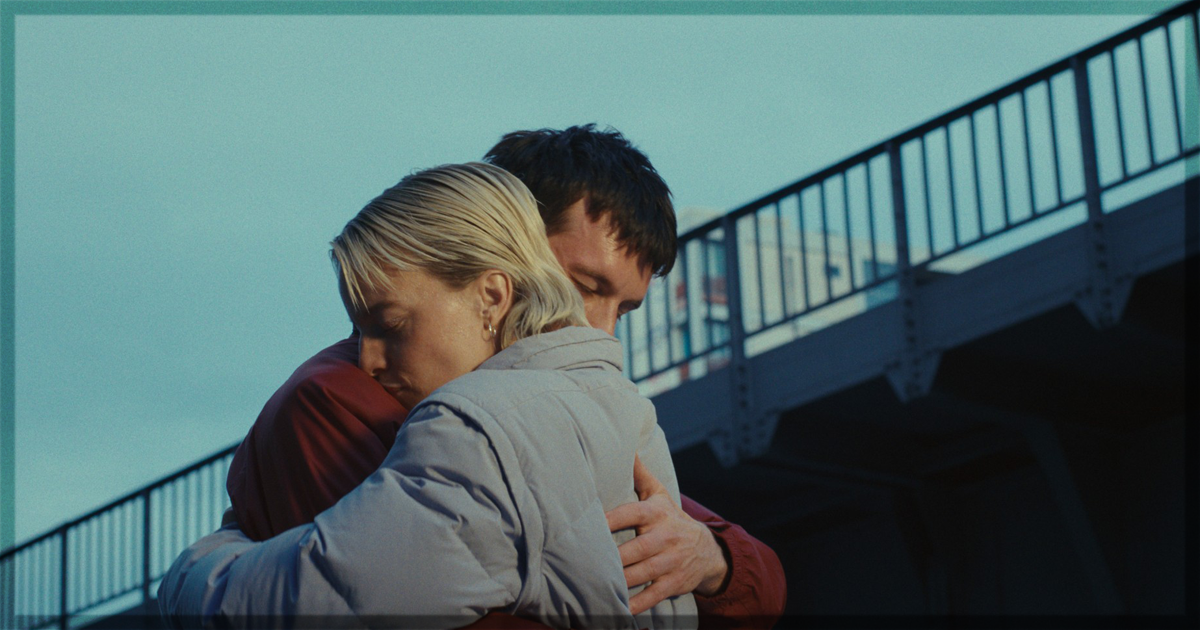
It’s 2018 and Tanja (Sylviane Faligant) is a pansexual novelist who lives in Berlin but appears at events around Germany making the provocatively noisy statements that enable a career as a public intellectual. Her father is French and her older sister Sarah (Luna Wedler) is having a tough time. Jerome (Jannis Niewöhner) is a straight tech guy who sheepishly lives in his mother’s paid-off house in the Hamburg suburbs. (She is English but moved to Lisbon after her divorce; it’s nice to see such accurately casual pan-Europeanism on screen.) They meet in a club – both are still regular clubgoers in their mid-thirties, with all the casual drug use and somewhat messy personal habits this implies – and are immediately mutually fascinated, even though the sex isn’t the greatest. But they make an effort to stay connected, sending each other long emails that take the place of the late-night talks they’d have if they were physically together. They also travel to each other’s cities for sweaty weekends in bed and bemoaning how all their friends are having kids and settling down. They commit to each other, but we all know nature abhors a vacuum. One afternoon in Hamburg Jerome is surprised to encounter his childhood crush Marlene (Haley Louise Jones) who is very definitely back in town. One night in Berlin Tanja goes ahead and sleeps with an old friend – whose ex, the mother of his child, is another friend of hers – without telling Jerome about it. If they want to be together, what will they have to compromise on? And how can those compromises be made when they’re apart in the first place?
Well, if you don’t know what you’re looking for you can’t be surprised when you don’t find it. The direction by Anna Roller is remarkably modern and accepting while also being clear-eyed about the first world problems here. The sequence at a New Year’s Eve party, where Tanja refuses a line of cocaine by saying “no thanks, I’m doing dry January,” demonstrates exactly how well these characters are known to their creators. The fact the men with the cocaine laugh and say “So are we!” is the cherry on top. The slow subtext becomes one half of this loving couple would like monogamy and parenthood, while the other half would like to keep their options open. The trouble is these two things aren’t necessarily exclusive, and they both know that. There are enough unconventional and/or non-traditional families around that Tanja and Jerome both know whatever works for you is possible. But being a parent is the only relationship dynamic you can’t ever change, and the needs of little children make it unwise to spend your days on molly before staying out all night dancing. If that’s what you want, no judgement! But then you probably shouldn’t be responsible for some little lives before your own.
The rough-and-ready production design by Lena Müller and Luisa Rauschert does a really great job of capturing the feeling Jerome and Tanja both have about themselves: that despite being in their mid-thirties they aren’t yet responsible adults. It’s pleasing to see that Tanja’s queerness and her emotional sloppiness are two separate facts about her, like her brown eyes and blond hair. The brief sequence at a wedding, where Jerome ends up toasting California punk band NOFX with a stranger, makes it further clear how hard it can be to admit you’re not a kid anymore. Felix Pfieger’s camera keeps them both firmly in context, contrasting the open weirdness (for lack of a better word) of Berlin with the more buttoned-up nature of Hamburg. The music by Max Rieger and the sound design by Arkady Gavrilov emphasises a kind of club soundtrack to their lives without ever being distracting, too. And the realistic finale enables both Jerome and Tanja to better understand exactly who they are, and realise they wouldn’t have achieved this understanding without each other. Sometimes that’s the best gift a relationship can give you, and Allegro Pastell’s wide-awake awareness makes its love story truly modern.
Allegro Pastell recently played at the Berlin International Film Festival.
Learn more about the film at the IMDB site for the title.
You might also like…