
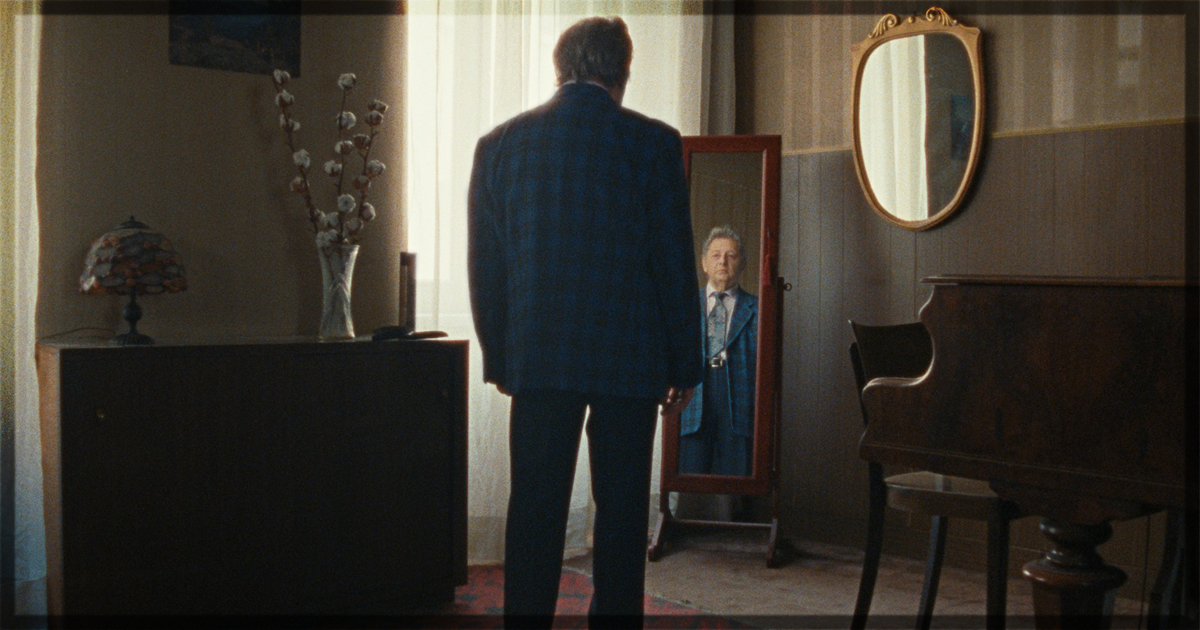
Not since 2012’s Oscar-nominated Belgian bluegrass film The Broken Circle Breakdown has a European movie been so in love with Americana. There is a significant though dwindling group of Europeans for whom the American dream has always been the ideal fantasy. For these people the most definite way to express that is through our music. Whether that’s thousands of women at country music concerts in sequined pink cowboy hats or owning a physical copy of nearly every word Bob Dylan has ever written (both sights which have delighted this critic’s eyes), there’s an mania for American culture in Europe that Americans rarely know exists. Certainly the black blues musicians of the Mississippi Delta were not thinking about how white Austrians might relate to their work when they were writing their songs. And yet The Loneliest Man in Town is about one man in Vienna whose whole life is based on the blues. Most wonderfully, it is largely performed by amateur actors or real people playing themselves, and stars Austrian blues musician Al Cook as a version of himself. It’s a charming movie about the power of music, how we shape our identities and how well our personal talismans can serve us.
Developers have bought the apartment building in central Vienna in which Al has lived his entire life. Now he’s the last resident the developers are beginning dirty tricks to force him to agree to their terms. This includes cutting the water and the electrics, and heavies letting themselves in to drink Al’s booze, eat his food, and pass out snoring on his sofa. Eventually Al realises this is a great opportunity to fulfil his lifelong dream of travelling to America, where his guitar and singing talent will obviously make finding work in Memphis easy. No one bothers to point out that the current political situation in the USA makes this plan… impractical. Also no one observes that Mr. Cook is over eighty so perhaps not a prime candidate for emigrating alone to a new country. But his beloved wife Silvia is dead (there’s a lovely photo of her holding an Elvis album over his desk in his home recording studio) and he has no family, so why not? Therefore Al begins selling off his carefully protected possessions, including a museum-quality array of Elvis memorabilia. But we all know what happens to best-laid plans.
Anyone who spends their weekends combing second-hand shops or salivating over auction websites will be agog at the treasures Mr. Cook has in his home. There’s a great sense that Al doesn’t quite live in the modern world. The family-owned restaurant where Al takes most of his meals suddenly closes after decades, and the audience in the blues bar where Al plays a gig are mostly on the far side of sixty. But of course he does live in the world; they all do. When Al bumps into a long-lost flame, Brigitte (Brigitte Meduna) on the street, the reason they broke up fifty years ago has everything to do with their musical taste, then and now. Could a Beatles fan and an Elvis fan truly be compatible? Co-directors Tizza Covi (who also wrote the script and co-edited) and Rainer Frimmel (who also did the cinematography) have made a career of telling fictionalised stories based on the lives of fascinating real people. Mr. Cook, whose recording career began in 1970, who released his 16th album seven years ago, and who also did the movie’s music, definitely qualifies. But time only moves forward and everyone, regardless of their age or the excellence of their taste, has to move with it.
Mr. Frimmel’s camera keeps close to Mr. Cook as he moves around the city or listens to his records or reads one of his huge collection of books about the blues. It’s edited by Ms. Covi and Emily Artmann so that we feel his thoughts along with him as he thinks them. The Loneliest Man in Town is an act of incredible empathy. It opens up a lot of thoughts about whether it’s possible to love something more by letting it go. Anyone who’s ever cried over a song or cherished a collection of physical media must hurry to watch.
The Loneliest Man in Town recently played at the Berlin International Film Festival.
Learn more about the film at the IMDB site for the title.
You might also like..

‘Allegro Pastell’ is a Non-judgemental Modern Love Story (Berlinale 2026 Film Review)