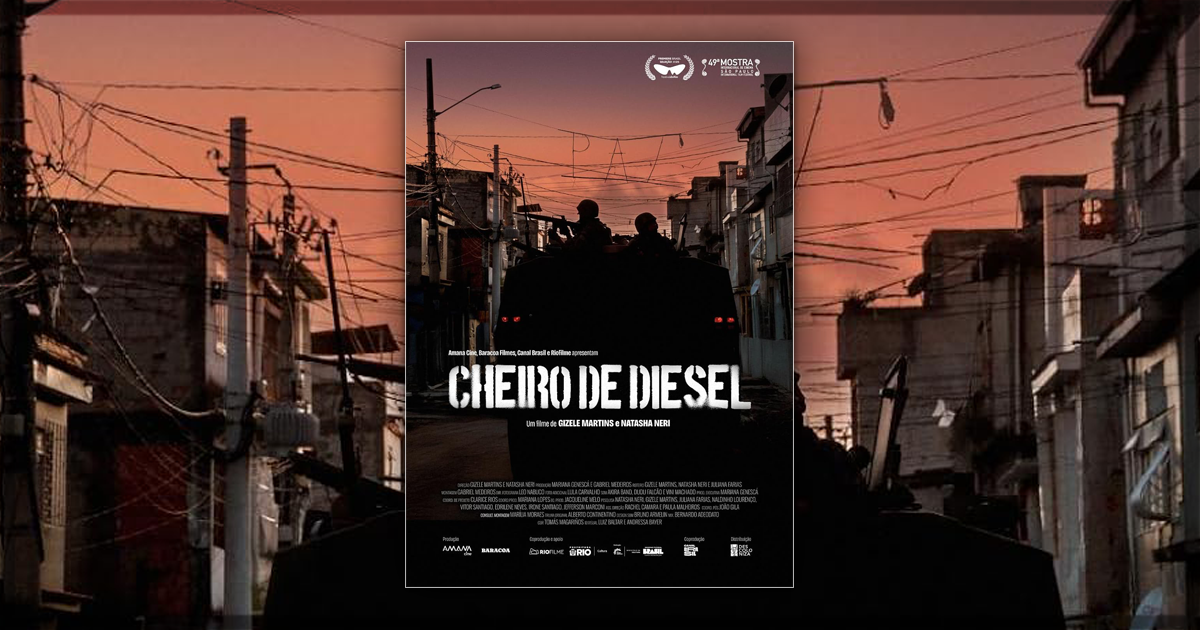
Rio de Janeiro is arguably the most well-known city in Brazil and one of the most iconic places in the world. However, despite the undeniable natural beauty, the town is destroyed by its contradictions. Throughout the construction of Rio as a city, there has been a connection between wealth and crime, creating dangerous armed groups who control the favelas, the outskirts where the working-class live. In this sense, mafias and cartels spread across the town, creating a disruption in the public life in Rio, developing a war between the police and those heavily armed organizations. In the middle of that, we have the citizens who are trapped in the chaos, risking their lives attempting to go to work and return home. In Smell of Diesel (Cheiro de Diesel) by Natasha Neri and Gizele Martins, we follow the traumas of a favela occupied by armed forces. Throughout the film, Gizele Martins is the voice of a collective of journalists in the favelas, attempting to document the wrongdoings of the army and the collective wounds of the population.
In the recent history of Rio, there have been a couple of interventions of the army in the conflict between the police and the drug lords. In 2011, in a massive effort, the army took down the reigning forces in the Favela do Alemão, in an operation that the images spread across the world. Three years later, the armed forces intervened in the Complexo da Maré, a group of fifteen favelas. Throughout a law called GLO, which translates to Guarantee of Law and Order, the army assumes the responsibilities of the police in that region. Therefore, they might arrest, investigate, and kill any individual they suspect of. It led to the death of multiple persons who crossed areas closed by the military, innocent people whom the army executed due to the intolerance and excess of power in that situation.
Smell of Diesel (Cheiro de Diesel) is a compelling look at the problem of the militarization of the public security in Brazil. Throughout the 2010s, the Governors of Rio de Janeiro, who are mostly involved with crimes and corruption cases, leaned heavily on the army and the federal government to interfere with the highest degree of the drug lords that command the favelas. Yet, the public administration sums up the population of the slums as all members of criminal organizations, promoting the massacre of Black individuals, who are the highest percentage of people in the favelas. The whole problem is an examination of racism and the diminishing of the value of the lower-income individuals and the working class. The police and the government consider those as less important, resulting in the mass execution of that population during the operations against the organizations. Martins, the central subject and co-director of the project, attempts to denounce the brutalities of the police. Her discourse is against the massive spending of money in operations that provide less safety, and result in the death of innocent individuals, the moving of families that lose their homes, and the takedown of that territory. Thus, there is a campaign against the guerrilla work that the journalist does, which leads her to lose social media accounts.
Another vital element of the film is the wounds of the excesses of the army. Mothers who lost their children, individuals kidnapped and tortured by the police, and a man who lost his movements after being shot by the police are some such wounds. In this aspect, the film is a journalistic effort that documents the endeavors of the victims of human rights violations. Subsequently, there is a heavy subplot of the denunciations of the violence caused by the army. In this sense, we hear about the kidnapping of innocent men hit by soldiers with wooden pieces. Also, a mother reports the death of her son, who got 8 shots in the back, and his body disappeared for hours. Therefore, the film is a conventional journalistic effort that efficiently captures the absurdity of the army in those situations, exposing the poor investigation processes that fail the address the army’s excesses, and suggesting a cooperative protection from military judges that absolves criminal soldiers.
Ultimately, Smell of Diesel (Cheiro de Diesel) is a testament to the importance of independent journalism. Natasha Neri and Gizele Martins created a film that documents the impact of the state’s violence in the favelas, leading to a recording of a crucial journalistic work that expands into the violations of human rights, exposing the lack of reparations to the victims, and those perpetrated by the militarization of the slums.
Smell of Diesel (Cheiro de Diesel) is now in limited theaters.
Learn more about the film at the IMDB site for the title.
You might also like…