
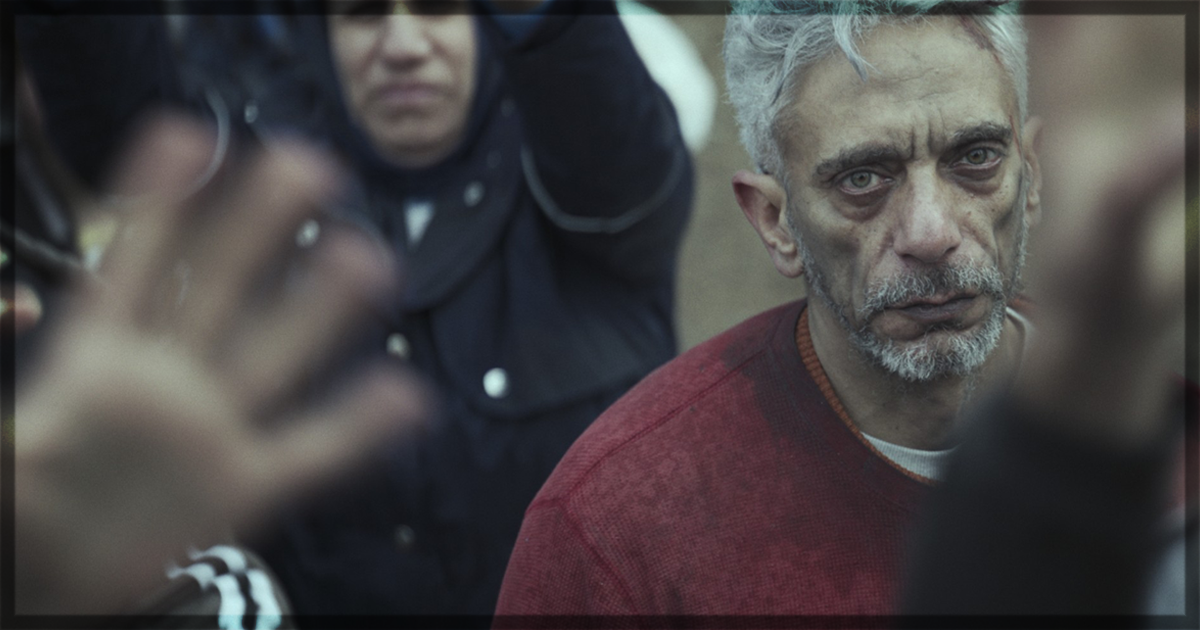
There’s a myth that knowing your death approaches brings out the best in you. In these circumstances you will simply rise above the horror of your looming demise to love your family, be kind to your neighbours, save kittens from trees and generally be all excellent until you perish. Anyone who actually knows someone under a death sentence, or been under one themselves, knows this is not true. What really happens is that your true nature is revealed. Sure, some people actually are capable of saintliness. Most are terrified, manipulative, selfish, horny, or too drugged or dysregulated to care. This is true in the comfortable cities of the west, and it is true in Palestine. Writer-director Abdallah Alkhatib, who also plays the key small role of the cigarette thief, has made a movie smart enough to understand how living amongst death changes everything. Chronicles from the Siege is an awfully human story about people scrabbling to survive. It tells a bold and honest truth: there are some heroes here, also some of the worst humanity has to offer, but almost everyone is actually something in between.
It uses a stream-of-consciousness style of little vignettes showing how some of the ensemble cast interact before breaking them apart to interact with new groups of people in new ways. But Chronicles from the Siege is also smart enough to pander to the international cineaste audience, with one of the early sequences set in a video store wallpapered with posters of 80s and 90s European art-house hits. The store has been abandoned and besides its owner, the poet Arafat (Nadeem Rimawi, who brings an incredible sense of grace to his role) has been off his medication for a while. A group of four friends arrive in the shop by sledgehammering through the walls in search of food or fuel. They are Leila (Saja Kilani), Youssef (Samer Bisharat), Mohammad (Ahmed Kontar), and Fares (Ahmed Zitouni), and when it’s too dangerous outside for them to leave they have to hunker down. There’s some discussion of whether the VHS tapes can be burned for warmth, or if they should be preserved in memory of the dead friends and siblings who used to rent them. A book of Arafat’s poems is found and there’s some discussion about the use of art. One of the four finds a single piece of candy which is instantly eaten, though when the others find the wrapper there is violence. And when it’s safe to move again it’s time to get back to the ordinary horror outside the walls.
Leila, a nurse, also plays a key role in the final sequence, when a severely injured man named Jafra (Omar Rammal) arrives at her barely functioning hospital at the same time as an injured woman in labour named Farah (Nour Seraj). Farah’s husband Saleh (Idir Benaibouche) doesn’t help things by threatening to kill everyone present if Farah or the baby dies. It’s very certainly possible; nothing’s very clean, there’s hardly any equipment, the medical staff are nearly blind from fatigue and the only blood available is from passers-by coerced into donating on the spot. But what other choice is there? The curtains between rooms are marked with bloody handprints, bombs are still falling outside and one of the nurses screams, “What about this is normal?”
But we’ve met Saleh before. There’s an extended sequence showing several desperate-looking men delivering him stolen white goods for a single puff of a cigarette. Not even a single cigarette – just one puff. Simultaneously the selfish Youssef is trying to keep Arafat alive, because Arafat and his late father were in prison together. And Fares has a girlfriend, Huda (Maria Zreik), who lives elsewhere in the city, and it takes the combined efforts of his relief-worker colleagues to enable Huda to sneak into his flat for a stolen hour. Fares wants to cook her something to eat, without oil for the pan, fuel for the stove or any real ingredients. Even worse, their attempts at a ‘rendezvous’ are continually thwarted, both by people interrupting and then by their own bodies not cooperating. How can the body cooperate in times like this? How can anything function as it’s meant to at all?
Talal Khoury’s largely handheld camera keeps the focus tightly on the people, but it roves around the spaces in long takes edited by Alex Bakri that provide ample room to breathe. Rana Eid’s sound design makes sure we understand how close the danger always is and the pressure everyone is under. And Mr. Alkhatib’s lack of sentimentality makes sure we understand both how difficult it is to be kind, and marvel at how many people actually sometimes manage to be. But the really remarkable thing is the ending. From one perspective, it’s a triumph of hope and the importance of hanging on to our humanity as much as possible. From another it makes you question whether prolonging anybody’s suffering is worth it. War damages everything and that damage is so ordinary sometimes we forget just what it costs. Chronicles from the Siege exists to show us how extraordinary ordinary lives become in a time of war. We are not as far from the lives shown here as we’d like to be, and we should try to let kind and clever movies like Chronicles from the Siege bring out the best in us.
Chronicles from the Siege recently played at the Berlin International Film Festival.
Learn more about the film at the IMDB site for the title.
You might also like…
‘The Loneliest Man in Town’ Sparks Joy (Berlinale 2026 Film Review)