
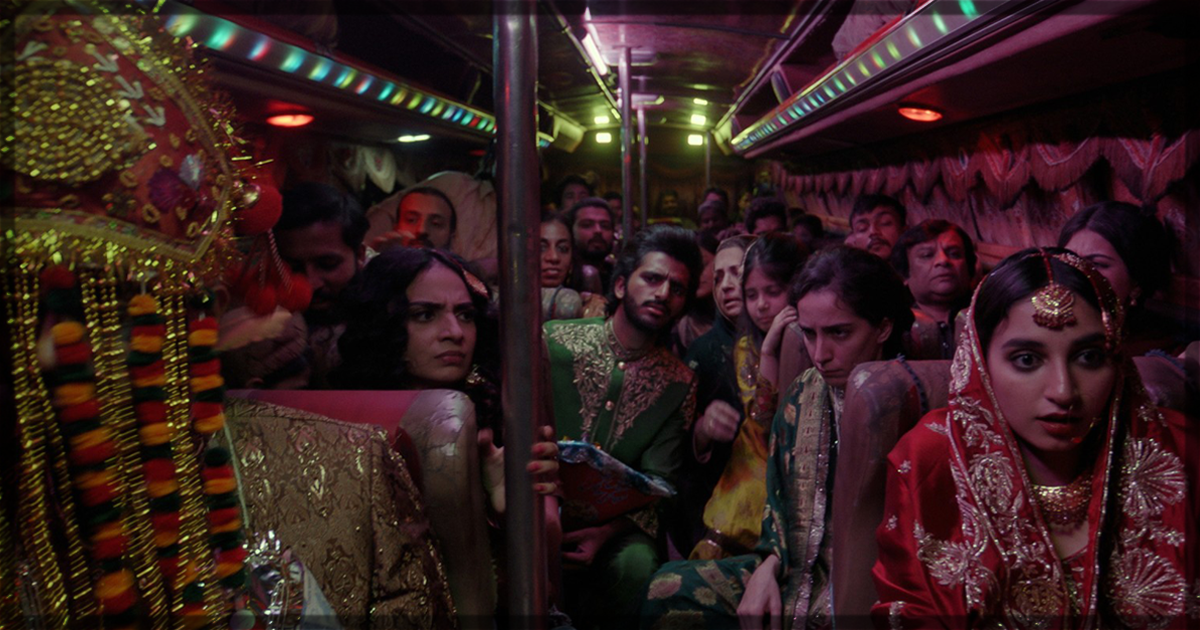
The central couple at the heart of this complex Pakistani movie have known each other from around the village since childhood. They are thrown together because everyone else considers them damaged goods. The way they deal with their damage, separately and together, enables an unusual depiction of the power struggles within a relationship. The wider world of their society, which is largely but not entirely designed for men, makes little nevermind in the bedroom, as everyone who’s ever been married knows. But while Lali is not perfect, mainly because it bites off more than it can chew, it’s never not interesting.
The groom, Sajawal (Channan Hanif), has a major port-wine stain, referred to by all as his red scar, over one side of his face. He’s been viciously bullied for this his whole life, to the point where he refuses to attend family gatherings in order to avoid the looks of others, and this means his personality leaves a few things to be desired. The scars of the bride Zeba (Mamya Shajaffar) are emotional, as she has had not one, not two, but three different fiancés die on her: one from illness, one overseas, and one from a scorpion bite in her arms on their wedding day (but before the ceremony). They agreed to their marriage mostly because no one believes either of them can do better. Unfortunately their own wedding has an inauspicious start when Saja’s incredible mother Sohni Ammi (Farazeh Syed, a well-known singer for whom this is her acting debut) is accidentally shot by a celebrating guest. But a little gunshot wound to the leg is not remotely enough to stop Sohni Ammi from getting what she wants. So the officiant is found and the wedding ceremony conducted over her hospital bed.
Once everyone is back home things settle down somewhat, and Zeba and Saja discover to their surprise that they actually like each other. Through a recurring series of amusing interruptions their marriage isn’t consummated despite their best efforts, since Saja’s family compound is full of a neverending parade of people. This includes his oldest sister Noor (Mehar Bano), a married mother who is worried about how Saja will change now he’s paterfamilias, and his younger sister Bholi (Rasti Farooq), who is developmentally disabled and kind of a handful. Saja resents all the activity and loud personalities but Zeba loves it. Her own family isn’t particularly warm, while Sohni Ammi is a well-meaning and overbearing one-woman hurricane. Zeba relaxes into her new life with some hope that things might be better now. But unfortunately nothing lasts very long.
Director Sarmad Sultan Khoosat (who cowrote Lali’s script with Sundus Hashmi) and producer/production designer Kanwal Khoosat are siblings; their cheerful chat after the screening at the Berlinale, full of eyerolls and interruptions and asides to the crowd from both of them, was unusually endearing. The script was based on a short story written by their aunt, which they told us is more explicitly about how self-loathing and distrust damages a relationship. The Khoosats answered several questions about exploring how a marriage might collapse so badly, especially within the context of Pakistani culture, and the importance of standing up for yourself regardless of the context. This is a franker assessment of the dynamics between men and women than might be expected from a brother-sister pair, but on the other hand, if you can’t analyse this stuff with your siblings, then who?
Khizer Idrees’ cinematography and Lala Ahsan’s sound design combine to make the family compound feel like a well-loved and well-used family home, for good and bad. The rowdy family setting is never confusing because everyone is very clearly delineated, and the music (composed by Abdullah Siddiqui) is largely supplied by four neighbouring musicians who cheerily refer to themselves as Sohni Ammi’s minions. For her part Sohni Ammi roars at them to stop parading around without shirts in front of the newly married Zeba, while whispering to Zeba that they’re super hot and she enjoys admiring them. She’s impossible to dislike and Ms. Syed brings all the indomitable goodwill necessary to drive the entire plot.
Unfortunately the big finale feels forced, and turns a messed-up but mature relationship into something more stereotypical and boring. The metaphor of the tree in the central courtyard is also overdone. But this is something of a quibble in comparison to the weird and dark dynamics that pass between Zeba and Saja. Both of them are indeed damaged, but neither of them want to be. With some room to breathe and a little tenderness they could probably be extremely happy together. Mr. Hanif does fascinating work as a man who has allowed his facial difference to rule his personality, and Ms. Shajaffar is also very good as a woman who is fighting with all her might to stay positive in the face of such misfortune and grief. The ending is probably too realistic to be satisfying, but it does at least offer everyone a real opportunity for a true fresh start. In that sense Lali is both something old and something very new. And luckily the uniqueness of the central relationship at its core more than makes up for its minor flaws.
Lali recently played at the Berlin International Film Festival.
Learn more about the film at the IMDB site for the title.
You might also like…

Two Star Turns Make ‘Sukkwan Island’ Worth Visiting (Glasgow Film Festival 2026 Review)