
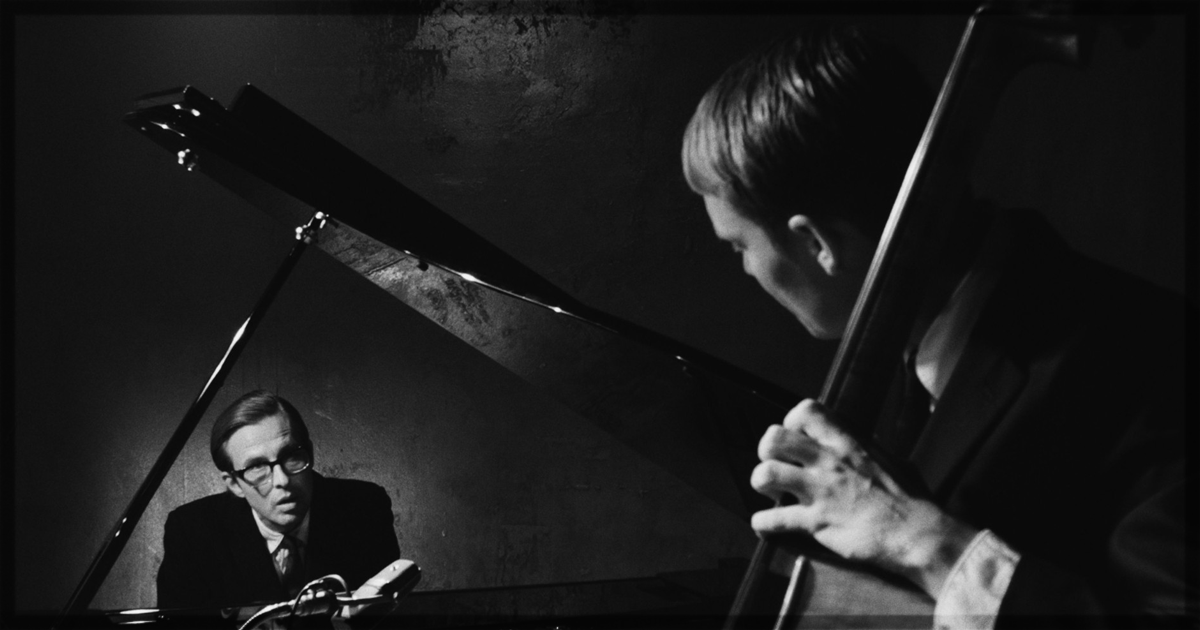
In one way, the jazz biopic Everybody Digs Bill Evans is a resounding success as it introduces those of us who are not jazz fanatics to the life of the artist behind some huge hits and of the greatest live jazz recordings ever made. In another way, the jazz biopic Everybody Digs Bill Evans is a failure because it tries too hard to paint a complete picture of a life, instead of focusing on a brief but essential window in time. But as the choice of the main actor, the Norwegian Anders Danielsen Lie here working entirely in English, makes clear, no single life can be summed up as just one thing, and to its credit Everybody Digs Bill Evans takes a clear-eyed view.
It’s 1961 and musician Bill Evans (Mr. Danielsen Lie) is finally more settled in his life and himself. His beloved brother Harry Junior (Barry Ward) and his family have moved from Louisiana to New York City to be near him, he has a girlfriend named Ellaine (Valene Kane), and he has a musical trio that is enabling him to do the best work of his life. But then one of that trio dies in a car crash, and Bill is poleaxed by grief that is also self-pity. He and his late colleague did not get along personally at all, but they were extraordinary musicians together, and now that he is gone Bill is wondering whether he’ll ever be able to play at the same level again. His heroin addiction, which he shares with Ellaine, kicks up a notch, so Harry Junior sends Bill down for an extended stay with their parents, Mary (a superb Laurie Metcalf, who embodies here a coiled tension often seen in disappointed older women) and Harry Senior (Bill Pullman, who weaponises his bland-seeming bonhomie perfectly here). Bill goes through drug withdrawal under his mother’s care without anything being directly said about it. It’s also very clear Mary and Harry Senior have a poisonous relationship that neither of them intend to change. Once Bill is feeling somewhat better he plays golf with his dad, chats with his mom, and observes how they are coping with the routines of their lives. His musical gift will always be there for him. The question is whether his demons will allow him to make the most of it.
Now. In addition to his acting career Mr. Danielsen Lie is a musician of professional standard, with two albums under his belt. He is clearly doing all his own piano playing here as well as acting in his second language. He is also somehow a practicing doctor, a career which comes before his work as an actor. What a showoff! (While he does not save anyone’s life on camera in this movie, that is clearly only a matter of time.) More seriously, this combination of musical and acting skill with an understanding of the tortures of addiction is clearly what drew Mr. Danielsen Lie to the part, and he makes Bill’s psyche and thought processes a cause for admiration before they’re a cause for concern. But director Grant Gee and cinematographer Piers McGrail chose to film the sequences set in the early sixties in crisp black-and-white, while briefer sections that take place in the 1970s and 1980s are shot in color. This is a mistake, because it distances modern audiences from the very modern actions and allows a remove to develop between us and the subject matter. Issues of abuse, addiction and terrible romantic choices are as important now as they were sixty years ago, and to show them as problems that can be closed off into the past is an alienating idea.
However Mr. Gee still won the Silver Bear for Best Director at this year’s Berlinale for his work here, and that is because of how neatly the movie swerves biopic clichés. The music is important, and the greatest hits, including Waltz for Debby, the standard Evans wrote for his niece, are all present, but presented without making a big deal about them. The Evans family might be a big mess with mental health problems all over the place, but they love each other and try hard to be kind. For his own part, Bill wants to make the best use of his talent and keeps steadily working even if he isn’t performing in public, and his love for Ellaine is largely separate from their addictions. That doesn’t necessarily make this love healthier or happier, just as the ways Bill and Harry Junior understand just how bad things were at home in their childhood doesn’t necessarily improve their own behaviour now they’re all grown up. If you are someone who knows little of Mr Evans’ music or his life Everybody Digs Bill Evans is a proper introduction, and if you are already an aficionado you’ll enjoy seeing the greatest hits be played once again. While it tries too hard to be good Everybody Digs Bill Evans is not really a failure, because it enables us to experience one man’s imperfect life while he works to perfect his skill. And there is little more valuable than that.
Everybody Digs Bill Evans recently played at the Berlin International Film Festival.
Learn more about the film at the IMDB site for the the title.
You might also like…
‘The Ballad of Judas Priest’ Vents its Frustrations (Berlinale 2026 Documentary Film Review)