
For a movie designed around a teenage pregnancy it’s a surprise that We Are All Strangers focuses on the baby’s father. What writer-director Anthony Chen is exploring here is how family responsibilities force young men to grow up. The assumption seems to be that women have achieved maturity already, regardless of their actual age. This isn’t terrific, but who said life was fair. We Are All Strangers is also the final film in his “Growing Up” trilogy, using some of the same actors in very different plots all roughly about life’s unfairness. That summation is simplistic, but We Are All Strangers’ firmly modern events make one young man’s difficult getting of wisdom a journey mostly worth following.
Junyang (Koh Jia Lier, who carries the film with ease) is in his early twenties, in the final year of his mandatory army service and otherwise spends his time playing video games. He was an indifferent student and has wasted no time in considering his post-army future, and absolutely no one can shake any sense into him. His father Boon Kiat (Andi Lim) runs a noodle stall in one of the little food markets that are the last inexpensive places to go in Singapore, and their relationship isn’t great. Junyang simply pays no attention to how hard his father works, and devotes his limited resources to spoiling his girlfriend Lydia (the sweet and underused Regene Kim). Lydia is still in high school, a devout Christian, and the only daughter of a wealthy mother. Junyang is clearly her bit of rough before going to university. Except an anniversary weekend in a fancy hotel has consequences, and thanks to the strength of her religious beliefs Lydia won’t consider an abortion. There’s a hideously awkward meeting at the food stall where Lydia’s mother insists the wedding must take place in a five-star hotel, and Boon Kiat insists right back that he will find the money to pay for it. That is Lydia’s marriage proposal, which Junyang is equally startled to learn of. In spite of that the big fancy wedding goes ahead, one of Junyang’s army buddies makes some funny but crass best-man speeches, and everyone has a lovely time posing for Instagram. And suddenly Lydia has dropped out of school to live in government housing with a husband who won’t stop playing video games even as her belly swells.
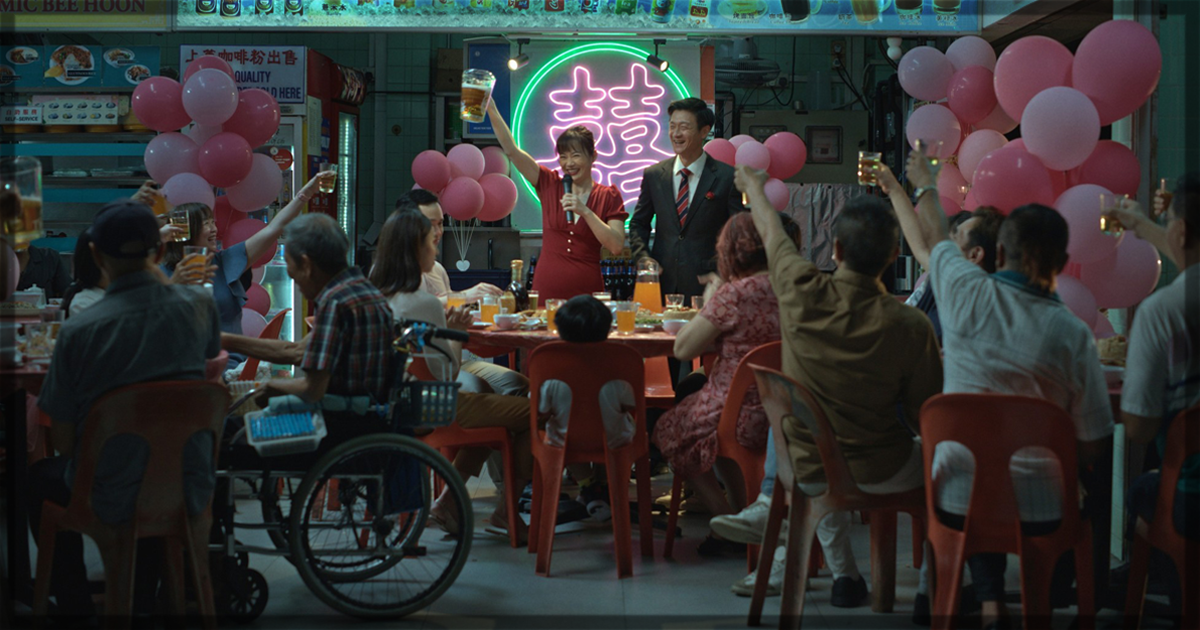
The fact Lydia’s mother vanishes except for a single visit after the baby is born is somewhat unbelievable, as is the fact that she apparently cuts Lydia off financially. Instead we spend time with Bee Hwa (Yeo Yann Yann), a ‘beer auntie’ who works at the same market as Boon Kiat coaxing tips from elderly alcoholics. Some living. She is Malaysian and, thanks to her immigration status, cut off from most of the city’s affordable housing, so is currently crashing with her brother and his extended family. Bee Hwa also has a heart of gold, perfectly happy to go on dates with Boon Kiat that are nothing more than them riding around on the bus, because that’s all either of them can afford. When Boon Kiat surprises her by asking her to marry him she collapses with laughter, out of relief. All her problems have been solved! Suddenly there’s five people crammed into that tiny apartment, though Teoh Gay Hian’s camera work and Hoping Chen’s editing somehow makes the small spaces feel spacious. It’s also really nice that Bee Kwa and Lydia are the best of friends, working together to look after baby Ethan with nary an argument between them. We could have seen a lot more of that. The problem is Junyang.
Far too much of the 157-minute runtime is devoted to Junyang’s various attempts at holding down a job. Many of those jobs are designed around housing in Singapore, by which is meant outrageously fancy modern apartments designed for foreign millionaires who pay cash. The thing is Junyang probably could be very good at coaxing outrageously expensive payments out of overseas buyers. He’s good-looking and his English is excellent, but his resentment at his responsibilities makes him incapable of acting like a grown-up. It’s nice to see art sympathetic to the fact that people make mistakes, but my goodness the pacing does drag. A more serious mistake is that we barely see Junyang interacting with Ethan until the very end of the film. That scene does pack an unusual emotional punch, but it shouldn’t have been about the only time we see Junyang as a dad.
A movie so focused on the price of survival also should have paid much more attention to practical logistics. The baby is largely quiet and invisible, for one thing. Bee Hwa’s silence to Junyang about what she knows of the family finances is as equally unrealistic as Lydia’s silence about how her life is working out. Bee Hwa does tells Boon Kiat it’s pointless worrying about Junyang, because if he doesn’t figure things out for himself life will take care of that for him. But the whole point of We Are All Strangers is that a family, whether born, made or found, is responsible for each other, whatever the cost. It takes a long time to get there, but a smarter movie would have paid equal attention to all the people as that family takes its form.
We Are All Strangers (Wo Men Bu Shi Mo Sheng Ren) recently played at the Berlin International Film Festival.
Learn more about the film at the IMDB site for the title.
You might also like…