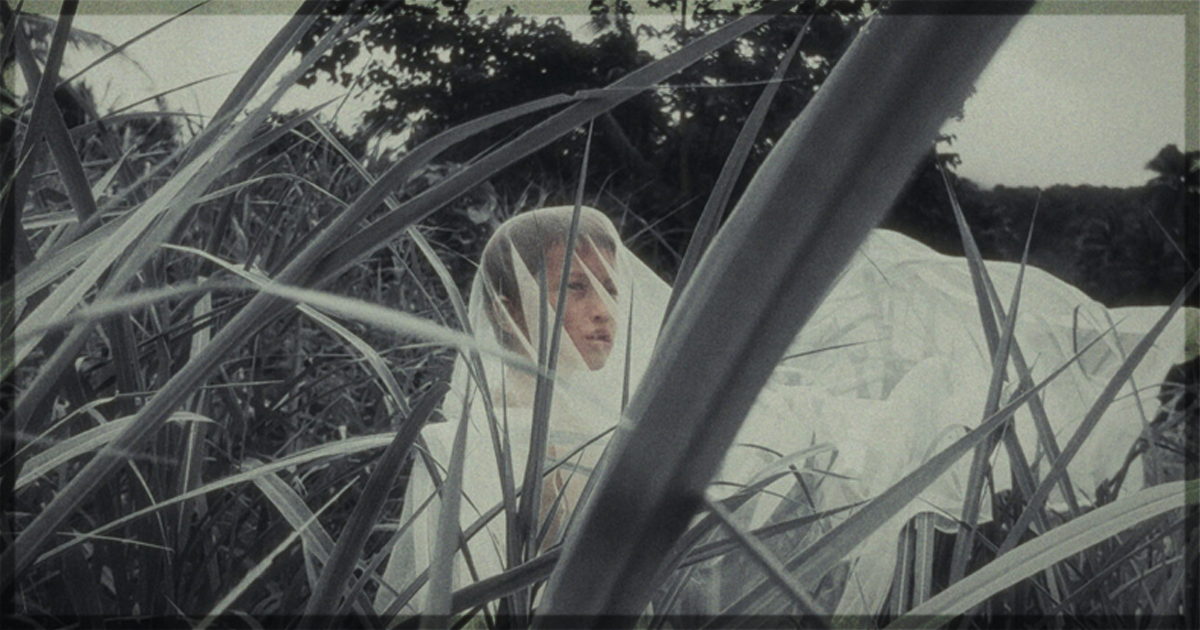
Three boys living in a rural, riverside community in the Philippines are forced to reckon with enduring grief and guilt following a gruesome crime involving their fathers. Shot entirely on iPhone across 35 days without a formal script and with a nonprofessional cast doubling as film crew, I grew an inch when my father died is a mutedly striking coming of age skewing the strict corners of morality. The film, directed by first-time feature filmmaker P. R. Monencillo Patindol, alternatively credited as Paulie Patindol, is premiering at the 2026 International Film Festival Rotterdam under its Bright Future Programme. Like his forthcoming feature Rafael, it reflects the director’s brio in examining how bloodlines hack into realizing one’s identity. As the film organically evolved alongside the environment where it was shot, Patindol fashioned a formalistic gesture apropos for his precocious protagonists, who are “suspended between this world and somewhere else.” I grew an inch when my father died announces the arrival of an audacious filmmaker steadily shaping his cinematic language — a desaturated vision befitting a Rotterdam debut.
In our conversation ahead of the Rotterdam world premiere, Patindol, along with his frequent collaborator Giancarlo Abrahan, who co-wrote and produced the film, opened up about his upbringing, the real-life incident that shaped the project, shooting under COVID protocols, and patiently making sense of his vision throughout its making.
The Interview with Paulie Patindol and Giancarlo Abrahan on I Grew an Inch When My Father Died
Lé Baltar: What was it like growing up in Baybay, Leyte?
Paulie Patindol: I grew up in Visca, a small university town in Baybay, Leyte, surrounded by sea and mountains. Most children were the kids of professors and staff, so everyone knew each other. Houses were connected in rows, so we could run from one to the next while playing hide-and-seek or tag. We rode our bikes everywhere — through the streets, to school, to the sea. I left for Tacloban at 12, then Manila for college, and have mostly lived away since. In 2017, my family moved to a nearby barangay, and filming in the river and surrounding areas of our new home gave me my first chance to explore these spaces and meet communities I had never known.
Lé Baltar: Can you speak about the film’s origins? I learned that you immediately set out to make another film following your short film Abogbaybay (Shoredust), shot during the pandemic.
Paulie Patindol: While filming Abogbaybay by the river, I noticed my crew teasing a boy from another group swimming and stopped them. The boy then threw a rock at us. I asked my crew why they were teasing him. They told me he was the son of a killer — during the pandemic, a drunken stabbing between two fathers had resulted in one man’s death. In the same river, the son of the murdered father was playing with the son of the killer. They remained friends. This made me curious: how could a friendship endure amidst such trauma?
I had hoped to cast twins for the story, but we could not find any, so my crew invited whoever was willing to participate. Kenken was cast first — whom we had seen during filming Abogbaybay rearranging rocks in the river. Ge was his cousin, and Cor was Ge’s best friend. This real-life dynamic became the heart of the film. As we filmed them day by day, I began to know them more and it felt natural to let their desires, fears, and experiences shape their characters. Watching the cast navigate fear, loss, and friendship as their characters, I began to wonder what it really means to want to disappear — and the film grew from that question.
Lé Baltar: How did Giancarlo Abrahan get involved in the project?
Paulie Patindol: Gian has been part of my filmmaking journey from the very beginning. At a time when I was close to quitting filmmaking altogether, he urged me to write and direct a short film. That became my debut short, Hilom (Still). Since then, it felt natural for him to produce Abogbaybay (Shoredust), I grew an inch when my father died, and the feature projects we’re now developing.
We’ve been friends since we were in the same choir at Ateneo. Although we studied film in different schools, we’ve always shared work — reading each other’s scripts, showing each other films, and rooting for each other. As I grew from cinematography into writing and directing, Gian guided me through that shift. He’s my producer not just in film, but in life — a friend and a mentor.
Lé Baltar: Walk me through the process of filming entirely on iPhone, with a nonprofessional cast and crew. Was that a conscious decision or a consequence of budget restrictions, or both? When did actual production begin?
Paulie Patindol: I learned how to shoot on an iPhone during the early months of the pandemic, when Manila was under strict lockdown. Using my iPhone X, I began testing its limits, its strengths, and its intimacy, starting with filming plants in our condo. I knew that if I made a film back home, the iPhone would be my tool — but I also knew I’d be funding it myself, conscious from the beginning of the constraints that would shape how we worked.
Abogbaybay (Shoredust) became a practical test — a way to learn by doing and see if the form could hold as a viable form. In 2021, I went back home. Having lived mostly in Manila, I didn’t know the area well or anyone there, so my parents helped gather children from the community who were curious and willing to participate. The first who said yes was the son of our former housekeeper, and he invited his cousins and neighbors. Each day, we spent afternoons like little picnics — at the beach, at the river, or at the foot of the mountain — letting them follow their curiosities. Through this play, they naturally discovered the areas of filmmaking that interested them most, gradually learning camera, sound, and production management as they found where they felt suited.
Confident in what the iPhone made possible, I continued the approach for I grew an inch when my father died, upgrading to an iPhone 13 Pro. Actual production began in early 2022 with a new cast and crew, expanding our team from five to twelve people and adding gear to address challenges we had faced previously. With a device they already carried in their pockets, the crew could handle the camera themselves, test ideas freely, and discover the possibilities of storytelling through hands-on exploration and play.
Lé Baltar: There was no formal script as well. How did you and Gian approach the screenplay then? And how did you go about that from a directing standpoint?
Paulie Patindol: Gian and I approached the screenplay as something to be discovered rather than fixed. As with Abogbaybay (Shoredust), the filming was the writing — the story revealed itself through the act of filming.
While I was in Leyte and Gian in New York, we stayed in close conversation. Between shoots, I’d describe what we had filmed so far. We talked for hours — not to plan, but to think aloud, to listen. Sometimes Gian would read poetry inspired by our conversations. Those poems left images with me, which I later tested during filming. From these exchanges, he would arrive at specific lines of dialogue, and one of these conversations gave the film its title.
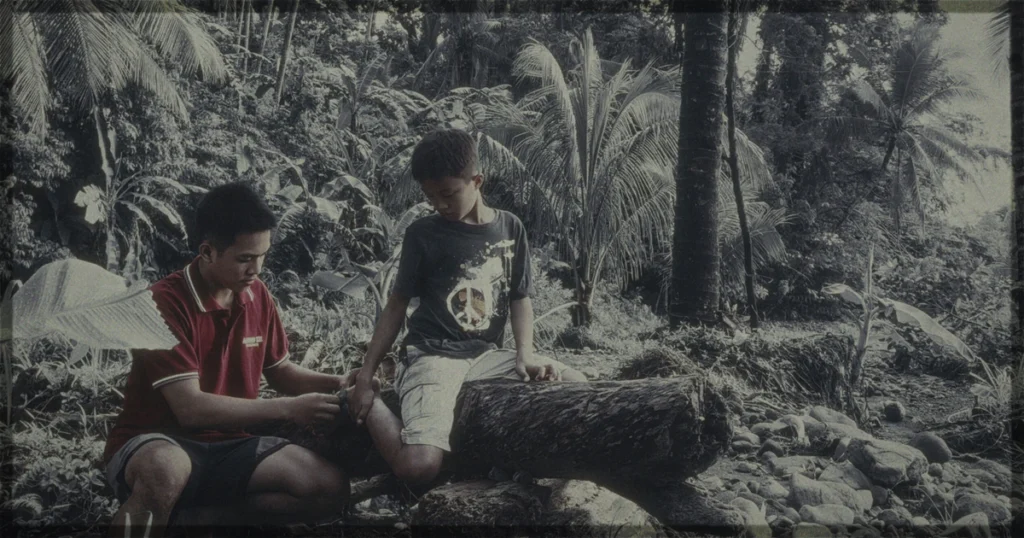
Life entered the film — loss, joy, weather, departures — and we responded. When Ge had to leave for Manila, the narrative shifted with him. I met Kenken while filming Abogbaybay, rearranging rocks in the river in the rain, and included that in the film. When Kenken was wounded during filming, I watched the crew tend to him using leaves from a plant growing on location; that care became a scene in the film.
The actors and crew were not simply performing; their desires, fears, and circumstances shaped the work. Directing meant paying close attention, letting the film write itself through everything happening around us.
Lé Baltar: The movie is magical realist, which immediately recalls 2014’s Dagitab. I wonder if the magical aspect was your idea, Gian.
Giancarlo Abrahan: Paulie has been exploring magical realist aspects in the screenplays he’s been developing. And even in Abogbaybay (Shoredust), the magical realist is very palpable in Paulie’s treatment of the story.
But of course, my own predisposition to the magical realist helped push (I’d like to think) the elements of the story that delved into a friendship with an unseen supernatural being from another world. Especially in retrospect, I see echoes of not just Dagitab, but also my short film May Dinadala permeate this work.
I am convinced though that more than our own proclivities, the milieu naturally revealed its magical realism for us to just capture. In that world, the supernatural is so embedded in the everyday as a mode of grasping the world. Our task was simply to design a narrative that could apprehend it.
Lé Baltar: How did you arrive at the predominantly desaturated visual treatment?
Paulie Patindol: I wanted the world in black and white and the characters to hold on to their color — anchored, alive, even as the space around them felt drained. The desaturation became a way to sit with partial presence — here, but not fully, suspended between this world and somewhere else, echoing their desire to disappear.
It came from how grief felt to me — not something that erases you, but something that loosens your hold on the world.
The visual treatment marked the present as heavier, distinct from the past, dreams, and the film’s final moments — each carrying its own breath.
Lé Baltar: Clothes left to dry on dilapidated roofs or makeshift clotheslines, including one along a basketball court, function as a motif in the film. How did you come up with that motif?
Paulie Patindol: In the Philippines, there’s a belief that if you get lost in the forest, wearing your shirt inside out can help you find your way back. This idea was present from the start of filming and shaped how I thought about clothing in the story.
We filmed across three months in 2022, for 33 days, and early on it became apparent that continuity with the actors’ shirts was unpredictable — sometimes an actor would wear one shirt in a scene and another in the next, because it was wet, misplaced, or forgotten. I filmed them changing shirts, making it part of the scene.
Afterwards, it took months to assemble the footage and decide how the story could continue, given Kenken had visibly grown and Ge was in Manila. A year later, I explored what is lost and found when Kenken returns — or perhaps enters an alternate world — and focused on his relationship with his mother, or a woman who looks like her. I wrote a script for a final two-day shoot.
During that process, I remembered a crew member saying he wouldn’t want to go to Manila because his mother wouldn’t be there to wash his clothes. Of course he could do it himself, but “she’s a magician,” he said. The pride and awe in his words stayed with me, inspiring the mother’s monologue about seeing boys’ clothes hanging on a line when she hadn’t done any laundry and had no sons.
During the last two days of filming, we stumbled upon various scenes of clothes drying in the community. It was a happy accident: drying in the sun, the lines of clothes spoke of mothers waiting for their children — washing and readying what will be worn again.
Lé Baltar: Can you give us some context about the river you’d been filming in and how it disappeared after a typhoon?
Paulie Patindol: The river was central to the landscape where we filmed — a familiar place for the cast and crew, a site of play and memory. Midway through filming in 2022, a typhoon struck, and afterward the river had disappeared, leaving only a dry riverbed, its waters perhaps redirected into new channels. We incorporated this into the film’s final chapter, when Kenken returns, letting the environmental change echo the story’s themes of loss, transformation, and the carving of new paths.
Lé Baltar: How does it feel having the film play at Rotterdam?
Paulie Patindol: I grew an inch when my father died was largely self-funded and built as we went, by a very small team — young local cast and crew, and a post-production team working closely and learning through the same spirit of experimentation. The story emerged through them, shaped by improvisation, real-time responses, and discoveries made in the edit. Having the film premiere at IFFR is a special gift for our small team, and we’re grateful to IFFR for giving this kind of work the space to exist.
I Grew An Inch When My Father Died recently played at IFFR.
Learn more about the film at the IFFR site for the title.
You might also like…
‘I Grew an Inch When My Father Died’ Movie Review: A Verdant River Village Comes Desaturatedly Alive in P. R. Monencillo Patindol’s Time-Shifting Debut