
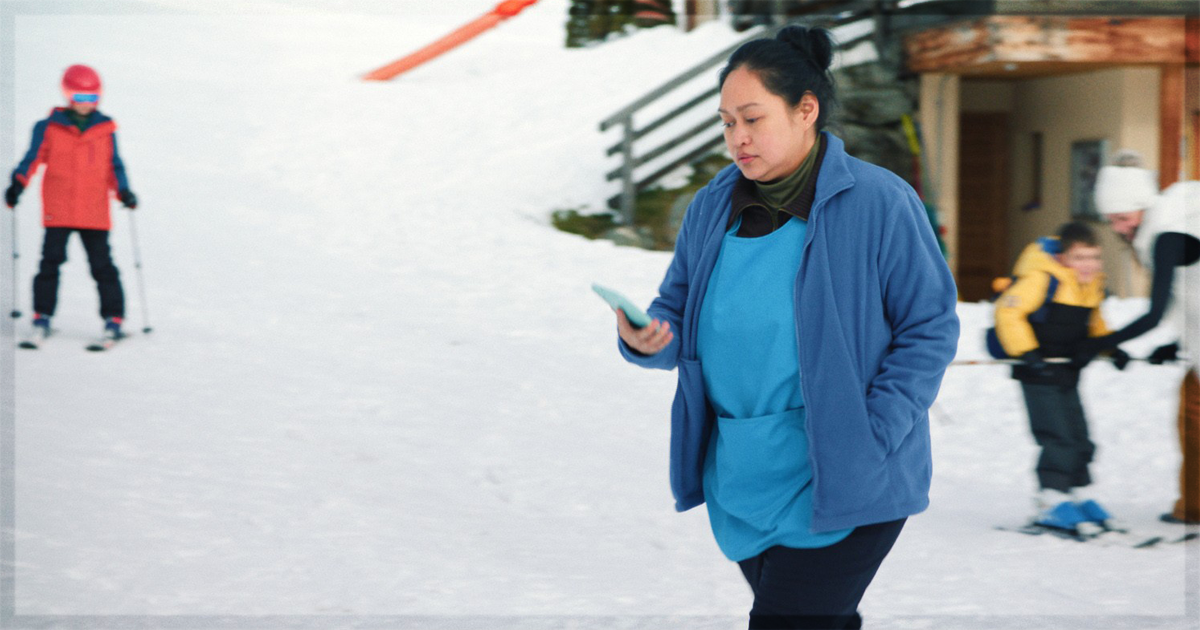
Enjoy Your Stay is a strikingly ironic and sinister title for a movie centered on the invisible labor that sustains the pristine and postcard-esque surface of a luxury ski resort in Switzerland. Played with an unassuming yet magnetic force by Mercedes Cabral, Luz is part of a mostly Filipino cleaning crew — all overworked, underpaid, and, most significantly, undocumented — who cautiously moves between luxury chalets in the snow-covered Verbier, picking up after rich clients, tidying surfaces, and salvaging what they can, all while trying to avoid authorities who could deport them at any moment.
Back home in the Philippines, though, she’s got more urgent problems to resolve as she tries to secure custody of her six-year-old daughter, whose story is being exploited by a tabloid TV show. To save more money before fulfilling her promise of returning to Manila for her child’s seventh birthday, Luz strikes a desperate deal with her predatory local employer Thibault (Alexis Manenti), compromising her own principles and that of her tight-knit community.
With an often handheld camerawork that reflects the consuming paranoia and precarity at the movie’s center, what comes through most poignantly is a story of survival that refuses to neatly assign a single character to play the heel for the systemic suffering at work. It is coldly biting and sobering. The more these undocumented laborers scrub and shine dirty surfaces, the more unpleasant their lives become.
Co-created by Swiss filmmaker Dominik Locher and Filipino screenwriter Honeylyn Joy Alipio, the film is making its world premiere at the 76th Berlin International Film Festival under its Panorama programme. Ahead of Berlinale, I spoke to both creators to discuss their first collaboration, migrant labor exploitation, and why the film forgoes a “perfect victim.”
The Interview with Dominik Locher and Honeylyn Joy Alipio of Enjoy Your Stay
Lé Baltar: Is this your first time working together? How did you both get involved in the project as co-creators and co-writers?
Dominik Locher: Yes, this is our first collaboration, but hopefully not the last; we love this concept of global authorship. Ever since we met at the film festival in Busan, where we said we’d like to work together one day. Some time later, I realised I wanted my next film to focus on a person working in Switzerland without papers — a person who helps create this country’s wealth, while remaining unseen. Once I started digging into the topic, it became clear to me that I couldn’t tell this story without Honeylyn. That’s how we became involved as co-creators and co-writers.
Lé Baltar: Honeylyn, I’m deeply familiar with your work as a screenwriter and your frequent collaborations with Brillante Mendoza. What was it like to be so much involved on the set?
Honeylyn Joy Alipio: Writing is a notoriously solitary act, so being on set is the exhilarating moment where my imagination finally meets reality. Beyond the emotional reward, my presence serves a vital practical purpose: it acts as a “reality check” where I learn to write tighter, more producible scripts by observing physical constraints and actor rhythms. It also allows for real-time narrative troubleshooting, giving the crew, particularly the production design department, the confidence to pivot quickly during the unpredictable chaos of production without losing the story’s soul. Being present allows me to maintain a creative partnership with directors like Brillante Mendoza and Dominik Locher, ensuring we stay in sync as every department contributes its own layer to the storytelling.
Lé Baltar: Migrant labor exploitation remains a big issue across many countries, especially in the West and the Middle East, and often involves Filipino workers. How did the concept of Enjoy Your Stay evolve?
Honeylyn Joy Alipio: It began with news of exploited Eastern European workers, but my mentor, Armando Lao (founder of Found Story), challenged us to look closer to home. We interviewed Filipino workers in Switzerland and synthesized their testimonies into a composite “face” of migrant labor. This process proved that exploitation isn’t about race or nationality — it’s a systemic vulnerability that transcends borders.
Lé Baltar: In the film, the custody battle between Luz and her husband is being aired and sensationalized on a tabloid talk show. The Philippines has a similar show still airing on national television, Face to Face. Was that an inspiration, and how did you decide to incorporate this detail?
Honeylyn Joy Alipio: Absolutely. It was sparked by a YouTube rabbit hole, where I saw an OFW mother pleading for her child’s return on a livestream. These shows — like Face to Face or the Tulfo programs — have become surrogate courts. We included this to show the “double battle” migrants face: fighting for dignity in the West while their private lives become public spectacles back home.
Lé Baltar: Talk me through the decision to cast Mercedes Cabral as Luz. Have you been eyeing her for the lead role from the get-go?
Dominik Locher: Before Honeylyn and I began writing the screenplay, we each suggested an actor we could imagine for a key role. Honeylyn brought up Mercedes and saw her as perfect for the part from the start. I suggested Alexis Manenti, whom I find incredibly compelling. With both of them in mind, we wrote the screenplay — and we felt very lucky that we were later able to get them for the film.
Lé Baltar: How did you arrive at the film’s largely handheld language?
Dominik Locher: With this style, Jeanne Lapoirie gives the actresses the greatest possible freedom and can respond to every impulse. On a visual level, the handheld approach also translates the constant paranoia that people without papers experience in Switzerland, because they are always at risk of being checked and deported.
Lé Baltar: I like the idea that Luz isn’t presented as a “perfect victim,” which would of course make her so easy to root for, but someone who makes tough, complex decisions when called for. Can you speak more about this texture and her characterization?
Dominik Locher: It’s important to us to tell stories where people meet people — and people usually carry both good and bad within them. So even someone very social like Luz can be driven by ambition and determination, and someone who might appear as a “villain” like Thibault may be trying to reach his goals without consciously wanting to hurt anyone. These kinds of characters allow us to recognise ourselves in each of them, in one way or another.
Lé Baltar: What was it like to shoot in Verbier, and why that exact location?
Dominik Locher: Verbier is one of the most fascinating luxury places in Switzerland. Structurally it’s similar to Gstaad, but with a much younger crowd — which Honeylyn and I, in our own way, could identify with more directly. Also, the mountains around Verbier are really striking, and together with the small town of Martigny down in the valley they create a strong “above/below” contrast — a contrast that Ursula Meier used brilliantly in my favourite Swiss film, L’enfant d’en haut.
Lé Baltar: This isn’t the first time that we have a film of this kind. In the Philippines, we have so many movies on the lived experiences of migrant workers, such as Milan (2004), Sunday Beauty Queen (2016), and Hello, Love, Goodbye (2019). Were there specific films or filmmakers you were taking inspiration from while putting Enjoy Your Stay together?
Honeylyn Joy Alipio: Those films are landmarks in our consciousness. However, Enjoy Your Stay comes from a different set of real-world referents. As long as migration is a survival necessity, these stories must be told. My bittersweet hope is that 50 years from now, these films will be seen as period pieces rather than reflections of a current injustice.
Enjoy Your Stay recently played at the Berlin International Film Festival.
Learn more about the film at the Berlin site for the title.
You might also like…
‘GoldenEye’ Film Review: A James Bond Departure That Feels Just More of the Same