Of course you’ve seen Frozen, the animated juggernaut which drew heavily both on Scandinavian culture and that of the Sámi, the people indigenous to the Arctic circle, for its story of female empowerment and the importance of bonds between siblings. But that was a story for children, made by people outside the cultures they were borrowing from. Árru is a movie for adults made from the inside of the culture it is depicting. But like Frozen it is not only about female empowerment and the importance of bonds between siblings, but also a musical! Sometimes emotions are too strong for mere words, and a movie which understands that how to handle these adult emotions truly knows how to let it go.
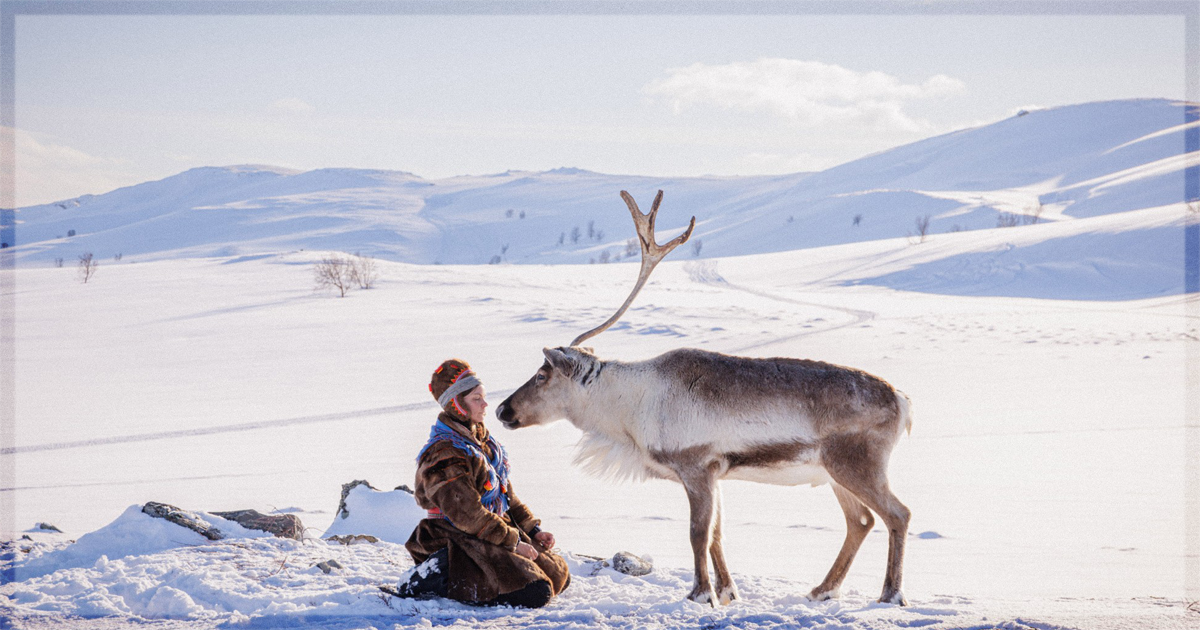
Maia (Sara Marielle Gaup Beaska) lives with her teenage daughter Áilin (Ayla Nutti) and her brother Dánel (Simon Issát Marainen) in a small village in the very far north (this is a Norwegian-Swedish-Finnish co-production). They are Sámi, but on the edge of their community since Dánel and Maia were orphaned as children. They all work together to manage a reindeer herd and are introduced on skidoos out in the wilds, looking after a reindeer who has miscarried and singing about their love of this beautiful place. For they are also joikers, singers of traditional Sámi songs, as Ms. Gaup Beaska and Mr. Marainen are in real life. The government wishes to sell the land rights in this area to a mining company, meaning both the gorgeous landscape and the family’s ability to earn their living from their herd are under threat. Therefore Maia has secretly called their uncle Lemme (Mikkel Gaup), a lawyer based in Canada and specialising in indigenous land rights, for advice. But Lemme took that call as a pretext to return home and set up a protest camp, where young activists, including Áilin, perform against the potential mine for the attention of social media. But for reasons slowly made clear, Lemme’s return is not an act of self-preservation. It is a betrayal.
Director Elle Sofe Sara, who co-wrote the script with Johan Fasting, is Sámi herself and therefore very aware of the pressure placed on nomadic cultures to settle, and on indigenous cultures to embrace ‘modern’ ways of living. She is also clearly aware of the value of a personal connection to lands and places, and the ways in which a symbiotic relationship with the land is healthier than an extractive one. The scenes of Maia caring for various reindeer allows this to be felt, and also captures an unusual skill rarely seen in fictional film. Áilin attending the protest camp in traditional Sámi clothing, as compared to her regular fleeces and jeans or the neo-hippie dress of the other activists, is another very strong visual metaphor. The ways in which small places (like a village, or a family) can assert themselves against outsiders is often a positive thing. But sometimes closed ranks are very dangerous indeed. When you’re pressured to put family first that can mean no limits to the damage a family can do. Árru is interested in how its little family must choose which is more important to them: their connection to the land, their connection to their community, or their connection to each other.
Ms. Nutti does a wonderful job showing how Áilin grows up, whether in crossing wilderness by herself on an ATV, partying at the protest camp, or coming to the slow realisation that her family ties are more complex than she knew. Her righteous indignation is a refreshing contrast to the jaded, wounded silence of Maia and Dánel, both of whom are more used to saving their feelings for their songs. Mr. Marainen, who literally gets to wear some great hats, gives Dánel a wounded vulnerability that’s unusual in an outdoorsy adventure story. Mr. Gaup brings a fresh edge to a very modern character who always thinks the best of himself. Finally Ms. Gaup Beaska combines her unusual, beautiful singing with a considered thoughtfulness that makes apparent how much Maia cares about her home and her family, but doesn’t know if she is making the right choices.
Cecilie Semec’s cinematography is interested in exploring how people inhabit these beautiful but incredibly harsh landscapes, and the quiet ways people take care of each other. The camera never looks away, even in the sequence of a reindeer being shot, butchered and skinned that was almost certainly done for real by the actors. Real life is messier than any cartoon, but being able to make your own choices about how to live is something we understand the importance of from childhood. Árru is fantastic own-voices storytelling that hopefully can parlay its unusual wisdom into becoming a juggernaut itself. But if nothing else, Árru knows exactly what it is, and how valuable just being itself should be. People who care about indigenous cinema will not be disappointed.
Árru recently played at the Berlin International Film Festival.
Learn more about the film at the IMDB site for the title.
You might also like…