When someone writes, directs and edits their own film, this can be a promising sign of an expert knowing exactly how to deliver the idea they have in their head. It can also be an exercise in the worst kind of self-indulgence, the kind that brooks no feedback and maintains a certain position in spite of all other advice. The problem with Sheep in the Box, which Hirozaku Kore-eda did indeed write, edit and direct himself, is that it tries to do too much. This means all the fascinating topics at its center are therefore handled so badly that the whole thing falls apart.
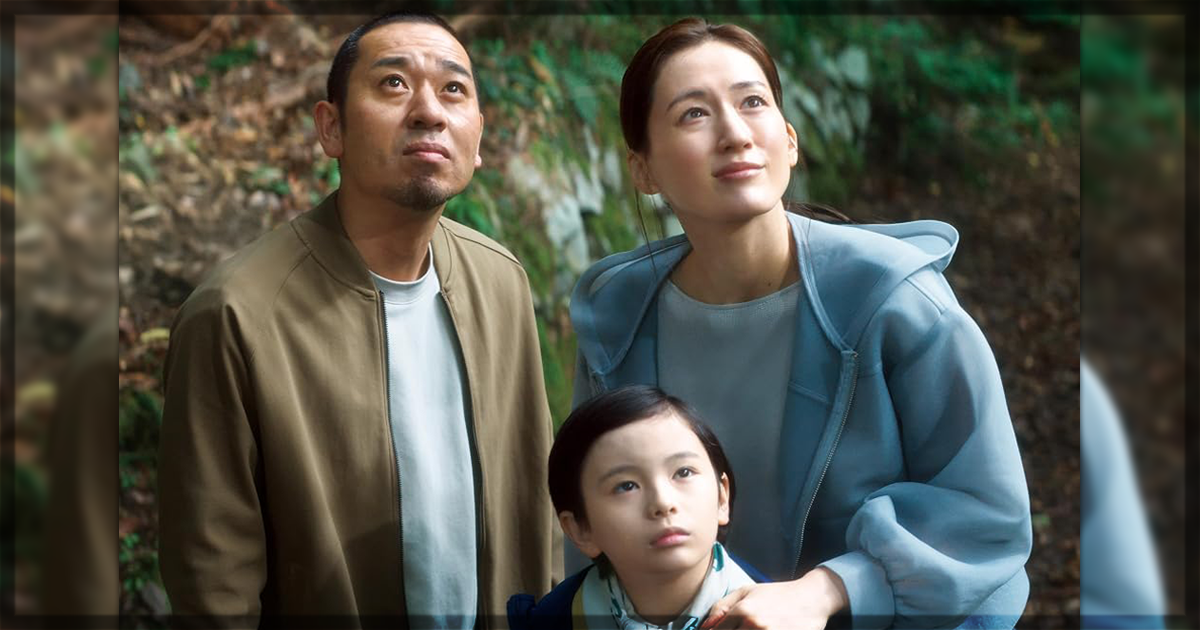
In “the near future” in a modernist house in Japan lives architect Oto (Haruna Ayase) and her husband Ken (Daigo Yamamoto), who runs a construction company. They have a peaceful marriage built around enabling their careers. That peace is surprising when you realise two years prior, their seven-year-old son died in an accident, which might have been murder. As the movie starts, Oto receives a sales pitch from a company that provide humanoid robots of the absent children to grieving families free of charge. Oto is very keen. Ken doesn’t, but he loves his wife, so a simulacra of Kakeru (Rimu Kuwaki) comes home.
A few years ago I’m Your Man wondered what it would be like if you could program your perfect partner. Another End wondered what it would be like if you could write your lost person’s memories into somebody else’s body. And just a few months ago Good Luck Have Fun Don’t Die explored the horror and the comedy of trying to parent a synthetic robot to replace the child you lost in a school shooting. I’m Your Man probably worked the best of these, because it was about creating a person to match your impossible fantasies, and not a version of a person who already existed. All of these movies have attempted to figure out why people might wish to hang onto a synthetic version of their lost family member, with mixed success. It’s only Ken who openly refers to Kakeru as a Tamagotchi and a Roomba until even he caves and begins referring to the robot by his child’s name. But none of these movies have successfully dealt with the absolute horror of their concept, and why so many people are seemingly prepared to eat sh*t if fifty, or five, percent of that sh*t is chocolate.
The title comes from a sequence in the beloved children’s book The Little Prince: after the narrator has failed to accurately draw his ideal sheep, he draws a box and announces that the sheep is inside it. This central metaphor is probably the best explanation we currently have for how well genAI (a concept barely mentioned in the film) and other people’s memories can accurately and entirely capture a person. That is to say, not at all, unless we pretend it does. But it also falls short of an explanation for what is happening here. Has modern life rendered us all utterly incapable of coping with death?
The subplot of Oto’s, who is having a hard time designing a house because the clients keep changing their minds about what they want, works very well. But the two other big subplots within Sheep in the Box simply don’t. The first is Ken’s, which belongs in a horror movie. The other is Kakeru’s, which leans into Mr. Kore-eda’s interest in abused children and how very young people survive when their families hurt them instead of love them. Without spoilers, this blurs some lines between care for humans and care for machines in shockingly inappropriate ways. It also shows a careless attitude to some real children from the adult characters when a much more interesting opportunity was right there. Instead we are pummelled with extended metaphors about trees, and the ways in which difference kinds of organic matter adapt to their environments. Ken’s construction expertise plays a large part into this. Even within the scope of this fantastical setup it’s unbelievable, and kind of rotten. This means the whole experience all spirals back around to nothing.
If our society does move into accepting these kinds of robot creatures alongside our humanity, these movies which tried to predict the future will become important records of our thought processes as we grapple with these issues. On that level Sheep in the Box is worth a look, but as an experiment, it is not a success.
Sheep in the Box recently played at the Cannes Film Festival. It will be in theaters on July 31, 2026.
Learn more about the film at the IMDB site for the title.
You might also like…