Director Jamie Adams has a no-budget niche. He finds a location and maybe six actors, prepares a concept and character arcs, starts the camera rolling, and allows the cast to improvise their way to the aimed-for ending. Within a week. His shooting schedule for his films lasts approximately a week. You can see why actors are flinging themselves at him and are thrilled to work within these parameters, but the results can be hit and miss. In spite of itself Only What We Carry is a hit, mostly because it depicts the kind of overwrought weekend its attendees will talk about for the rest of their lives. In the moment itself though it’s not particularly easy to enjoy.
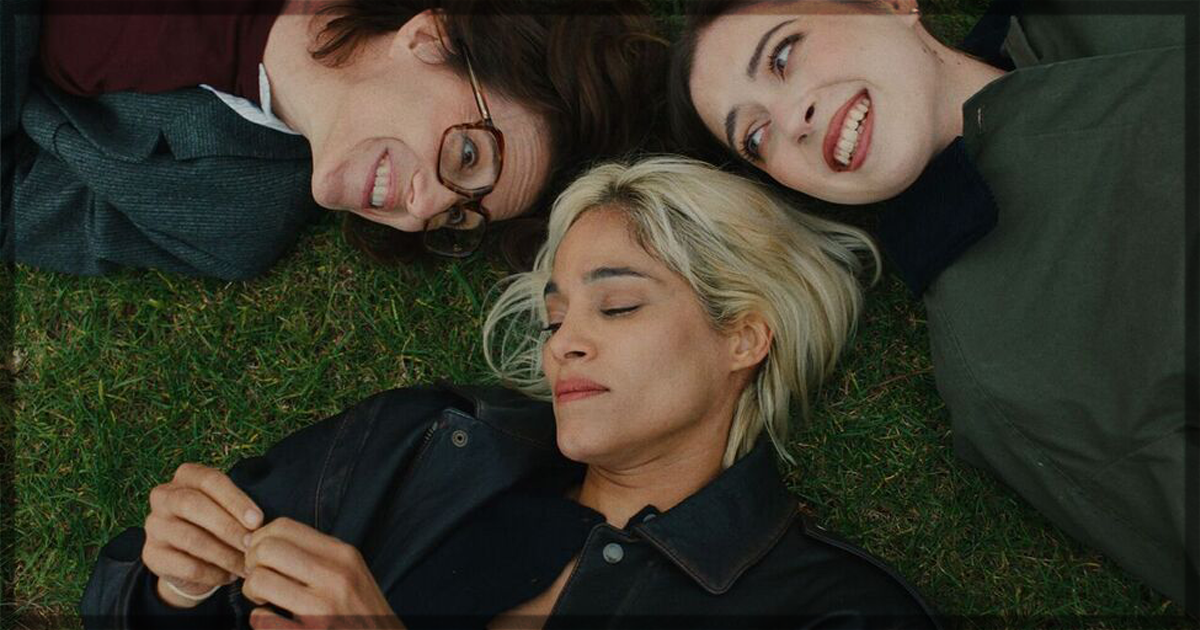
Charlotte (Sofia Boutella), a dancer at the Moulin Rouge in Paris despite her age, currently is in the middle of one of her periodic bouts of depression. Her sister, married mother Josephine (Charlotte Gainsbourg) doesn’t help by showing up with bad news: the former creative director of the Moulin Rouge, world-famous choreographer Julian (Simon Pegg), has given a high-profile interview about his retirement in which he also talked about Charlotte’s career. This upsets Charlotte so badly she leaps out of bed with a plan to confront Julian in person. It turns out Julian is in a northern French beach town called Deauville, so the sisters get in the car. He’s there to write his memoirs, staying in the fancy holiday home (with a pool and a tennis court) belonging to his publisher John (in a surprising choice, Quentin Tarantino). By coincidence, Josephine and John have a flirty conversation at a gas station before realising their journeys have the same endpoint. It further transpires that Charlotte is so famous she is approached with wide-eyed admiration by a few employees of their hotel, Vincent (Liam Hellmann) and Jacqueline (Lizzy McAlpine). So when John invites everyone for a party back at his, he kind of has to include the youngers, and the stage is set.
Julian wants to hang out with Charlotte, who is so upset than she can barely be in the same room as him. Jacqueline and Vincent want to hang out with Charlotte, the big celebrity. John wants Julian to stop wasting time and get writing, and Josephine wants to see how far her connection with John can go, husband and children be damned. But Josephine is also very worried about Charlotte, who is acting the woman scorned, scowling and sneering and drinking herself into a rage. It doesn’t help that Julian does that passive-aggressive male thing of seeing himself as a good guy, so he simply can’t compute why any woman might be upset with him. It’s not so much Who’s Afraid of Virginia Woolf as the kind of melodramatic party you hopefully never have to endure after you turn 25. But everyone in the house has a very good reason to be there, so the sparks definitely fly.
Mr. Pegg is not anyone’s choice to play a massive bastard but that makes the casting so effective. Ms. Gainsbourg, who the costumer inaccountably decided to dress as the love child of Harold Lloyd and Diane Keaton, in other words in an oversize man’s suit with square glasses swallowing her face, deserves special praise for making it even semi-believable that someone could be uncontrollably attracted to Quentin Tarantino. But the real surprise here is that Mr. Tarantino acts everyone else off the screen. His choice to play this wealthy and powerful man as a self-conscious saddo is the very best thing about the film. John is the eye of the storm; it’s his house they’re in and his booze they’re drinking, so it’s no wonder everyone kind of revolves around him. But he largely reacts to events, including letting Charlotte’s bad behaviour pass without judgement, instead of trying to shape them. Unfortunately Ms Boutella, as the world’s worst houseguest, struggles the most. Charlotte is in real emotional trouble but rather than trying to minimise it keeps trying to stage public scenes, which the others mostly avoid. It’s clear it took her longer to figure out how to approach her character, which would be no problem on a more ordinarily shot film. But when the entire rehearsal process is of necessity part of the 93-minute runtime the experience drags badly.
The ending pulls it all together, but by then it’s almost too late. The major downside in exercises in minimalism is that they don’t often hold together. Mr. Adams’ work can often feel like a student play, the kind of thing designed to reward low expectations and mostly seen by an audience pre-disposed to forgive any faults. Moments can work beautifully – as when Ms. Boutella gives up trying to find the words and instead dances – but here they are too few and too far between. We can’t fault Only What We Carry for not having the budget of say Star Trek Beyond (which Mr. Pegg co-wrote and in which he starred with Ms. Boutella) and it is always fascinating to see how different actors can run with an idea. But we can fault Only What We Carry for not being a lot more thoughtful about how it addressed the elephant in the room, instead of choosing to let the inherent drama of the topic do the work for them. That said – and I can’t believe I am saying this – Mr. Tarantino’s work here is so fresh that the weaknesses elsewhere simply don’t matter. Just like your son or big brother’s school play, Only What We Carry is worth seeing just for him.
Only What We Carry recently played at the Tribeca Film Festival.
Learn more about the film at the Tribeca site for the title.
You might also like…