There was an unusual preoccupation with performance art at this year’s Cannes Film Festival. Perhaps this is because performance art is by definition tied to a specific place, people and moment, providing an experience that can never be replicated. On the other hand, in a world where all our moments can be recorded, distorted, manipulated and distributed without our knowledge, consent or ability to control, time-specific performance art might be the only way we have to reclaiming that power. The End of It uses the metaphor of performance art to think about dying. But to say this is unpleasant is an understatement.
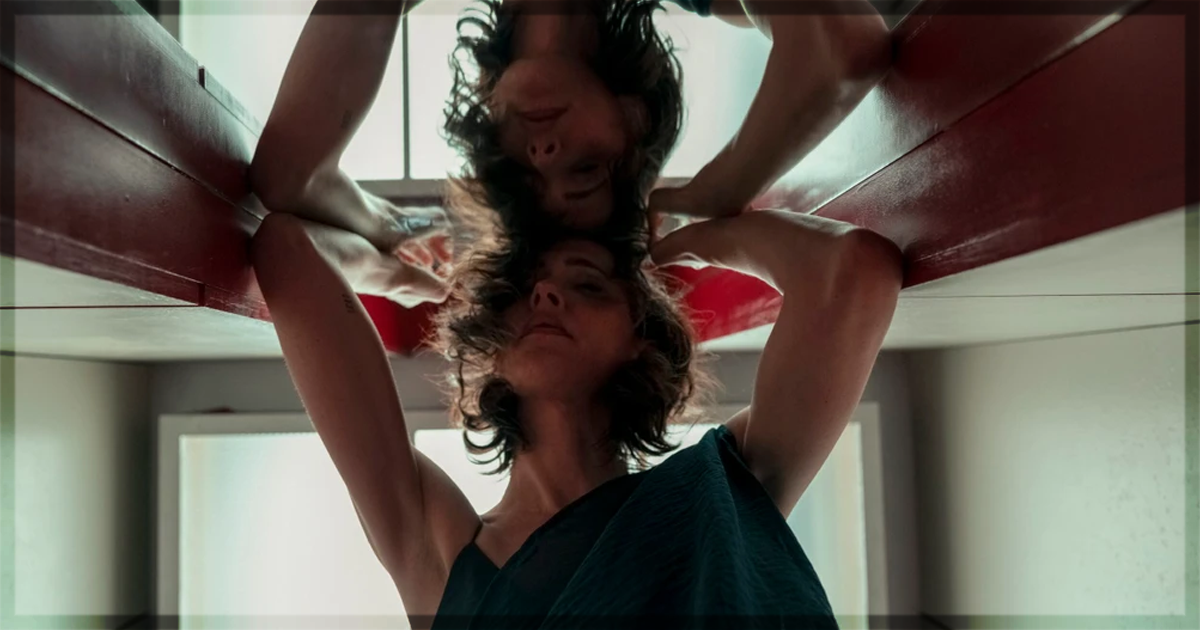
Claire (Rebecca Hall) is a former performance artist, now high-end jewellery designer in a world where healthcare is so good death is basically optional. The movie begins with Claire breaking the last original bone in her body in a treadmill accident – kind of weird an era where nobody has to die still requires exercise, but a world where nobody cares if you’re fat can’t even be imagined, eh – and then having a tantrum at the 250th birthday party her husband Diego (Gael García Bernal) hosts for her. She is bored of her work, she is bored of her friends, she never liked being a mother to her daughter Martha (Noomi Rapace) anyway, and well, that’s it. The party is over. But Claire did not anticipate that news of her plans to die would spur renewed interest in her life and work. This naivety is surprising from someone who mentions she replaced her own skull with an artificial one in an enormously successful performance piece [sidebar: GROSS]. But as the countdown begins to the moment of her end, Claire comes under tremendous pressure to reconsider.
Claire and Diego live in a modernist villa in Spain, where their every whim is catered to by their AI assistant Sarah (an unexpectedly good Beanie Feldstein). [Second sidebar: for the purposes of this review, your humble critic chooses to overlook the unpleasant personal coincidence in that choice of name.] The weather is perfect, the pool is clean, they are wealthy to the point of silliness and yet for Claire it’s not enough. When Martha shows up, dressed largely like a small child pretending to be a clown, it becomes clear she’s thrilled to learn about her mother’s impending death because of what that will enable for her own future. Further things disintegrate long before the end of the film comes around.
Writer-director Maria Martínez Bayona could not choose which current societal ill she most wanted to bemoan and as a result hit exactly none of her targets. She wants us to reflect not only on aging, how we care for the body, and how a refusal to grow old harms others around us, but also how limitless ease makes us selfish, the potential space for religion in a world where the answers have been found, and what purpose it serves to have children. All of this is done in the most sour and spiteful way possible – things are shown which are even grosser than the story about the skull – meaning there’s no joy in any of this. The fact Claire’s only real friend is a robot slave, and one who can never quite work out how to anticipate Claire’s feelings to boot, is also treated as normal instead of a source of further satire. Ms. Feldstein does provide the only real moments of levity, at least.
Ms. Hall does a very good imitation of what someone like Yoko Ono or Carolee Schneemann would be like in this situation, but art based on physical squalor and squeamishness is generally left for grad students these days. The up-your-nose confrontationally-feminist era of art has moved in a different direction, if it still exists at all. Lili Lea Abraham’s production design makes fantastic use of brutalist, futuristic spaces, and Andrés Arochi Tinajero’s cinematography finds a good balance between inquisitiveness and disgust. But despite the beauty of the images, The End of It is so disquieting it can’t be watched. And that’s not because its topic is too hot to handle. It’s because The End of It is so badly made audiences will find themselves tactfully looking away.
The End of It recently played at the Cannes Film Festival.
Learn more about the film at the IMDB site for the title.
You might also like…