In the rich history of Brazilian filmmaking, animation is a medium that does not have as profound a filmography as others. Before the 2000s, there were very few examples, like Meow by Marcos Magalhães and Frankenstein Punk by Cao Hamburger and Eliana Fonseca. However, in the 2000s, the animation sector bloomed, resulting in impressive productions like Uma História de Amor e Fúria (Rio 2096: A Story of Love and Fury) by Luiz Bolognesi and O Menino e O Mundo by Alê Abreu. The historic production by Abreu, which was even nominated for an Academy Award, shifted how people view Brazilian animation. Also, it changed how the Brazilian animated productions reached audiences and the international market. Thus, Abreu started helping other Brazilian animation directors with his producer role, such as Priscilla Kellen’s Papaya. It had its world premiere at the Festival de Brasília, and now the film landed its international debut at the Berlinale.
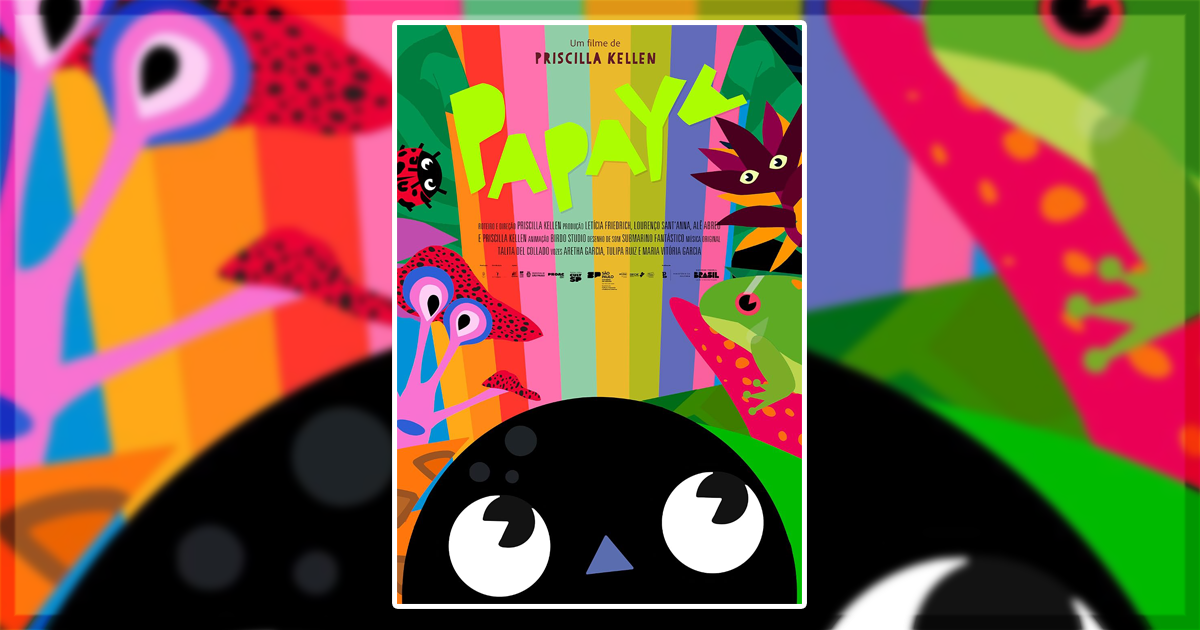
Papaya follows a Papaya seed that fell from the papaya tree because it loves to fly away. The small seed travels through the Amazon forest to return to the mother papaya tree. We follow this black dot escape from predators, water, and the immense rural machinery in the farms amidst the Brazilian Amazon. Structurally, the film is not intricate; the seed needs to traverse point A to point B. In a sense, it even reminds one of O Menino e O Mundo by Abreu. That film tackles the journey of a young boy in an urban reality after he leaves a rural community for the city, because he is seeking his father. Still, Kellen is not interested in the allegory of the Odyssey as a dive into civilization, as Abreu proposes in his magnum opus. The newcomer searches for the visual construction of a colorful world with shapes that resemble those of childish cartoons, even though it represents a sector in the Brazilian society that advocates for destruction. Kellen rejects elaborate metaphors and political allegories, deciding for the composition of the visual feast.
Contrary to the animation productions in cinema, Brazilian children’s programming features a plethora of options for parents and kids. Kellen even had her TV show with Vivi Viravento, a 2D Discovery Kids original. In this film, she respects the tradition of TV animation. Throughout the composition of a plain colored background and the central character, the rounded seed, moves around the scenario. The result is a film that utilizes bright colors, such as purple, orange, and variations of brown, to compose the look of a forest that drifts away from the realism in its portrayal. It is Kellen’s visualization of the Brazilian Amazon and how it might provide a visual invitation for the youthful crowd. Despite the environmental messaging, which is present through the creation of a film about the challenge of returning from the woods that became a battleground due to the industrial agriculture, Papaya is more of a project for the children, and it is notable through its approach.
The childish content of the film tires throughout its duration. In its sixty minutes, the troubles of the papaya seed are less interesting and and lose steam; it is not a visually or narratively bold project, but one that fascinates for its colorful approach to nature. Kellen uses the score by Talita del Collado as the textual element; the film does not feature any dialogue, so Collado exhales the Brazilian culture through their take on popular music, such as the samba, using popular whistles as the rhythmic aspect of the score. The composer transposes samba to the North of the country and mixes it with melodies characteristic of that region, which is grounded in drums. Thus, the music substitutes for the lack of dialogue, expressing its Brazilianess through the use of local sounds and the reconstitution of the forest in the eyes of the child. Papaya engages the ludic imagination of a crucial aspect of the country’s flora, and how it spreads to the newer generations, in its colors, characteristic sounds, and moves that grab their attention.
In a sense, Priscilla Kellen approaches the odyssey of a Papaya seed, rejecting a more profound commentary on the politics of the industrial agriculture that destroys significant portions of the Brazilian Amazon. With Papaya, she presents a ludic view of the forest, inviting children to listen to the characteristic sounds of the nation, and engage with one of the most prominent elements of pride in the country: our forests and culture.
Papaya recently played at a number of film festivals.
Learn more about the film at the IMDB site for the title.
You might also like…