
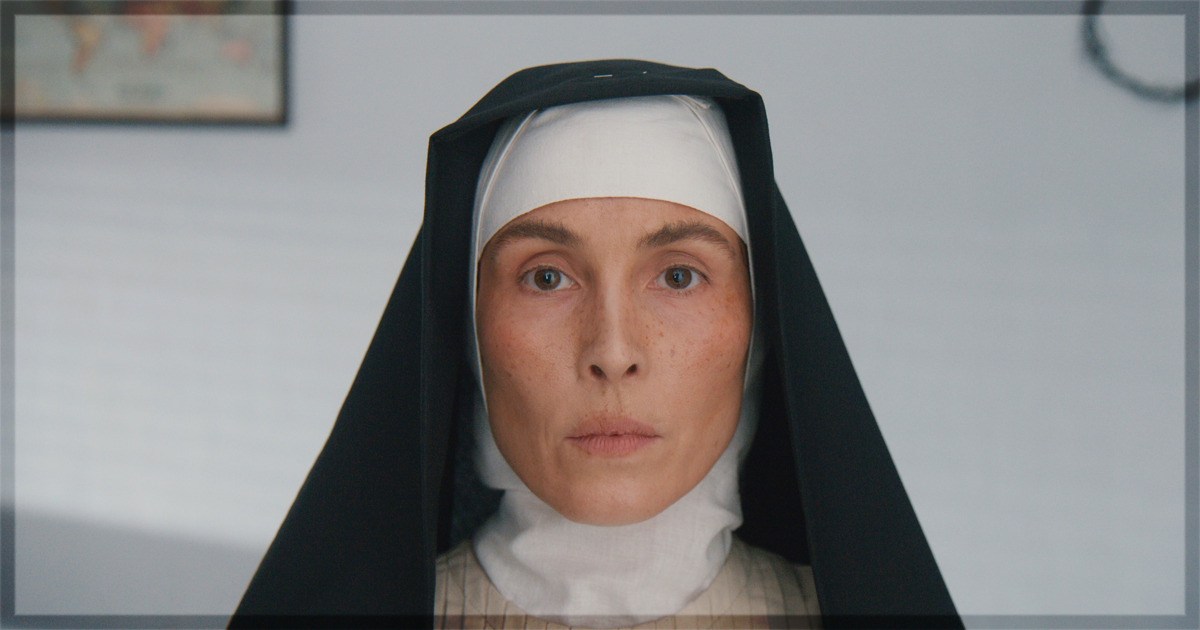
There is a needle drop in Mother so insane that it either singlehandedly turns the movie into a triumph or ruins it completely, and I still can’t decide which it is. But this is precisely the point director Teona Strugar Mitevska is trying to make with her fictionalised biopic of Mother Teresa. Depending on who you ask, Mother Teresa was either the living embodiment of sainthood, or one of the most narcissistic practitioners of Christianity in the modern era. The story focuses on the week before Teresa (an exceptional Noomi Rapace, acting mostly in English) was granted permission to set up her own religious order, and the problems she faces during this countdown in her convent in Calcutta. It is clearly an entirely fictional plot, mainly because it feels like a philosophy degree stuffed into some rhetorical questions made flesh. This is either a fascinating angle to take in a story about a nun, or a ridiculously limiting approach to gendered personhood that has no place in 2025. The great surprise of Mother is that it just about manages to have its cake and eat it.
It’s 1948 and Teresa is impatiently waiting for that letter of permission. In the meantime she walks the streets providing morsels of bread to anyone who asks, and rules her convent with a will of iron. Technology like an adding machine to make the bookkeeper’s job easier is unnecessary; jobs being harder by design are excellent opportunities to offer suffering up to the Lord. But it’s hard to imagine all this penitence, which includes rearranging the furniture in other nun’s cells for maximum discomfort, was enjoyed by her colleagues. The only one of them she respects is Sister Agnieszka (Sylvia Hoeks, best known to English-language audiences as the cop replicant in Blade Runner 2049), who is in line to take over as Mother Superior if Teresa is allowed to leave. Unfortunately Agnieszka has some news which should not be spoiled but involves perhaps the last personal decision a nun should ever make. Teresa not only takes this news as a personal betrayal, but also spends the following days trying to force Agnieszka into obeying her, when really it has nothing to do with her. And for someone who believes she is guided by a higher power, she seems uncommonly determined to impose her judgement on herself and others both.
It’s a nasty internal and external power struggle that’s meant to open up debate between free will and submission, the best way to serve God, the purposes of a human body, whether the wish for love is a weakness, things of this nature. The trouble is these conversations are so obviously by design they don’t hold true interest. Ms. Hoeks does as much as can be done with a character designed to embody so many nun clichés she could have been directed by Pedro Almodóvar. This includes the mention in passing that the Polish Agnieszka was a Jew who converted to Catholicism in order to avoid the Holocaust, which doesn’t so much go over the top as into space.
But Ms. Rapace, who has always specialised in intense, curious women with a remarkable capacity for violence, is so perfect in the part it’s extraordinary. It’s entirely believable that she is granted all her authority because it’s the path of least resistance. Her violence here is twisted inwards and it’s impossible to say if any of Teresa’s choices are made for the right reasons. This ambiguity is the point. Cinematographer Virginie Saint Martin has a great time highlighting Ms. Rapace’s cheekbones and allowing her eyes to bore across the lens. But Ms. Rapace ensures Teresa is more than her stubbornness combined with her desperate doubts that her abnegation serves a purpose.
It all leads to that needle drop, genuinely the most shocking moment of the entire Venice Film Festival, because it is so anachronistic, so silly and yet somehow so appropriate that the movie explodes like a bomb. You simply can’t look away even as the pieces scatter and dilute the original intensity, and even as the plot lines up with the person Mother Teresa became famous as. But Mother is more interested in wondering whether we should judge a person by their actions, or by their thoughts. The fact those go hand in hand should be taken on faith; instead the fact we can never know anyone else’s true heart is ignored. Mother is never boring, but it’s unusually difficult to say whether or not it is good.
Mother (Orizzonti) recently played at the Venice International Film Festival.
Learn more about the film at the Venice site for the title.
You might also like…
‘Silent Friend’ Film Review: Tony Leung in Nature is Truly Extraordinary