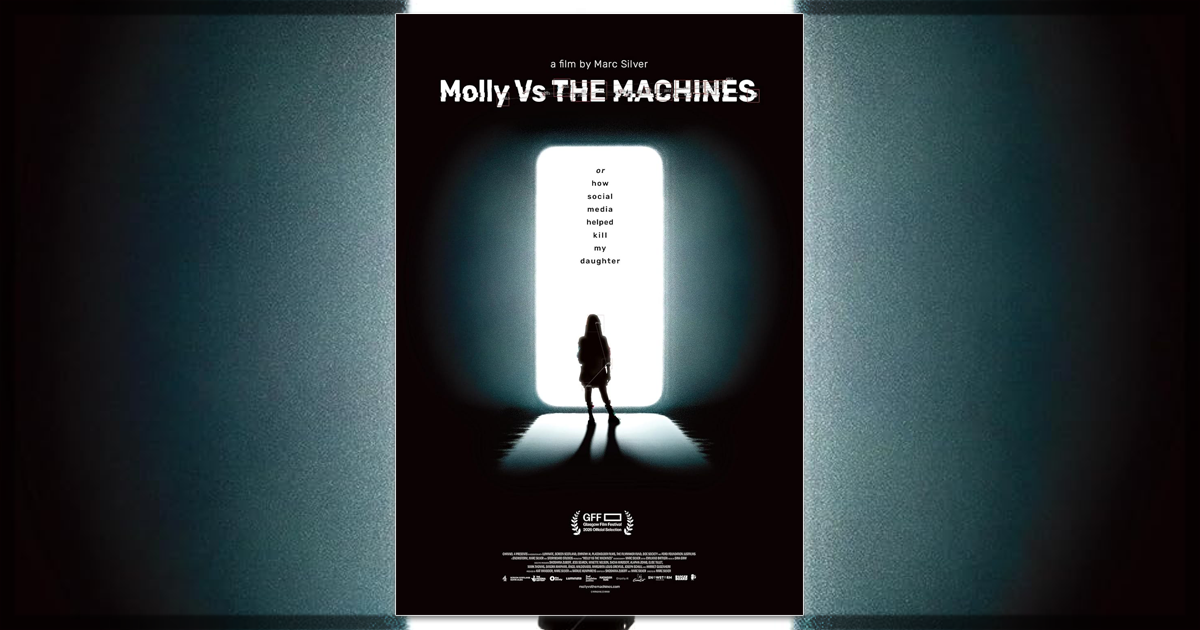
There are five reasons why Molly vs THE MACHINES should never have been made.
- It makes significant use of generative AI, from having AI voiceovers read the narration to AI images illustrating various points. This appears to have been done as a budget saving. Molly Russell, the 14-year-old named in the title, killed herself in 2017, long before AI and LLMs moved into common usage. The use of AI in art is always unjustifiable, but to use AI in a documentary explicitly about how algorithms affect people’s thoughts is dehumanising, both for its subject and for its viewers. It’s so callous it’s hard to speak about it.
- The title implies that we are going to learn about Molly and who she was separate to the social media algorithms that directly contributed to her suicide. This is not the case. We learn almost nothing of what Molly was like as a person. Of her family, only her father Ian Russell appears onscreen, and his discussions focus on the aftermath of her death and its impact on him. Her mother is mentioned by name only once and neither she nor Molly’s two siblings appear. Instead a large part of the focus is a re-enactment of the coroner’s inquest into her suicide, which was one of the first times anywhere in the world a social media algorithm was held responsible for anyone’s death. I wanted to watch this documentary because this result of the investigation into her death was a major factor in the UK passing the Online Safety Act in 2023. This allows the UK government some oversight over social media in regards to the impact it can have on children. That act has directly led to social media companies around the world demanding their users verify their ages, as well as nations like Australia banning under-16s from social media. NONE OF THIS ASPECT OF THE AFTERMATH OF THE INQUEST IS MENTIONED. This is an extraordinary failure on the part of the documentarians.
- Instead the documentary is credited as an adaption of the 2019 nonfiction book The Age of Surveillance Capitalism by Shoshana Zuboff, who is unusually credited as Molly vs THE MACHINES’s writer under the name Shana Zuboff. The scripted sections of the documentary are largely an attack on how social media attempts to analyse, assess or control (choose your verb, depending on your viewpoint) individual people based on the attention they give to different social media posts. Important stuff, but not an argument best made using the suffering of a real child, and certainly not what Molly Russell’s death has led to on social media and how users around the world of all ages now interact with it.
- Molly was British. The social media companies that she was involved with (mainly Instagram, Pinterest, Twitter and Snapchat) are American, albeit with offices and employees around the world and with users in every country speaking every language. The former employees of those social media companies who participated here (and who center their own unhappy experiences instead of those of the users) are Danish and American. And yet the presumption is that online culture is its own uniform, overarching thing, with a cultural context that is the same everywhere in the world. This presumption is so solid that it is not even addressed, despite director Marc Silver being British and Ms. Zuboff being American. Regardless of the absence of an assessment of the global ramifications of the Online Safety Act, there is no analysis of how people in different places relate to social media on a cultural level, much less individually. Friends of Molly’s, all now in their early twenties, who participated were very clearly coached in what to say for the cameras, too. This means Molly’s larger identity as well as her own distinct individuality is ignored.
- But the worst thing of all is that Molly vs THE MACHINES does not consider children people. The entire argument against the social media algorithms, from the lawyers in the coroner’s court to the AI-voiced narration, is that they overrule a parent’s ability to control what and how their child sees the world. In the legal conversations about the algorithms, in the testimonies, in the discussions, there is not even one mention that a 14-year-old deserved help with her mental health because she was her own person. This is especially awful because the documentary makes clear that Molly’s increasing unhappiness was apparent to her family and friends in the months before her death. But this awful fact isn’t pressed. At no point is Mr. Russell asked what he would have done if he’d seen his daughter’s social media feeds while she was still alive. These sensitive discussions might have happened elsewhere between 2017 and now, but the fact this also swerves that issue is baffling. This makes Mr. Russell’s repeated insistence that they were just a normal family incredibly depressing, too.
The entire experience of watching Molly vs THE MACHINES is baffling and depressing. Molly Russell was a real person with her own body and her own ideas, and she was clearly struggling with the transition from childhood to adulthood in the ways millions of others have done and are doing. In life it seems she felt she was left to struggle with this alone, and took her own life because she did not feel she could succeed. Now in death it feels like her corpse is being used as a weapon to berate the social media companies who profit from these struggles. Molly vs THE MACHINES had its premiere at the Glasgow Film Festival and is already available for view on streaming in the UK, but it deserves to be forgotten. How dare the people involved in this erase the life of a child for their own purposes. In that way they are not particularly different to the social media companies, who do not care whether their profits come from suffering as long as they profit. They are also the same as the governments who would prefer to pretend children don’t use social media than attempt to prevent or mitigate the potential harms of them doing so.
In every way, Molly Russell deserves a better memorial than this.
Molly vs the MACHINES recently played at the Glasgow Film Festival.
Learn more about the film at the IMDB site for the title.
You might also like…