
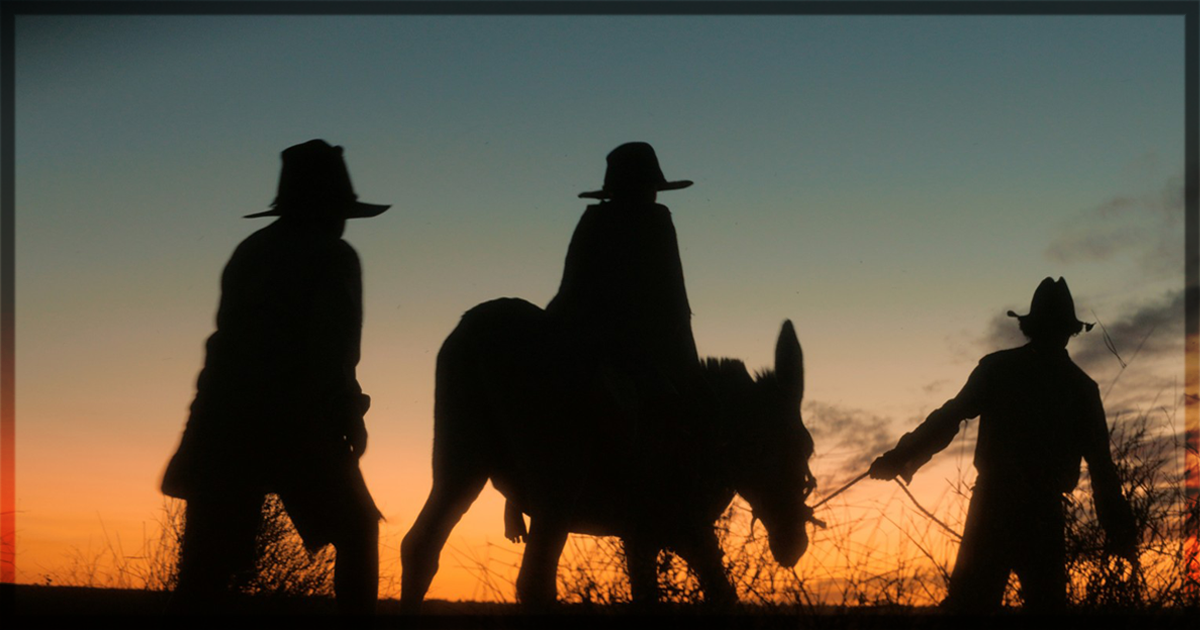
Wolfram, which is full of plot twists that should not be spoiled, contains one particular twist that makes it very difficult to review. I would therefore encourage you to read this review after you have seen the movie. Otherwise please read this months before you actually see it, forgetting everything except it sounds good and you’re curious to check it out. And I encourage everyone to check out Wolfram; it’s the newest entry in the genre of ‘meat-pie Western,’ that is to say a frontier story of lawlessness and difficult lives in remote country, but in Australia. And Wolfram is all about Australia’s specific indigenous history as well as being the first Australian film with Chinese characters in a historical outback setting. While it never shies away from the brutality it is also an uplifting story about the importance of perseverance and keeping hope alive.
It’s sometime in the 1930s and a small outback town called Henry is in such bad shape a dead horse, marked with wheel tracks, has been left to rot in the main street under the sun. Absolutely everything here, at all times, is covered in flies. Henry is circled by wolfram (tungsten) mines, small hand-dug pits worked by child miners with only sunhats to protect them. Outside town lives a feeble and tubercular white man named Kennedy (Thomas M. Wright) with his mixed-race son, Philomac (Pedrea Jackson making a huge impression), who he treats as a servant. One day a relative of Kennedy’s, Casey (Erroll Shand), and his sidekick Frank (Joe Bird) ride into Henry on horseback, and because they’re family Kennedy can’t turn them away. This is a nightmare because Casey is an angel of death, causing mayhem and misery everywhere he goes. He thinks nothing of torturing and/or killing pretty much every indigenous person he encounters, just because he can. At the same time, an indigenous woman named Pansy (the incredible Deborah Mailman), who has a new baby with her new husband Zhang (Jason Chong), must leave Henry, traveling by horse and buggy, for work elsewhere. This means temporarily abandoning her two older children, Max (Hazel May Jackson) and Kid (Eli Hart), who are enslaved labourers working down a wolfram mine for the abominable Billy (Matt Nable). After a series of events, Casey and Frank kidnap Max, who’s eight or nine, to enslave him for themselves. The maybe seven-year-old Kid bravely steals a donkey – a crime punishable by death, even for a child – and goes to rescue Max alone, while Kennedy and Philomac try to figure out if Frank and Casey can be stopped without getting killed themselves.
Director-cinematographer Warwick Thornton and screenwriters David Tranter and Steven McGregor all worked together on 2017’s Sweet Country (unseen by me), to which this film is a loose sequel, set in the same part of the world with some of the same characters and also based on Mr. Tranter’s family history. But that knowledge is not essential to appreciate the core dilemma: all these characters are connected, but the racism of the white people makes these connections brutal. Despite the wide open spaces, it’s still a small place: when Kid and Max end up at a remote claim worked by strangers Shi (Ferdinand Hoang) and Jimmi (Aiden Du Chiem), the Chinese men realise they are Pansy’s children because of their own connection to Zhang. The total solidarity of the characters of colour against white people is further emphasised when Pansy and another indigenous woman have a quick sign-language conversation that none of the men around them notice. Of course, women have neither power nor value here, but still have to stay alive somehow. And without those crumbs of solidarity, the brutality of the white men would truly be bottomless.
The racism is so brutal than when one of the white men is unexpectedly beaten up, the Berlinale audience burst into applause, a very rare occurrence. But Mr. Thornton is right to make the full horror of that racism fully felt. In London theatre when old plays are revived, it’s now common for racist language to be excised or watered down. And while it can be unbelievably jarring to hear the n-word thrown around, it’s also wrong to minimise the racism of the past to pander to the sensitivities of the present. If we don’t know how bad it was back then, we won’t know why things are the way they are now. And since the Australian talent for foul language – as casually crass and brutal as anything you’ll ever hear – is on full display here, any censorship of any kind would have made the plot ridiculous.
The ways the plots weave in and out of each other emphasise how all the characters also continually criss-cross the same physical spaces. Those spaces are extremely beautiful, but Mr. Thornton’s sharp eye doesn’t allow the beauty here to take over. The goal here is the hope that somehow justice can be done. Better still there’s no sympathy for Kennedy, a man who could have been good if he wasn’t so racist, or Billy, who abuses children to feel better about himself, or Casey, who lost his goodness in the First World War and since then has created his own hell. Instead there is an awareness of their human weaknesses and the understanding that their horrendous behaviour is always a choice. Philomac’s core decency, even when he becomes ‘the boss,’ becomes essential to many people’s survival (and through his work here Mr. Jackson announces himself as a star on the rise). Kennedy could have been a loving father, Billy could have earned a living without risking Max and Kid’s lives for it, and Casey – well, Casey might not be worth saving. (Mr. Shand goes so deep into this character he could spend the rest of his career as the villain in horror movies, if that’s what he wants.)
Ms. Mailman doesn’t have much to do other than be a symbol of the suffering of indigenous women, but she does so with such an air of hopefulness that Pansy never feels like a cliché. And the thing is, Kid and Max are such brave kids, so clearly used to mistreatment but not yet ground down by it, that your hope they’ll survive carries Wolfram all the way through. It’s a tough and unpleasant story that somehow manages to end with a message of hope. Whether or not that hope is a cinematic invention, it’s what turns Wolfram from a catalogue of suffering into an inspiring survival story. And the cleverness of the plot twists ensure the surprises never stop coming.
Wolfram recently played at the Berlin International Film Festival.
Learn more about the film at the IMDB site for the title.
You might also like…
‘The Education of Jane Cumming’ is an Offensive Fantasy (Berlinale 2026 Film Review)