
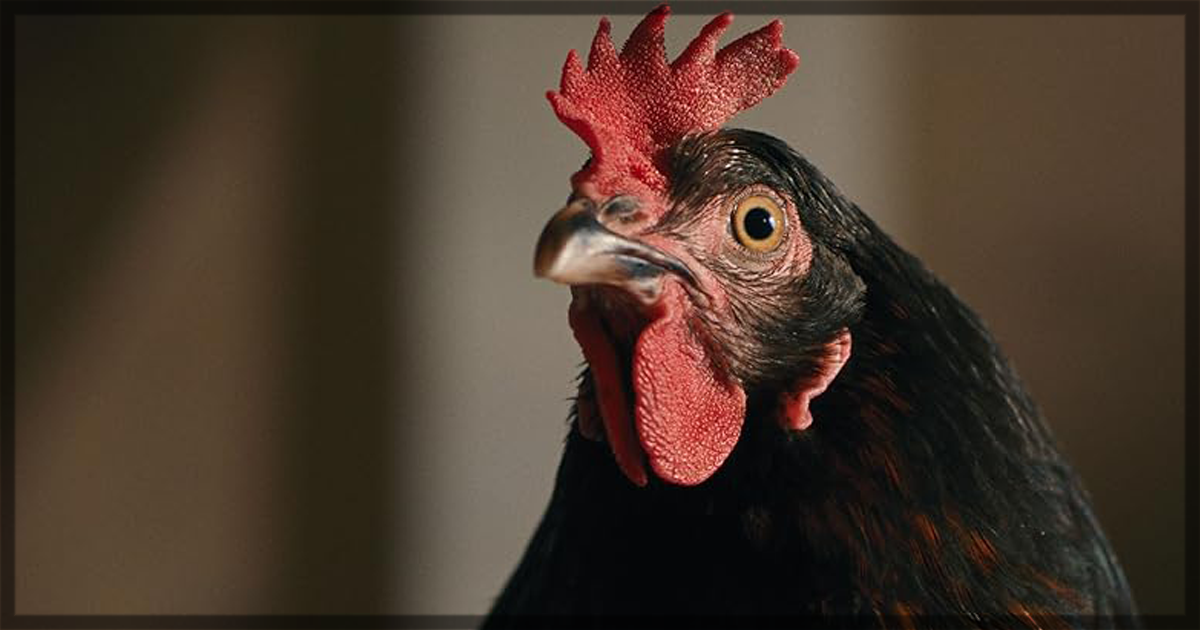
Babe: Pig in the City this ain’t. There are some similarities, in that Hen was filmed using real animals with humans as incidental to the plot, but this Hungarian film set in Greece is so disturbing that it’s definitely not for kids. It is from the perspective of a black hen (played by eight hens named in the credits* as well as three ‘stunt hens’) and involves interactions with the human world that are nightmarish for animal and human both. It’s very clever, but oh boy is it depressing.
A black hen is born in a battery farm and highly visible due to her colour. She is saved from being sent to the slaughterhouse thanks to this visibility, and when the truck driver who plans to cook her for dinner leaves a window cracked she makes her escape. Her wanderings around the villages of the Greek countryside have no purpose but plenty of drama, until she is snatched by a dog. The dog brings her to his owner (Yannis Kokiasmenos) who sets the hen’s broken wing and gives her a cardboard box in which to heal. Once she’s better the man, who owns a disused restaurant over which he lives with his family, moves her into his chicken coop. The behaviour of the rooster towards the hens is treated as violence and the hens’ daily laying of an egg is implied as being against their will. The repeated close-up underneath shots of eggs being laid intertwined with shots of the hen cawing in pain make this perfectly clear.
György Pálfi’s direction implies this is when the hen begins plotting her revenge, despite the hen being only an animal. There is no way it could plan, or even understand the consequences of its behaviour. But one little thing the hen does has major consequences for the restaurant owner, in ways neither human nor animal could have anticipated. But whether it might be possible for an animal to do these actions deliberately is the question Mr. Pálfi and his co-writer Zsófia Ruttkay want us to consider. The fact the hen’s story is told in the bleakest possible way, with humans behaving as badly as possible to each other, may well be realistic. It’s certainly dramatic. But it’s really not fun to watch. The horrors of what the people here do to each other are the only thing worse than how badly the animals are treated. Framing all this as revenge by the animal kingdom is a loud choice. The movie does not anthropomorphise its creatures, so this sense comes through via Réka Lemhényi’s excellent editing. It makes a powerful argument against battery farming and will certainly have people reconsidering how their dinners are made. That at least is a major achievement. When you think about how none of the animals filmed could have read the script, it makes it even harder to believe this could be so well done.
That said, Hen leaves such a nasty taste in the mouth it’s hard to recommend. The curiosity is why this film was made. Is it a political attack on how people are currently treated in Greece? Is it a cluck of protest at the ways people acquire their cheap proteins? Or is it both? On the other hand, when the story here and the way in which it’s told is this fresh and unexpected, does the reason for its existence matter? The answer is kind of. Hen wants us to be on the side of its hen. This is understandable, but the fact is kindness to people is always more important that kindness to animals, and anything which implies that cruelty to humans is justified thanks to unkindness to animals is vicious indeed.
*The titular hens are named Eszti, Szandi, Feri, Enci, Eti, Enikő, Nóra, and Anett.
Hen will be in UK theaters on May 22, 2026.
Learn more about the film at the IMDB site for the title.
You might also like…

‘The Education of Jane Cumming’ is an Offensive Fantasy (Berlinale 2026 Film Review)