It’s rare that the context of a movie’s making is as important to appreciating it as that of A Girl’s Story. It’s not only that the writer whose story has been adapted, Annie Ernaux, won the Nobel Prize for Literature in 2022. Ms. Ernaux has spent her life documenting, well, her life, including the ways in which sexual mores and misogyny have shaped her. She’s been such an awarded and beloved writer because of her skill in demonstrating these specific feminine experiences of hers are also universal. She has been a pioneer in writing about women’s experiences without shame, which is why her work has been so widely embraced in France and elsewhere. Society is beginning to change because of the work Ms. Ernaux and others have done to bring these hidden stories into the light.
It’s another unhappy fact that the director of A Girl’s Story, Judith Godrèche, has real-life experience with the sensitive subject matter here. This is not a secret; in fact at the 2024 Cannes Film Festival she showed a short film Moi Aussi (French for Me Too) shortly before criminal cases were opened against two French film directors based on things done to Ms. Godrèche when she was a child. Those things were not secret either; in fact the films in which Ms. Godrèche acted as a teenager for those directors could have been the evidence. So the presence of A Girl’s Story at the Cannes Film Festival, including Ms. Ernaux speaking from the stage before the screening, was both an apology, an acknowledgement of how the world is turning, and an important demonstration of support. Watching A Girl’s Story while knowing these things is scalding, for the same reason the title is generic. These kinds of things keep happening to girls all around the world, over and over again. And the girls and women want to know what we are going to do about it.
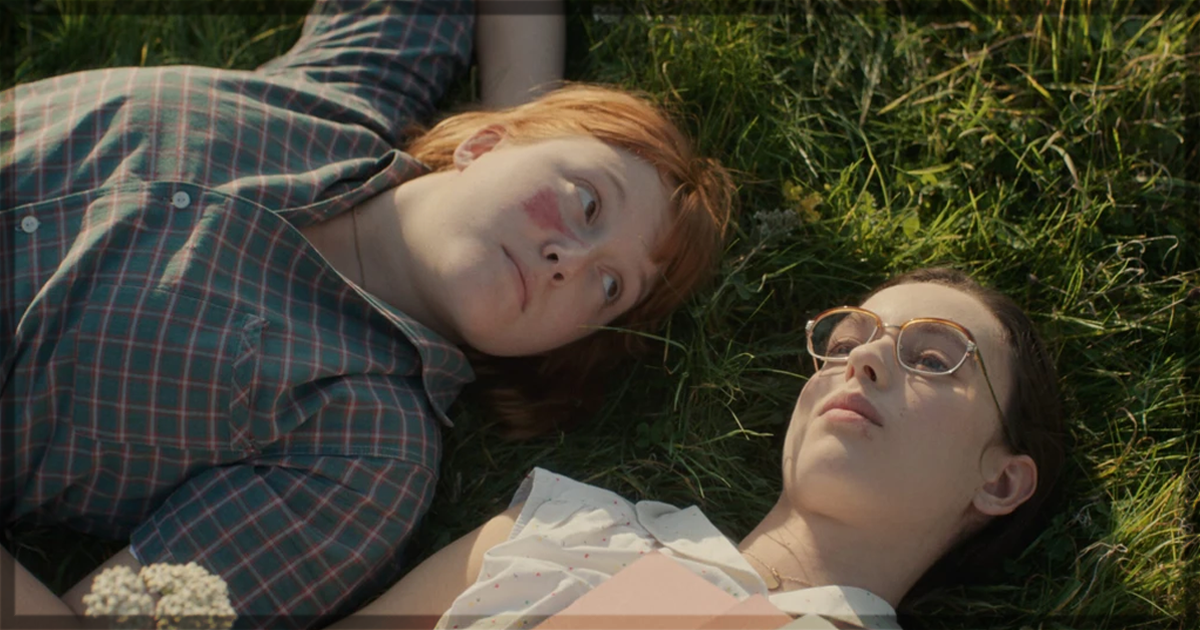
It’s 1958, Annie (Tess Barthélémy, the director’s daughter) is 17 and a half, and away from home for the first time in her life. She has gotten a summer job as the youngest counsellor at a sleepaway camp for tubercular children and absolutely thrilled by the opportunity. Small-town provincial life, where her parents run a grocery store, and her friends are excited to get married and settle down, is not ambitious enough for our girl. She’s bright, motivated, and desperate both to shed her country mousiness but more importantly find her own place among people who share her enthusiasm for art and ideas. Fresh air, hard work, and a gang of potential friends to mess around with does indeed sound ideal. But the men counsellors have other ideas.
The head counsellor, H (Victor Bonnel), who is 23 and engaged to be married, kind of helps himself. Annie is so excited to be receiving some attention she doesn’t stop to think whether these attentions are what she really wants, if H is someone she actually likes, or if the things she does with H are things she wants to be doing, with him or anybody. She is also blindsided by realising that her secret sneaking off with H is absolutely no secret at all. Suddenly Annie realises she’s in the trap for women as old as time: you’re frigid if you don’t and all kinds of slurs if you do. The worst part of it is that Annie is never forced. All the mistakes she makes are ones she chooses. But it is perfectly, obviously, blindingly clear to every single other person there, man or woman, that she has no idea what her choices mean. And that means she is being taken advantage of.
The unkind running commentary of the girl counsellors, most of whom are at university with fiancés somewhere in the background, implies they’re glad H selected Annie as his focus for the summer because it means they’re spared his attentions. The sole exceptions are Claudine (Maïwène Barthelemy), who seems to be a lesbian (although no one, even Annie, seems to have the sense to realise that), and Rose the nurse (Guslagie Malanda, who really is building a career holding France to account). The general consensus is Annie is stupid, and therefore deserves to learn about the world the hard way. The male counsellors don’t physically hurt Annie; there’s no physical violence in the film, and when she says stop people stop. But nobody except Claudine and Rose is kind to her either, and have a good time making fun of her while they’re at it. So Annie slowly realises she’s being punished for doing things men are rewarded for and mocked for thinking sexual experimentation – or any happy attitude to sex outside of an engagement or marriage – is appropriate for a girl. She’s playing a game without knowing the rules or how to succeed while slowly realising no one, man or woman, will ever let her win. And by win, that means being happy in her own body and with her sexual identity.
It’s safe to say a lot of young women learn this precise lesson this precise way, regardless of the year or the location. It’s hard to watch only in that being a teenage girl is hard to watch. Annie’s parents send her off with admonitions to behave and be a good girl, which Annie correctly dismisses with contempt, but it’s impossible to imagine the young men here were given such lectures by their own parents on drop-off. Another tale as old as time: the only way we’ve come up with to mitigate the behaviour of young men is by punishing young women who go along with it. When is that going to change? A Girl’s Story has the sense never to ask that directly, but a lot of people watching will wonder.
In 2022 another one of Ms. Ernaux’s memoirs was adapted into Happening, an unusually tactile film that shows what happened next. Ms. Godrèche’s style is more observant, more external; all the details here of ceiling lights and red toothpaste and Annie binge-eating are for us to think about, not to feel ourselves. Joachim Philippe’s cinematography finds a good balance of the little details without ever feeling exploitative, and Guillaume Lauras’ editing is the main expression of the pressure Annie is under. This little distance is probably a good idea, as is the voiceover by Miss Barthélémy, based on letters to her best friend, that spells out the roiling thoughts percolating under the surface of the camp’s daily routines. The campers barely feature, which is about right. And Miss Barthélémy’s performance is hard to describe because of how powerfully she demonstrates how innocence is lost. There’s a brief bookend with Valérie Dréville as an adult Annie learning where some of her peers from the time ended up. This ties in with Ms Ernaux’s work but wasn’t truly necessary. But A Girl’s Story is a necessary film that wants to know when we’ll be able to stop telling stories like these. Its expertise is so clear the excellence risks being unappreciated, but even without knowing the specific context of the filmmakers this is a thoughtful and important film.
A Girl’s Story (Mémoir de fille) recently played at the Cannes Film Festival.
Learn more about the film at the IMDB site for the title.
You might also like…