
In the recent history of the Brazilian society, despite the majority in numbers, the Black population is a minority economically. This fact reflects the hundreds of years of slavery that exploited those coming from the African continent, and after their freedom, led them to the margins of the society. One of the consequences of the inequalities is a memory decline. As a project of institutional washing, the Black Brazilian population has not had access to its history. Contrary to multiple diasporas in the country, such as the Lebanese, Italian, and Japanese, the Afro-Brazilian community is a homogenous group that lacks an understanding of origin as a project of dehumanization. A customary situation for Black or mixed families is the lack of information about their ancestry and the scarcity of registers, whether written or pictures from the ancient generations. The emergence of new technologies and the widespread access to digital cameras in the 1990s enabled these individuals to learn how to manage their memories. Aristótelis Tothi and Inez dos Santos, son and mother, deal with their memories and the construction of imagery in Vasta Natureza de Minha Mãe.
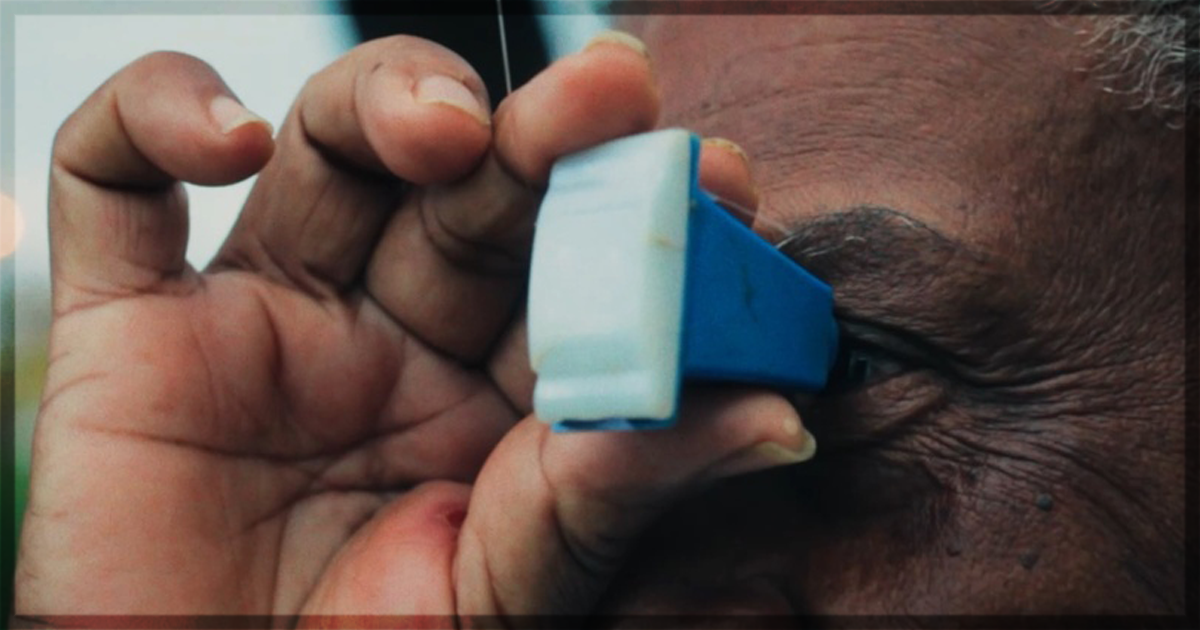
Tothi is a well-known independent director in the local independent film scene of Goiás, the state in the middle of Brazil. Despite its importance in the history of the nation, film is still an ongoing construction as a community. He is one of the few individuals who work cohesively toward the goal of that scene in the state’s capital. He is already a veteran, having directorial credits as Búfala and Do Peito ao Prumo, and also producing other directors’ projects through his Dafuq Filmes. Contrary to her son, Vasta Natureza is the first directing experience for Inez dos Santos. Hence, the starting point of the film is their backyard conversations, where Tothi teaches her how to film the trees with a digital camera. He is watching his mother closely through the lens of a cellphone, which captures the learning process of a curious individual. The central aspect of the film is how the labor of film has a presence in the family.
Despite it becoming a profession in the new generation, with her son, the archives in VHS from 1992 show a mother fascinated by registering her child. Inez even narrates it, tracing a genealogy of the child, saying the parents’ name, the grandparents’, and the pictures of him as a baby. Even unintentionally, she aims to create the record of his birthday and his childhood. We watch a young Tothi wearing a green kit for Goiás Football Club, the local team. Still, there is an inherent beauty in the recording of the life of a black child in the early 1990s, particularly when the country was freshly out of the dictatorship that lasted for twenty-one years. He is a child of a democratic country, but it was never a free land for black people. The duo finds liberty in the poetry of image – the juxtapositions of pictures with Inez in the centre of the frame.
The mother and son design a poetic documentary about their life. The vast nature of its title borrows its name from Inez‘s desire to understand what the animals and other beings have in their heads. She wants to comprehend the world. Yet, there are multiple mentions of her age, and she questions the possibilities of still learning something now. Why make a film in your late 60s? But Tothi tells her, why not? Consequently, we understand the beauty of the singular, the dedication to capture the process of learning while time flies. In our late capitalist world, learning is exclusive to the youth, while the older generation needs to work until they retire. Everything ought to follow the logic of a market that requires selling at all times. Vasta Natureza de Minha Mãe thrives in showing the necessity of connection to understand history, memory, and learn how to tell their own story. Throughout the choice of himself and his mother to operate the camera, Tothi and Inez bring us closer to their lives, presenting a version of themselves eternalized in film.
Similar to the VHS recordings playing, the imagery in the film captures specific moments of the mother and son. Despite not noticing, the activity of crafting memory is present in the family since the birthdays, particularly that of the 2-year-old one that she narrates. Vasta Natureza de Minha Mãe is a film that has been in the making for thirty years, not finalizing when the credits roll, but enduring for eternity, exactly like Inez’s curiosity to understand the animals’ heads.
Vasta Natureza de Minha Mãe is not currently in theaters.
Learn more about the film at the Letterboxd site for the title.
You might also like…
‘The House on the Moon’ Film Review: Much to Admire in the First Singaporean Wuxia