
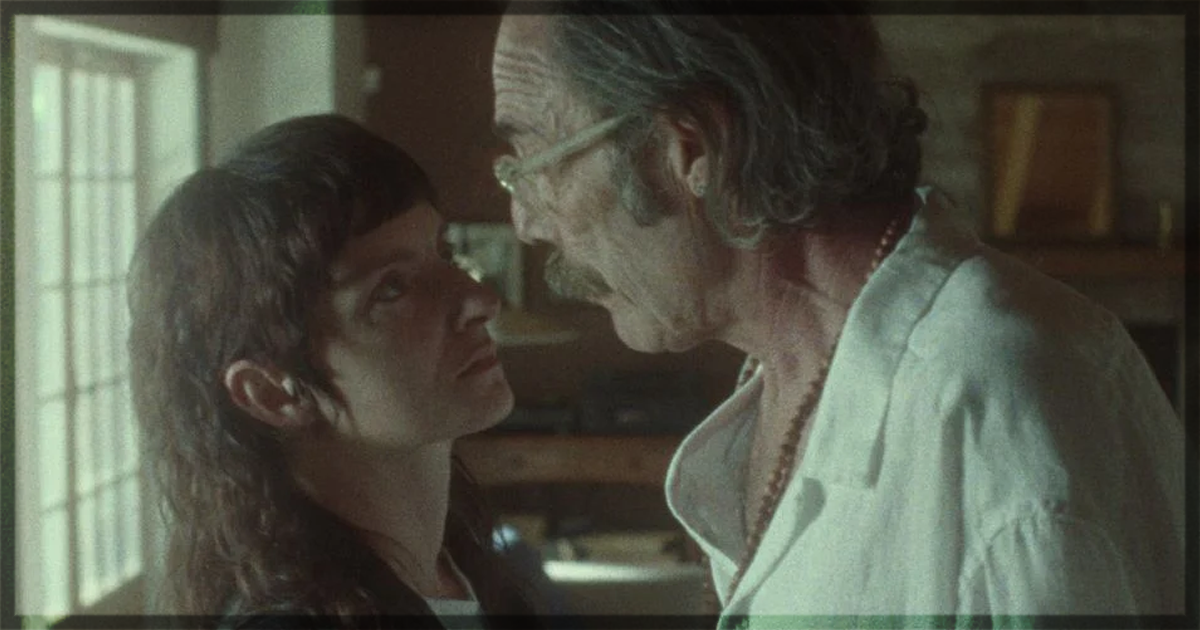
The oeuvre of Denis Côté is uncomfortable, answerless. His multiple works approach the mundane, the psyche, leaning towards complicated places. Paul, his latest film, is a documentary on a simp, a man who pleasures himself through humiliation from women. Now, he returns to the Locarno Film Festival with an intriguing debate on death. Violence du corps de l’autre (Nobody’s Violence) narrates the story of Mira (Larissa Corriveau), a woman who convinces others to succumb to their death. In the first sequence, she talks to a woman driving, begging her to stop the car, park, and drink a liquid, which results in her demise. That is her occupation, her talent: crossing with people and persuading them to die. Côté debates the morality of death through a bleakness that traps its audience; we are not allowed to lean toward a Machiavellian notion of bad and good.
In this sense, the return of the Quebecois filmmaker to fiction carries a timid approach to the simplicity of dying. Living is simple, perishing is complex, sometimes even immoral. Consequently, the thematic axis of the filmmaker’s latest is a complicated conversation about death, the only certainty we have. Still, everything surrounding us is death; natural and provoked. Yet, there is a taboo regarding the provision of a decent death for those suffering, mostly because of natural illness. The director of Mademoiselle Kenopsia acknowledges the roughness of dying. Throughout Mira, we see an agent of death, not the popular portrayal of it as a lady in a black cloak and mask, but as a shy woman in the corner. Promptly, despite the unidimensionality in her construction as a mysterious woman, she holds the mystery of how this service works.
In this aspect, the Côté creates a universe that plays like a cult. People who provide death for those in need, while there are individuals in that society, union, or a third party who carry an energy to them. When Ludo (Phillipe Rebbot) appears, there is a shift in the tonality of it. The hedonism of that person, their ability to create a connection with the others who provide the service, but most of all, he shows an empathy that the others do not. In the sea of hungry sharks seeking blood, Ludo is a sympathetic fish. He shares the ocean with the others; in this sense, the film creates a layer to Mira’s interpersonal relationship with her colleagues. Still, those connections are flawed, faux, and they point towards the necessity of the flesh – both the orgies and affirmations. Mira does not want the killers; she wants to bond with the victims.
Consequently, there are two opposing lines of this construction: Mira’s connection with Ludo and with one of her victims, a young guy, who challenges her to enjoy life. Promptly, there is a dichotomy between the woman who feels nothing most of the time. At the same time, she should feel related to one of hers, but the guy who dances naked and has sex with her is the one who cracks her hard shell. When Mira is feeling alive, the film has a fascinating element: the visual construction, which is based on the dirtiness and the highly perforated film reels, feels lighter at night, when she is with the guy. Intentionally, the director creates an atmosphere of nothing, a lack of sentiment around it. Still, there is an emptiness that gravitates around the project that meticulously crafts discomfort. Mira is out of the space there. But opposed to the connections with that individual, she feels vague, empty.
Ultimately, Côté attempts to construct something more expansive, a discussion about death and the ethics of it. In the first half, the camera is by Vincent Biron, who highly manipulates the perception of the reel to control that reality. At this point, the film is a genuine invitation to reflect on the morals of passing away: what changes when someone else performs it and when the illness does? Even if he does not mention it, the taboo of death lies in the religious rites that surround existence in different societies. The Quebecois legendary director attempts to justify the creation of a commercial outline for people without feeling. There lies the dichotomy, the best reflections of it, between feeling more for those who are not attempting to charm everyone. In most of those moments, Larissa Corriveau nails it as someone apt to perform that activity because she does not feel. Yet, despite the bleakness and the provocation, Nobody’s Violence lands in the middle of the road, between the fascination for its themes and the necessity to provoke sentiment for the dismal aspect of his universe.
Nobody’s Violence (Violence du corps de l’autre) recently played at the Locarno Film Festival.
Learn more about the film at the IMDB site for the title.
You might also like…
‘Princesa Burro’ Film Review: A Visual Charmer, but a Misfire by León & Cociña