
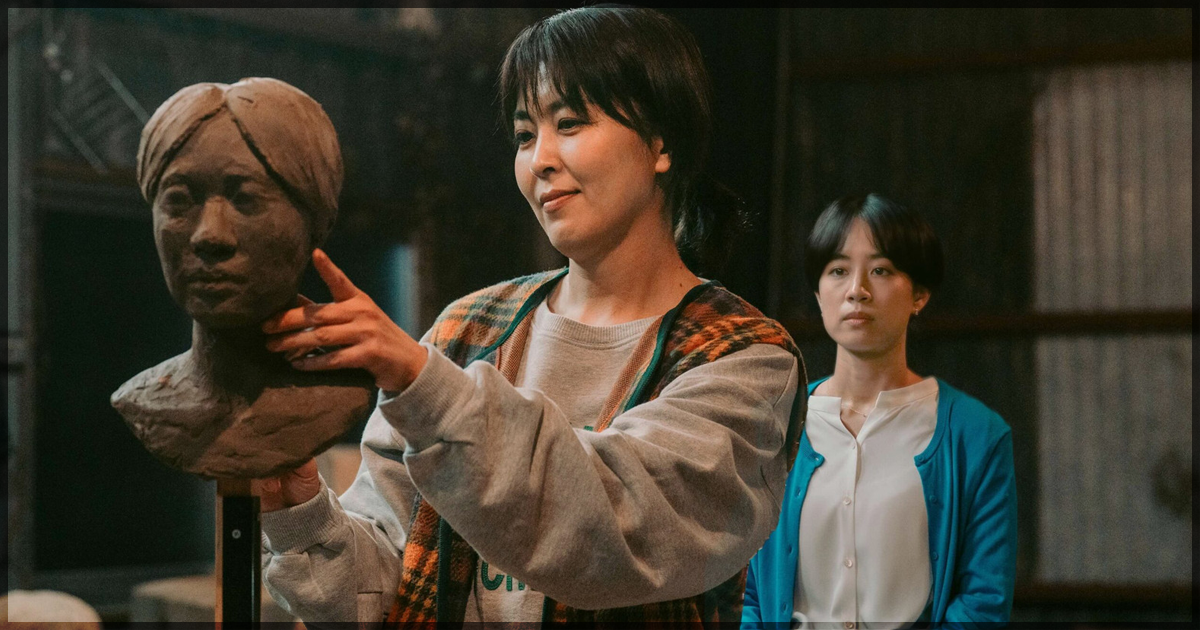
Nagi is a real town in rural Japan. It is next to a ‘self-defence force’ base which uses live ammunition in its training. As compensation for the constant sounds of shooting in the background, the town was given a world-class art museum, the Nagi Museum of Contemporary Art. There is also a daily public-access radio program that among other things warns people when the base will be running its live-ammunition exercises. These are all evidently real facts which contributed to Koji Fukuada’s decision to adapt the setting of a play called Tokyo Notes for this town. Nagi Notes is about two women’s friendship and how it’s affected by a small midlife crisis. Its pace is leisurely but its issues are large, and its kind heart is what you’ll remember.
Yuri (Shizuka Ishibashi) is an architect who has come to Nagi to pose for well-known sculptor Yoriko (Takako Matsu). They have remained friends despite Yuri’s divorce from Yoriko’s brother and are generally very supportive of each other. Yuri lives in Tokyo but knows the town and its people somewhat, most especially teenage Haruki (Kawaguchi Waku) and his father Yoshihiro (Kenichi Matsuyama). Haruki is a keen art student and Yuri has been acting as a kind of mentor to him. In the meantime Yoriko has been kind of a mentor to a friend of Haruki’s, a less happy teenage boy named Keita (Kiyora Fujiwara). He is left to his own devices so much Yoriko lets him help at the art classes she runs, and in which Haruki is a keen student. Yoriko works in wood, at first carving with chainsaws before working down to smaller tools, and Yuri has used the excuse of posing for her as a small holiday for herself. She has not quite recovered her equilibrium since the divorce and needs a friend like Yoriko to spend time with. But with teenagers in the mix, things are never simple.
Everyone spends a lot of time in this movie talking about art, looking at art, thinking about looking at art, and doing all of this with the relentless sounds of gunfire and explosions in the background. But despite the aural vibe not matching up with the bucolic pace of life otherwise in Nagi, this is a calm and thoughtful movie about how people make decisions. Yoriko has become an expert on the properties of different kinds of wood, and the one chosen for Yuri’s portrait has taken three years of preparation to get ready, so her choices must considered without being stultifying. Ms. Matsu makes Yoriko’s sense of self-confidence a palpable thing; Yoriko is definitely in the right place for her self and her work, even if there has been a personal cost, and this comes through clearly. For herself Yuri is at a crossroads and therefore very happy to listen to other people talk, so as to avoid asking herself any tricky questions. Both boys, separately and together, therefore confide in her with relief, though the heedless narcissism of teenagers also has a lot to do with that. But Yuri is smart and open-minded, and takes the boys seriously without losing sight of their youth.
Of course the boys are too young to realise this and think she is treating them as adults. Keita hides behind his bangs while Haruki hides behind his good cheer, and the ways the two of them explore the town together on their bikes is actually very charming. This does not stop Yoshihiro from worrying of course; he is the voice of the public access safety warnings and worrying about the well-being of others seems to be his hobby. He can sometimes take this too far, but the awkward conversation Yuri must have with him as a result is also good-natured on both sides. Everyone here wants everyone else here to be happy. But when there are human beings in the mix, things are never simple.
The leisurely pace of the film builds like the shaping of Yoriko’s statue. It seems like nothing is happening and then a lot does at once. Life is like that of course. Quiet afternoons on a walk in the mountains. A local art performance after which everyone claps politely. An attempt to consider a new perspective on things, in art and in life, to which you’re not necessarily open. And understanding the necessity of making the right choice of what to do with your life, without being crushed under the anxiety about that responsibility. The sense of consideration Mr. Fukuada has brought to the film is unusual, but on the other hand it’s known that paying attention to something is the first step to love. And oddly love is the main sensation of this film – unrequited, lonely, misdirected, yearning love for the most part, but love all the same.
That’s not to say Nagi Notes is perfect. The pace is indeed so thoughtful and leisurely it takes some time to get used to. Western audiences will struggle to differentiate the three adult characters in their heads because of the similarity of their names. Everyone is so proper and polite the whole time you kind of wish some soldiers from the base would pop in and liven things up. The picture of homosexuality here is also so bloodless that it’s downright boring, which is a source of great cheer to anyone who remembers how such things would have been handled in Japanese art even twenty years ago. But anyone at their own personal crossroads will feel like Nagi Notes is holding their hands as they work their problems out, and there’s a great deal of beauty and importance in that.
Nagi Notes recently played at the Cannes Film Festival.
Learn more about the film at the IMDB site for the title.
You might also like…
Modern Folktale ‘Minotaur / Минотавр’ is So Very Brave (Cannes 2026 Film Review)