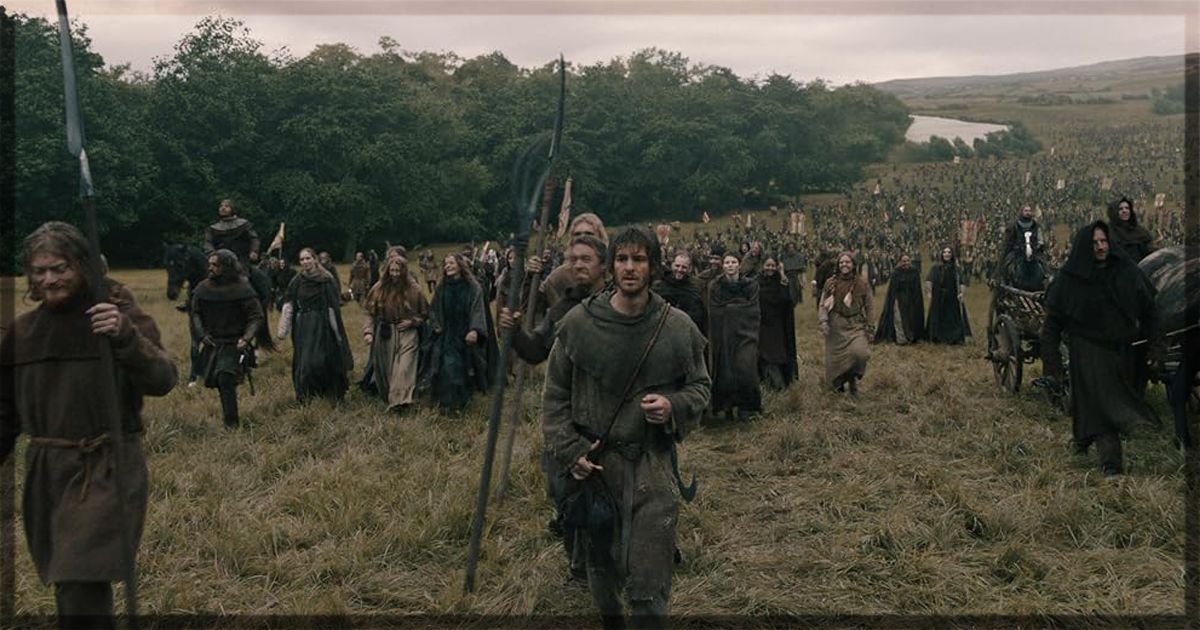
In 1789, Ben Franklin famously wrote that “in this world nothing can be said to be certain, except death and taxes.” The Uprising, set 400 years before the American statesman put ink to paper, sure has an awful lot of both. It’s a story about the 1381 Peasants’ Revolt in England, when ordinary people rebelled against King Richard II and his advisors over high taxes and life as serfs. We follow Andrew Garfield as the Ploughman, our story’s hero. He’s already lost his family to the Black Death and doesn’t have much to lose in resisting the unjust treatment of Richard II’s goons.
It’s hard not to look at The Uprising and draw parallels to modern wealth disparity and working-class frustration. And the fact that we’re not even a decade out from a pandemic makes this even more interesting. If you’re paying attention, you’ll realize, with the script and hyper-specific language that I won’t spoil in this review, that screenwriter and director Paul Greengrass is trying to make a very political statement with this movie.
Andrew Garfield simply does an excellent job as the Ploughman. He carries the grief of his loss in his performance, and the audience feels everything he aches for. In some ways, his intensity reminds me of what Mads Mikkelsen brings to the excellent 2023 film, The Promised Land. The Ploughman faces choices about what to do and what to stand for, and Garfield telegraphs clearly what the character is wrestling with. He doesn’t set out to be an icon at all and the character has no ego. By the end, he is a leader. It’s heavy stuff, and there’s hardly a moment throughout the film where you don’t feel like the Ploughman is in some kind of peril because of his choices. And Garfield brings it home that this man is not a superhero; he’s just an ordinary person putting one foot in front of the other.
Cosmo Jarvis delivers some of the movie’s most impressive acting as Wat Tyler. Tyler is a soldier and has bled for king and country, and Jarvis fully embodies that ethos. The actor has a gravitas and manner that meshes well with Garfield‘s Ploughman. As a viewer, you believe that the Ploughman would trust and work with Tyler. Every moment Jarvis is on screen is riveting. And the young Woody Norman as King Richard II is appropriately both haunted and verging on sadistic.
Similarly, Richard’s advisors are awful and every horrible stereotype you’d expect about government officials. They are selfish and arrogant and look down on the very people they’re supposed to care for. Tom Hollander, Stephen Dillane and Stanley Townsend bring their disdain, treachery, and greediness to life in a very visceral way.
It’s a shame because there is some great dramatic skill on display that’s totally destroyed with what Greengrass offers as a director. It’s impossible not to note his signature shaky camera style throughout the film. What worked for the Bourne movies, United 93, and Captain Phillips doesn’t fit at all in medieval England. For a lot of the film, it was distracting and broke the cinematic immersion. The frantic cuts rob the audience of the chance to absorb these dramatic performances. Similarly, at moments that are burdened by that insanely shaky lens, The Uprising feels endless. Two hours and 8 minutes is simply too long a run time when some of the footage doesn’t actually advance the story. A tighter cut (and maybe some Dramamine) would have done the performances justice.
And that dovetails into the next point – if you are squeamish at all, The Uprising is not for you. There’s a lot of blood; after all, the film is about a rebellion. At one point, there’s so much violence happening in the city of London that it’s hard to watch. It is excessive and bogs the story down. It’s a stylistic choice for sure, but by trying to force modern docudrama grit into medieval warfare, it makes the action unwatchable.
Interestingly, there was a point in the film’s marketing where this was sold as a Robin Hood prequel. While the elements of the classic story are there if you squint enough, the actual history that the story offers doesn’t need to be dressed up with a hastily tacked-on final scene to be compelling.
The acting and craft behind this film are so stellar that it’s almost possible to overlook the pacing, the gore, and the shaky camera style. Almost. But Greengrass undercuts his own actors and lets relentless camera frenzy and overlong pacing turn the story of historical rebellion into an exhausting theatrical slog.
The Uprising is now in theaters.
Learn more about the film at the IMDB site for the title.
You might also like…