Company is directed by Casey Affleck, whose reputation as an actor is not unblemished, and whose reputation as a director will not be helped by the fact there are eight (eight!) credited cinematographers on Company, including himself. It is also not necessarily a positive thing that two of the movie’s stars are his partner Caylee Cowan and his younger son Atticus Affleck, with his older son Indiana Affleck in a smaller part. But Mr. Affleck co-wrote the (original) screenplay with Ron Hansen, which was a very smart decision. For Mr. Hansen is the novelist who in 1983 wrote The Assassination of Jesse James by the Coward Robert Ford, and whose import into creating the mood of its film adaptation in 2007 was so strong that pieces of the text were lifted wholesale into both dialogue and narration (even though Andrew Dominik did not share credit for the screenwriting). As a result, the ways in which Company creates mood is so utterly fascinating that in my professional opinion it’s very much worth a look.
I have read most of Mr. Hansen’s novels, and his unusually powerful area of expertise is showing how people cope with loneliness and yearning in unforgiving landscapes. Sometimes that’s in war, in other times that’s in confinement, and most famously it’s in how people cope with the relentless hard work needed to survive on a farm. For he also co-wrote the screenplay for 2020’s The World to Come which also starred Mr. Affleck, which was not terribly successful on plot but absolutely brilliant on mood. And the mood in Company, of a story within a story within a story, combines all three of Mr. Hansen’s areas of expertise into a piece that perhaps needed the commitment of an entire family to get made because of the importance of its tone.
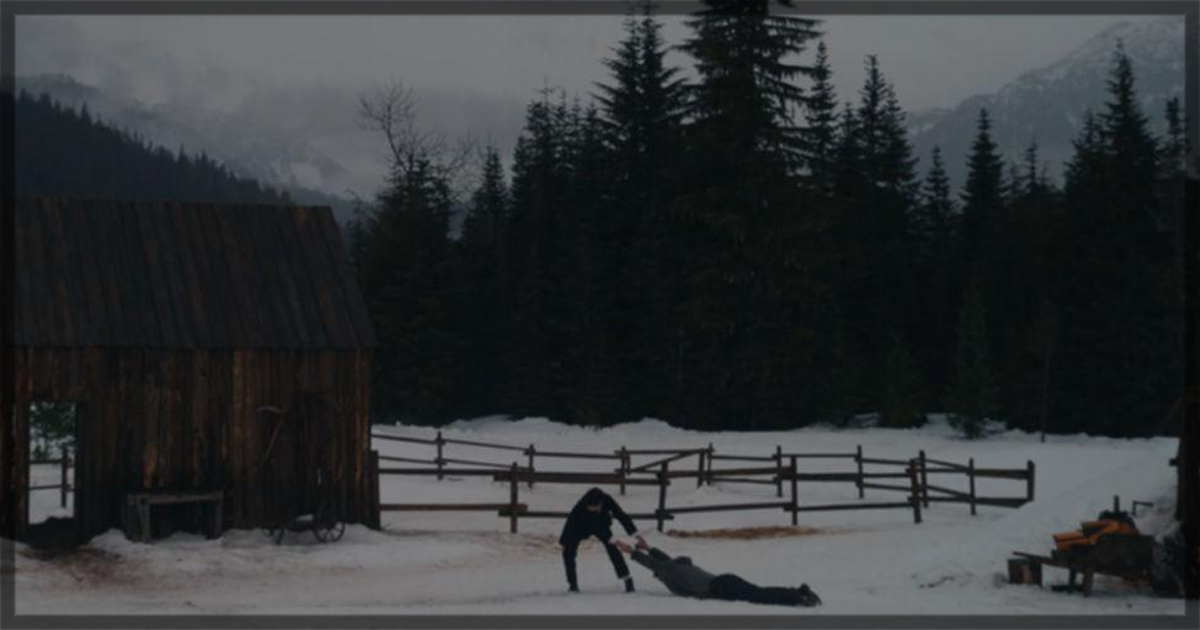
In the 1970s a stranger named Evelyn (Emily Alyn Lind) shows up at a Christmas party in a rainstorm where the hosts take pity and welcome her in. The guests take a polite interest and to repay everyone’s kindness Evelyn begins telling a story she learned from her grandmother. It’s about a hermit in the woods of the American west (Nick Nolte) who finds an unconscious woman on his land and takes pity on her. That woman is called Alice (Ms. Cowan) and to repay the hermit’s kindness, she tells a story she learned from her grandmother, of a farm couple also in the American west, Rebecca (Adelaide Clemens) and Emmett (Scoot McNairy) who themselves take pity on a young man called Caleb (Mr .A. Affleck). [Sidebar: I might as well point out right now Caleb is Casey Affleck’s government name.] It becomes clear that Rebecca’s kindness to Caleb in keeping in around on the farm, which Emmett is not so keen on, will have unforeseen consequences. And echoes.
Well, the consequences were unforeseen to about half of the Venice Film Festival audience, who gasped aloud at the major plot twist. The other half had an inkling. It’s not all handled perfectly. But this is a mood story and the mood absolutely is. Mr. Affleck absolutely has us hunkered by the fire, warm and safe from the weather, a rapt audience listening to a woman tell a scary story. If some of the audience feel above it, or scoff at the twists, or even saw the twists coming, that is not his fault. The point of such experiences is to be experiencing them, to be feeling the things the storytellers make us feel, and to judge whether or not those feelings are landing as the storytellers intended.
Mr. McNairy is a mark of quality for any project he’s involved in. He makes really interesting choices and knows how to make his underlying sense of decency and charm work for him in whichever direction he wishes to push it. Ms. Clemens, who got her start as a teenager in prestige Australian television but who is little-known elsewhere in the world, gets to make a major impression as a woman who knows the value of her good heart and is willing to go very far to ensure other people do the same. Ben Mendelsohn as their neighbour, who is so eaten alive by his loneliness that he can no longer think clearly, has the good fortune of his face and reputation doing most of his work for him, as Mr. Nolte also gets to do.
More importantly, Atticus Affleck bears an obvious resemblance to Timothée Chalamet, and the notes of petulance and thwarted ambition in Caleb echo a great deal of Mr. Chalamet’s recent work. But young Mr. Affleck is also the nephew of River Phoenix, who had an extraordinary gift for quiet longing and whose horrible sudden death at the age of 23 deprived us of a great actor. (It remains a lovely and elegant tribute that his siblings were able to keep their pact of each naming their own oldest sons after him, as Indiana Affleck is.) Critics who were not old enough to see Mr. Phoenix’s work in a cinema will not be forcibly struck by the family resemblance there, and they will therefore miss some of the echoes that this entire film is wrapped around.
For Company is a movie based on echoes, on memories of better times and on the hope those echoes and memories will convince others to take pity. This entire film is Casey Affleck’s attempt to apologise for his bad reputation and ask if he can be allowed back beside the campfire. He doesn’t want much, maybe one or two sympathetic listeners who understand how a mistake can derail an entire life and who will take pity, if only for a night. That I cannot judge, of course; a film critic is not here to review the personal lives of the filmmakers, though our knowledge – and whether or not somebody’s Wikipedia page has a long section labelled “sexual harassment allegations” – does have an impact on our reception of their work. Sometimes loneliness and yearning is well deserved. But sometimes the past should stay in the past, and everybody gets to make their own mind up on that. That part is not for me to judge. What I can say is the hunger within Company for someone to take pity and enable a fresh start is as clear as a bell, and the power with which is makes it points is undeniable. Whether or not anybody wants to open the door to this is up to them.
Company recently played at the Venice Film Festival.
Learn more about the film at the IMDB site for the title.
You might also like…
Our Dumb Present is ‘Digger’ but Not Our Dumb Future (Film Review)