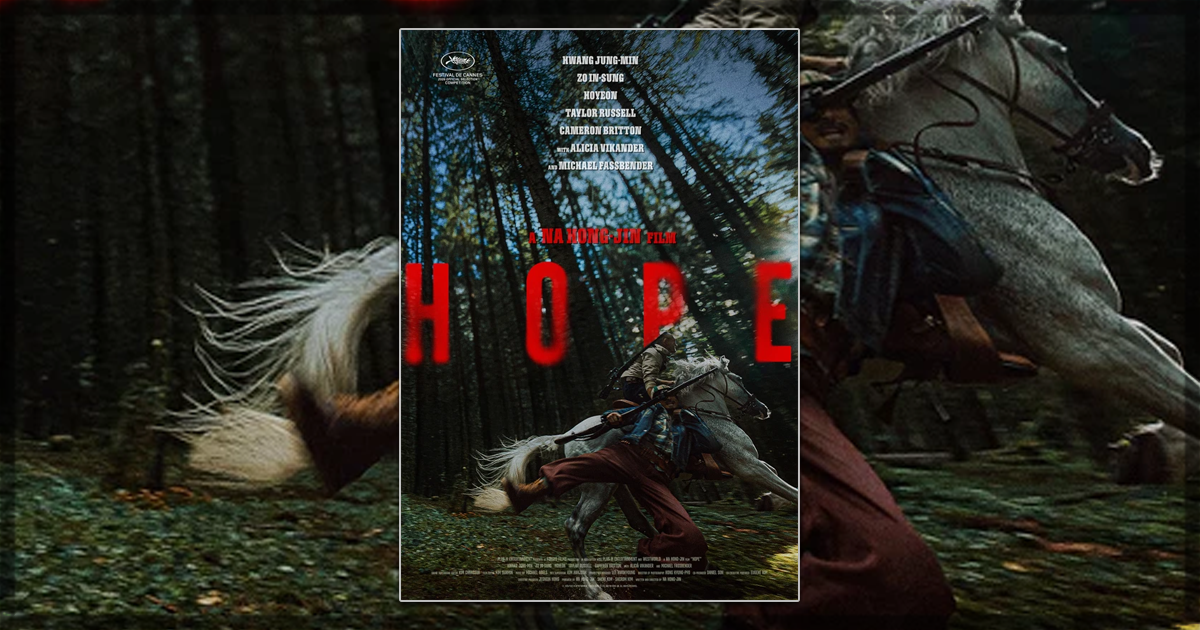
Film festivals can be a little too intellectual sometimes. There is of course space in movies for people giving each other lectures on why capitalism is bad (something that featured in an awful lot of films at Cannes this year). But those movies are rarely a good time, and most people go to the movies mostly to be entertained. It’s an awful lot more fun to watch a man on horseback riding for his life through the woods while screaming obscenities and trying to machine-gun the thing chasing him. Hope is not a perfect film – it’s overlong and seems to be setting up a sequel more than anything else. But if you just want to have a great time watching a bunch of good-looking people having an implausibly bad day, Hope could not be improved. And you don’t have to be an intellectual to know it.
Bum-seok (Hwang Jung-min) is the police chief of Hope Harbor, a remote fishing village near the border between North and South Korea. It’s the kind of small town where the inhabitants are either roughneck fisherman who go hunting on their days off, or elderly people with nowhere else to be. Sung-ki (Zo In-sung) is one of those roughnecks, but when he and his buddies find a bull that’s been murdered in an impossible way, he calls his cousin the police chief. Bum-seok and the hunters agree that there’s no way a bear could have done this, but maybe a tiger could have. So the hunters go into the woods to see about bagging that tiger, and Bum-seok heads back into town to warn the others, chatting to his deputy Sung-ae (Hoyeon) on the way. But help is not coming: wildfires have diverted other resources from the area and the phone system is down. Whatever is out there, our heroes will have to face alone.
It is not a spoiler to say that the thing in the woods is not a tiger, nor it is a spoiler to say that there’s obviously more than one of them. But to say anything else would spoil the fun, as Bum-seok tries to stay alive in the village, and Sung-ki and his friends in the woods find themselves the prey. There are two different monster movies happening here, and for the first hour or so the pace is perfect. Bum-seok is scared out of his mind, dropping as many shotgun shells as he manages to load, but he’s also a good cop. The village residents have enough unregistered weaponry and ammunition to last for months, and are very, very keen to get involved in the shoot-em-up. At first Bum-seok chastises everyone for their alarming attitudes until even he realises he’s missing the point. All the panicked running around, seeing blown-apart buildings and people getting killed without seeing the monster itself, is handled to absolute perfection. The section after the big reveal is much messier – there are literally chainsaws involved – but then the focus pivots to the mystery in the woods and just how bad things are really going to get.
Writer-director Na Hong-jin also does something Hollywood doesn’t bother with anymore: it makes all its characters human. Bum-seok pauses in the middle of a firefight to gulp down water from a bowl at a food stall, and when Sung-ki sees a fresh riceball at a campfire he takes several bites. Sung-ae makes a frantic bike ride across town to deliver some news, meaning when she arrives everyone has to wait until she catches her breath. The monsters smell awful, and there’s a lot of discussion of just how bad; “rotting fish and feces” is the general consensus. Best of all the revered elderly wild-ginseng hunter makes a detailed police statement about what he saw in the woods while he was also in the middle of a fit of diarrhea. The genius of this l-o-n-g speech is how very funny this genuine brush with death is. (“I’d have died,” Sung-ae says in disgusted sympathy.) The use of tropes is also handled very well: Bum-seok’s empathic panic and bad aim contrasts with Sung-ae’s by-the-book efficiency and skill as a shooter. The men in the woods don’t have a lot of time to chitchat, but they are all such clearly defined people, both in costumes and in tone of voice, that we always know exactly who they are. And this means when they die we are sorry, too.
Hoyeon’s slow-motion introduction, when she gets out of a cop car with a gun practically bigger than she is, will have quite an impact, but Sung-ae’s righteous indignation and fighting spirit is what people will remember. Mr. Hwang has a wonderful time prowling through various destroyed sets and showing what courage is. The production designers must have had an equally wonderful time figuring out all the different ways to show the mayhem and destruction; we see so much of the village it feels like a real place horribly torn apart. Alicia Vikander and Michael Fassbender also lend their talents to parts which must not be spoiled (and which I suspect will feature more heavily in a sequel, should there be one). And Mr. Zo, who has worked quite a bit in Korean television, is now a great big movie star, just for getting back up on his feet in the middle of a bad fight he’s badly losing and saying “That didn’t hurt a bit.” It’s a real pleasure to have heroes who are just ordinary people doing their best, and fortunately they’re good at their jobs, want to stay alive and also pay attention to each other’s feelings while they’re at it. Who knew the monsters would bring out the best in everybody who manages to stay alive? Well, maybe that’s just what Hope is. And my goodness is it fun.
Hope recently played at the Cannes Film Festival.
Learn more about the film at the IMDB site for the title.
You might also like…