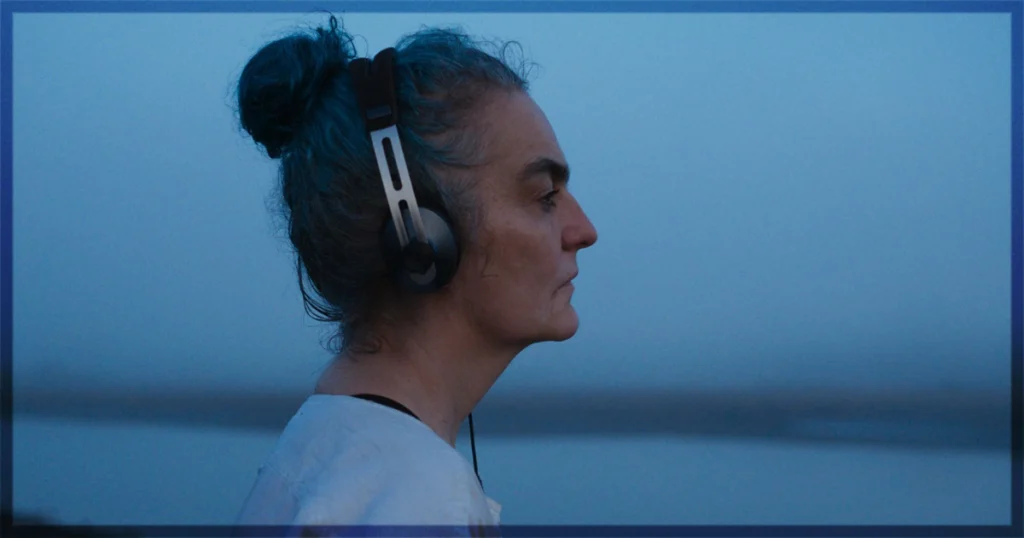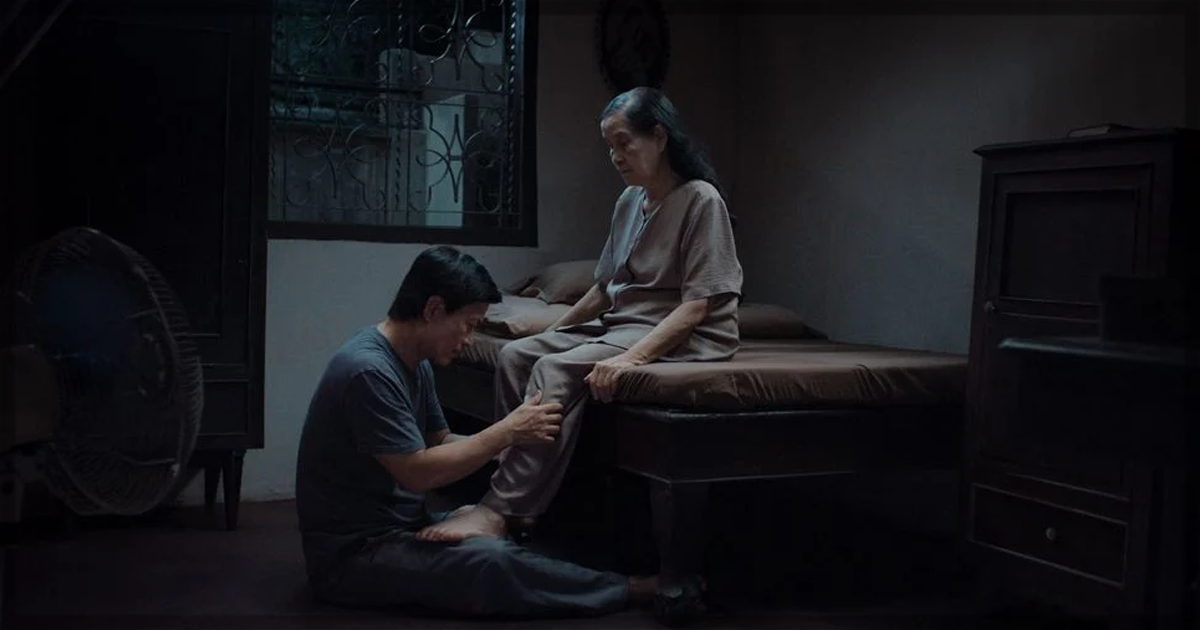
Following the trend of selecting young filmmakers in the competition, as with Nelson Yeo’s The House on the Moon, Locarno also presented Lê Bảo’s Hearing (Thính Giác) in the main section. The project is a continuation of his works involving the senses; he released Scent (Mùi) in 2014, and Taste (Vị) in 2021. In his latest project, the director tells the story of Ninh (Quốc Tuấn), a divorced individual who now lives with his mother. He works as a mechanic for a business that installs decibel meters in public spaces and homes. He misses his ex-partner and their children, but also wants her mother and father to reconcile. The film traces his life trajectory while he lives mostly in silence, reflecting on the past and present.
In this sense, Bảo opts for a slow-burn narrative of silence. As the title suggests, listening is utterly vital to Ninh. After all, he works installing equipment that measures sound intensity in decibels and classifies it on a scale; 60 dB is a normal conversation, 120 dB is a painful level. There lies a fascinating contrast to the execution of the idea. The director chooses silence in most of the sequences. In this regard, the film appeals to sensorial cinema, a concept popularized in Asian cinema that shifted the focus from fast-paced cuts to contemplation. Tsai Ming-Liang and Apichatpong Weerasethakul populated the early 2000s arthouse circuit with their films. The latter reached festival glory by winning the Palme d’Or with Uncle Boonmee Who Can Recall His Past Lives, a film of the senses and about the passing of time. Bảo leans more toward this territory than a traditional narrative space, where the film needs to follow a preconceived structure. The young Vietnamese author goes for the more flowy option, where the story serves as a passage of time.
If in Taste, the director portrays the reality of a football player who breaks his leg and cannot play, then Scent revolves around a pregnant woman who receives an offer to sell her fetus, and Hearing is about the distance created by the inability to speak properly. Both situations in the lead character’s life revolve around relationships broken by poor communication, either his parents’ or his own. The title suggests a sense that is intrinsically vital for his circumstances. Ninh’s life depends on his hearing; he installs equipment to protect it.
Instead, in his personal life, everything else collapsed because people were unable to talk properly with one another. It is a fascinating dichotomy between his work and his personal life. As with most people, the work you do might be the exact opposite of your life. The reality is not plain; there are nuances to it. Then, Bảo presents one of those cases in which the protagonist is a simple man living day to day, lacking a broader perspective on his existence. In his case, he misses a dream or hope for a future that is different from the one he lives now.
Visually, the work is by Nguyễn Vinh Phúc, who worked with the director in Taste, and Phạm Ngọc Lân, another crucial Vietnamese director in the international circuit. The cinematographer decides to portray shadows and darkness that, poetically, reflect the character’s current situation. Another amazing portrait is of a woman lying on a mountain with two children, with fog over them. The camera here tends to document the sensorial, the glimpses of the dark streets when he is working, or the fog in the air. It connects to the sound work by Vincent Villa, Florian Penot, Teo Wey Yinn, Vince Van Driesten, and Sreynith Ros, which is crucial to the film as a whole. We hear the immensity of the daily sounds through the Foley work, which highlights the filmmaker’s intention to use sound to symbolize everything listening means to the character.
In this sense, there is much to admire in the film’s construction. Still, it is a film that demands your patience with each bit of it. It slowly unfolds, which suggests it might not pay off. Still, the visual atmosphere reinforces the sense of separation and the inability to speak that Lê Bảo introduces throughout. Hearing (Thính Giác) crafts a story about the contradictory nature of that man’s life: he installs equipment to protect people’s hearing, yet cannot speak properly around him. The director continues his studies of the senses, constructing a trilogy based on dilemmas and tough challenges in one’s life. As a feature, it might drag in parts, but the young filmmaker creates something truly compelling.
Hearing (Thính Giác) recently played at the Locarno Film Festival.
Learn more about the film at the IMDB site for the title.
You might also like…