
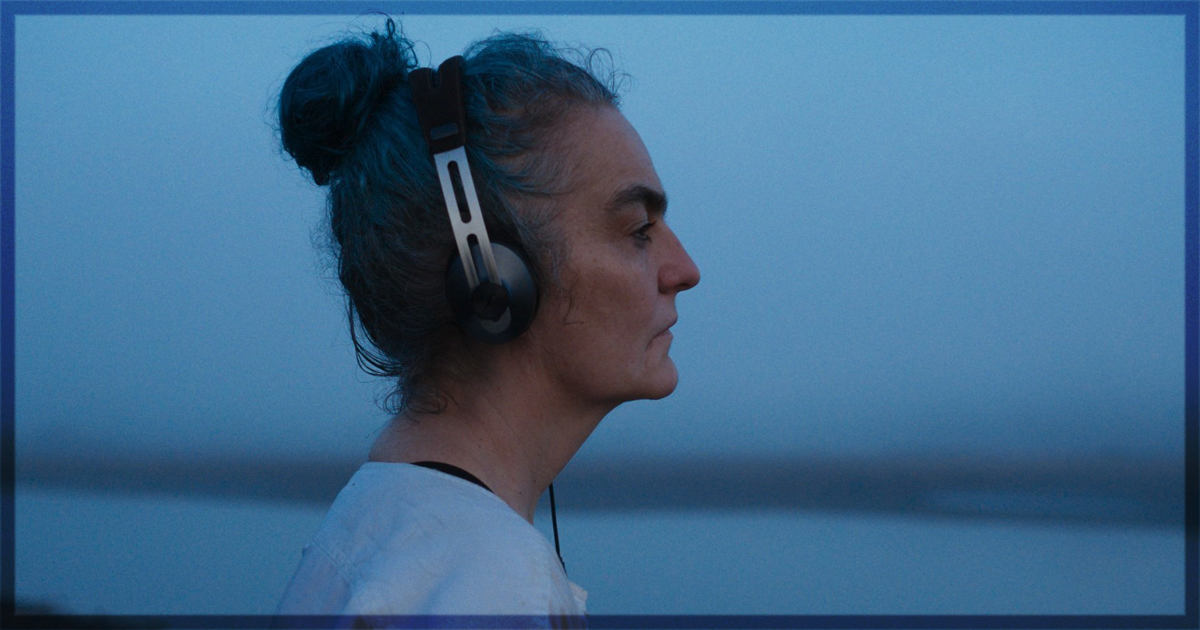
In 2018, the Spanish director Meritxell Colell Aparicio presented Con el viento (Facing the Wind), which played at the Berlinale Forum section. Four years later, she presented Dúo at the Málaga Film Festival. Now, she has been upgraded to the Locarno Film Festival competition with her latest work, Far From the Trees (Lejos de los árboles). The film portrays the story of Adela (Angélica Castelló), a Mexican sound artist who travels to the Peruvian interior. She travels from the jungle to the Peruvian Andes, alongside Lucho (José Luis López Cama), her guide and translator. She is traveling to follow the legacy of her grandfather, who was an exiled man in Mexico. Adela documents the languages spoken in this trajectory, creating a sound map of endangered tongues. Thus, the trip is a connection between her past – her family’s history- and her interest in soundwaves.
Fascinatingly, the director captures the trajectory of a woman seeking to understand her family’s history. At first, the film is highly personal. The director describes it as a manner of saying goodbye to her grandparents, since she has not had the opportunity to say a farewell. Colell Aparicio finds in the film form a way to pay a homage to them. Therefore, in its execution, the filmmaker uses two different formats to encompass memory: digital and 16mm. Shot by Julián Elizalde, the project takes on an aspect of worn-out memory, especially in the film portions. It creates a texture of the woods, which the cinematographer beautifully portrays. The film inflicts a sense of realism on that trajectory; there is a lot of visual effort to document the hardships of that path, from the woods to the mountains, a meandering route.
In this sense, there is a sentiment of overcoming the difficulties glued to that mission. The Andes are the largest continental mountain system in the world; they span seven South American countries: Argentina, Bolivia, Chile, Colombia, Ecuador, Peru, and Venezuela. Each country has its own segment of the mountains, with its own difficulties and influences on the region. In this regard, the director portrays Adela as suffering from those conditions, which differ from her usual state. Visually, the situation recalls William Friedkin’s Sorcerer, adapted from the novel by Georges Arnaud, which also inspired Henri-Georges Clouzot’s The Wages of Fear (Le Salaire de la peur). The transportation difficulties caused by crooked roads and bridges are very similar in the three films.
Yet, those classics are utterly different in content from Far from the Trees. While the first two are survival thrillers that narrate the duty of hired men to transport dangerous cargo on risky highways, the Spanish work is a contemplative look at the hardships of the path as a metaphor for a greater purpose in life. Adela looks at the trip as an homage to her grandfather, a republican who fled to Mexico. Still, she turns that trip into a fascinating collage of sounds that generates a sound map of languages on the verge of disappearing. On the other hand, Angélica Castelló imbues her character with a highly humanistic performance, almost as if on a religious pilgrimage during that voyage. Being in Peru is a point of connection to her past, one much older than her existence, which shaped her entire identity. She is in search of that understanding, and Colell Aparicio frames the film through a philosophical lens, which lends it value.
As a whole, Far From the Trees feels like a contemplative film that combines the director’s documentary filmmaking roots with a fictional work. Yet, it combines many elements of reality and fiction, creating a fascinating juxtaposition. Castelló plays a sound artist, while also being one. It led her to record the film’s soundtrack while portraying someone who also works with sound. Also, there is an indirect link to another film of the same name, a 1972 travelogue by Jacinto Esteva Grew that exposed the poverty of Spain’s interior. It was shot in 1963 but released only nine years later. Somehow, Meritxell Colell Aparicio is doing the same here. She is documenting the country’s profound interior while commenting on the political necessity of the lead character’s grandfather fleeing. It also happened in Spain with the dictatorship of Franco, which killed and forced many opponents to leave.
In the end, the young Spanish director combines fiction and non-fiction to create a realistic portrait of the Peruvian interior. It demands patience from the audience, which is floored by the beauty of that contemplation. Also, it allows Angélica Castelló to shine as both a composer and an actor, drawing on her experience to enrich the character.
Far From the Trees (Lejos de los árboles) recently played at the Locarno Film Festival.
Learn more about the film at the IMDB site for the title.
‘Hanabi’ Film Review: Post Nuclear Disaster