Using the court system as a way to discuss societal problems has been a mainstay of television around the world for decades. Yet since Anatomy of a Fall gave the world an clever, multilingual mystery, the court system has suddenly become just as popular a technique for movies to address societal issues. This tactic has been so popular that Fjord has just won the Palme d’Or at this year’s Cannes Film Festival for it, but the prize was a mistake. Fjord uses the framework of a family court case to make an apologia for child abuse and demand that so-called liberals allow such abuse in the name of religion. There is no mystery here, and to pretend so is offensive.
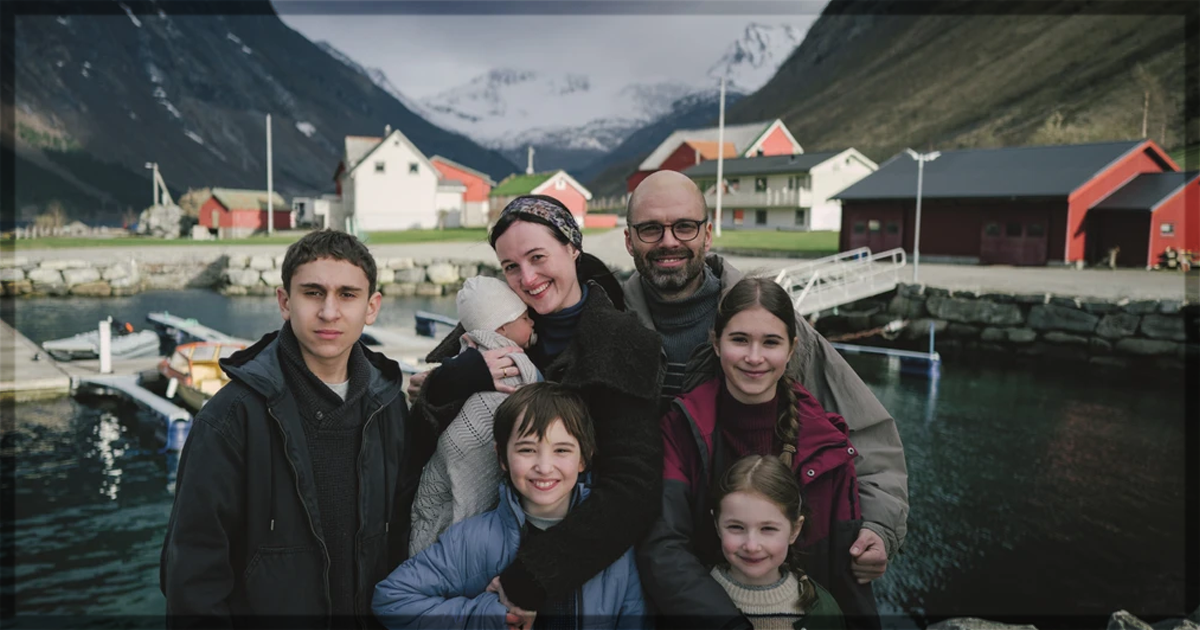
Norwegian Lisbet (Renate Reinsve) is married to Romanian Mihai (Sebastian Stan). They speak English to each other and belong to a small and conservative Christian church, the precise denomination of which and belief systems of are never specified. Well, except that homosexuals are going to hell. They have five children, Emmanuel (Jonathan Ciprian Breazu) who is maybe thirteen, Elia (Vanessa Ceban) who is maybe twelve, two younger ones, and a baby. The family was living in Romania until some deaths in the family and a job offer brought them to a small village in Norway, closer to Lisbet’s family. Mihai starts working in IT for the local government. Lisbet, who covers her hair, works part-time in the local old folk’s home. The local school is avalanche-proof, happy to use English to get the kids settled, and its headmaster Mats (Markus Tønseth) lives next door to the Gheorghius. He is married to Mia (Lisa Carlehed), who used to be a lawyer, and they have a difficult daughter, Noora (Henrikke Lund-Olsen) who is Elia and Emmanuel’s age. Noora is the kind of child who says she’ll slit her wrist if Elia and Emmanuel don’t immediately do something she wants, and then immediately does it. Mats and Mia find the Gheorghiu kids a calming influence on Noora, but Mihai, who doesn’t speak Norwegian, doesn’t like Noora hanging around. It’s mostly through Noora’s eyes that we see the only glimpses we get of Lisbet and Mihai’s parenting, until the day Elia shows up at school with fresh bruises on her face and back. Lisbet hit her.
Writer-director Cristian Mungiu is purportedly exploring how culture clashes manifest in how people raise their children. But the legal proceedings do not dwell on whether Romanian parenting, which allegedly sees no harm in occasionally hitting children, is different to Norwegian parenting. The issue becomes whether the Gheorghius have the right to raise their children within their religion, which allegedly does allow physical punishment, even if this goes against the beliefs of society as a whole. At no point do the opinions of the Gheorghiu children come into it. At least in court the prosecutor for the state (Christian Rubeck) invites Mihai to slap him, to see if that might change his own mind about whether hitting other people is okay. Mihai refuses the invitation, claiming he is not responsible for the prosecutor, but this misses the point. In fact the whole thing misses the point. There is no mystery like the one in Anatomy of a Fall, in which it was equally plausible that the wife either did or did not kill her husband. It is settled fact that Mihai and Lisbet hit their children. The mystery is whether wider society will accept that this specific family’s religion allows this.
When the kids are brought into foster care, the older ones stay connected to Noora through a secret cellphone that nobody notices, even though it’s emphasised the kids are not allowed to use computers or cellphones, even to watch videos on YouTube. After Mihai gets so aggressive after a court hearing their lawyer quits on the spot, Mia agrees to take over their case. This is apparently because the Gheorghius are good neighbours, hitting your kids a little is no big deal, and Noora misses Elia so much what else is a mother to do? One might have thought public anger from a man facing a criminal trial for child abuse would have different consequences, but that’s not what Fjord is interested in. It doesn’t care about how the kids find either their home life or foster care. It doesn’t even care whether Mihai has ever been violent with Lisbet, or what their actual religious beliefs actually are. It cares so little that Lisbet and Mihai only have one brief scene alone together, near the very end. Instead there are recurring discussions about how Lisbet can supply breastmilk for the baby. Mihai takes to social media to claim the family are victims of religious discrimination and gets journalists and activists as well as the Romanian embassy involved. All we are left to know for sure is that their beliefs are different to that of the social services and child protection teams, and both sides believe their way is the only right one.
Tudor Vladimir Panduru’s camera emphasises the great beauty of the area through shots which largely hold their distance. There’s a recurring motif of the hymn “Amazing Grace,” but Kaspar Kaae’s score is used sparingly, probably to emphasise we’re supposed to make up our own minds about what’s happening here. The set design is sarcastic: when Lisbet has the first conversation with the social workers, an enormous Norwegian flag in their yard waves in the breeze behind her. Ms. Reinsve and Mr. Stan bring their star power to their empty parts, and allow that star power to provide characterisation where otherwise none exists.
The ambiguity about what the Gheorghius are actually like as a family is being taken to mean that the screenplay is good. That is not the case. Mr. Mungiu chose to hide the true nature of Lisbet and Mihai’s beliefs, and made that lacuna the mystery. But if Lisbet and Mihai’s religion is so meaningful, then the movie should have articulated that meaning. Allowing people’s strong emotional reactions to this emotive subject to fill in the blanks about what their beliefs are – other than physical punishment and hatred of homosexuality, of course – is as cynical as you can get. Fjord can claim to be about religion, and it can claim to be about culture clashes. But it is actually a backlash to the facts that children are not the property of their parents, and that people of every age have the right to go about their lives in physical safety. Fjord is a hateful movie and giving it the Palme d’Or was a hateful choice.
Fjord recently played at the Cannes Film Festival.
Learn more about the film at the IMDB site for the title.
You might also like…
‘Via Negativa’ is Lonely and Lovely (Tribeca 2026 Film Review)