Christopher Nolan may have made many a release that is regarded as his best; and that’s the telltale sign of a good director. You get debates over The Prestige, Interstellar, The Dark Knight, Memento and more, but one film that doesn’t crop up as often as it should is Dunkirk. The world-war-two drama about the ‘successful failure’ that was the British army’s rout from Dunkirk by the Nazis in World War 2 in 1942, before the Americans joined the war and when the British stood alone in Europe against the Germans. Part of this film’s success is built down to the fact that we simply never see the Germans, not once, until the very end when they surround Tom Hardy’s downed plane do we even hear them – outside of the gunfire, outside of the faceless bullets, outside of the ever present time motifs of the ticking clock that Nolan is oh-so-fond of using – the threat is there, the danger – the sense of palpable relief and emotion whenever there is a small win – this is a film that for all intents and purposes, captures a wave of emotion more effectively than most Nolan films – for all his perceived coldness – Dunkirk succeeds in more ways than one.
The British are trying to get as many men off the beaches of Dunkirk to their home soil as possible. Our characters are nameless cogs in the machines of war; numbers, not people – stripped down to their bear minimum and forced to survive.
One of the best accomplishments of Nolan is getting an in-point performance of Harry Styles as an everyman out of this – he has never looked more at home as a soldier caught out of his depth braving survival. The use of practical effects; real planes, real boats, real beaches, Nolan’s trademark – adds to the danger – incredible editing and sound design anchoring the film at every turn. Zimmer’s score is unique; anxiety inducing and capable of creating tension by itself, the dread and despair anchored by the need to get out, get gone, leave now is frightening. The crashing wave of euphoria that comes when you hear ‘Home’, and the efforts of the ordinary arrive to save the day feels more real and more earned than most superhero entrances in recent years, because these are people – asked to do the right thing. It is not pulp fiction but a disaster movie in human form – a story of its own, and a warning to tell.
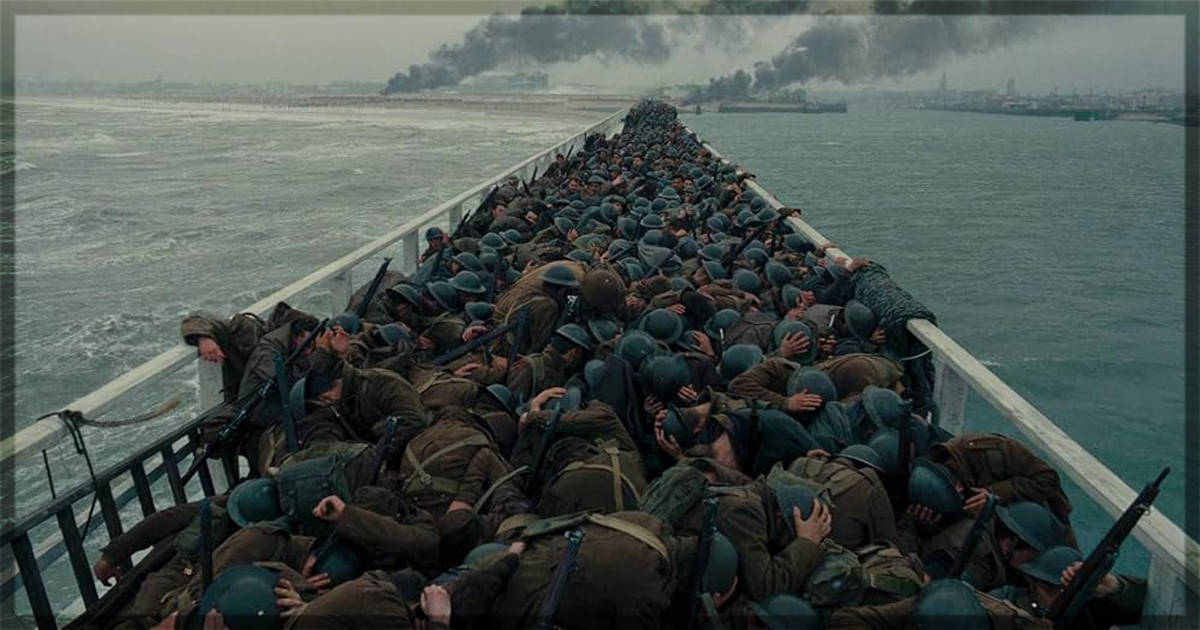
The blazing big screen-essentialism has followed Nolan right the way through to recent release The Odyssey – a big marketing pull around IMAX was showing audiences what was left off the screen for IMAX vs what was visible with it – but the beachscape really shows a way of shame and failure follows these men from the off. “You can practically see it from here” / “See What?” / “Home” – follows the sense of yearning for escape that they have, the sense of being ‘so close, yet so far’. The tide is coming in as the bodies come washing back, and the safety of the white cliffs of Dover adorn the background.
They are stripped down and met with the prospect of defeat, of humiliation – Britain’s darkest hour, playing to Nolan’s strengths of not being able to write women well by barely having any of them there. It’s Zimmer’s best score – devoid of the Inception loud, deafening bangs, but instead, a dive bomber-scream and turning of the tides are felt that aid the tension and exist a character onto itself. Artillery is turned up loud, the bombshells and the threat from the off is created by the posters being littered down on display for all to see – the Germans are all around you – there is no escape – if you were somehow unaware; this could almost be a horror movie. There is in parts, elements where Dunkirk feels like a horror movie – stripped to its core and terrifying in is prospects. Yet to the same time it’s typically Nolan, massive in scale, focusing on the underdog redemption in disaster.
The gripes that follows Nolan’s films are absent here. The bloated runtimes and poor characterisation that follow his weaker films aren’t an issue; a beloved cast of talented actors like Cillian Murphy, Kenneth Branagh and Mark Rylance all give the depth that the roles require. Hardy is effortlessly cool and Jack Lowden too, now a favourite for Bond and a Slow Horses star, applies an earlier career role marvellously. These actors all believably play terrified soldiers and Nolan’s greatest achievement may be getting a stadium-level popstar to appear ordinary.
The opening is tense right from the off – Fionn Whitehead’s Tommy leads a charge with a friend under heavy fire and bad-dream chaos, carrying a wounded man in a bid to escape, only to find himself back on the beach whilst RAF pilot Farrier (Hardy) engages the enemy overhead en route to protect the beleaguered soldiers who have no air support preventing them from being picked off below. There are callbacks to films like The Cruel Sea to The Great Escape. But devoid of any boy’s own charisma this is something of despair; and Murphy’s traumatised soldier who endures something terrible further still – a matter of accident in war – showcases the strength of the everyman. The home front eye view from Mark Rylance is fantastic – and whilst the battle may have finished before Dunkirk even started it is anything but.
Films like Atonement and Saving Private Ryan and more recently De Gaulle: Libertie; the second part of a two-part drama about the French General De Gaulle, have focused on either Dunkirk itself or D-Day with intense measure of brutality and fame. Yet these have been parts – rarer still have whole films been devoted to Dunkirk and the subject matter of it. It feels like it owes as much to Napoleon and the silent films of the 1920s than more modern work, stripped down to bear essentialism dialogue, no “well that just happened” blockbuster humour. Immersive and stripped down with Hughes’ Hell’s Angels and All Quiet on the Western Front as inspirations, the 1930 film, and in turn, we’ve seen the Edward Berger remake come out since take inspiration from Dunkirk in tow, mimicking Nolan’s essentialism. Films like 1917 and Hacksaw Ridge have also been released operating in different theatres with a similar approach to Nolan’s Dunkirk, but nothing quite matches the intensity of a master craftsman at work. It is a film that is held aloft by the standards of its bleakness, of survival – of a need for stripping film down to all that’s good. At only 107 minutes, it’s devoid of any faff, any elongaged call to arms – it’s Nolan’s shortest film to date. And as a result – his best. Not once is are the words “Nazi” nor “German” uttered. Churchill is only mentioned fleetingly at the end. The RAF were present in real life; and the Royal Navy were supporting Dunkirk with more destroyers – but the despair and dread that Nolan creates here leaves its mark.
Dunkirk is now available to purchase or stream at the retailer of your choice.
Learn more about the film at the IMDB site for the title.
You might also like…