In retrospect, it makes sense that EP Jonathan Nolan and Lisa Joy were always going to be the ones to bring Fallout to the screen – after all; what was HBO’s one-time flagship series Westworld if but a trail run? What was Person of Interest if not for a show designed to test what they could get away with on major network programming – it becoming a full on science fiction drama by the end of its five-season run? Fallout is that show – based off the Tim Cain and Leonard Boyarsky-created franchise and helmed by Graham Wagner and Geneva Robertson-Dworet. Robertson-Dworet is a co-writer of both the ‘2018 Tomb Raider script rewrite and Captain Marvel, and seems to have learnt what has worked and what hasn’t from video game adaptions and transported them from Tomb Raider into the world of Fallout – a series seems like a natural fit for a game world as sprawling as this, set in an already-alternate, 1950s post war culture of America that is transported to a post nuclear war setting rather than that of the second world war – existing in the same world of the games in 2077, following a cold war between the United States and China turned hot, and a world ravaged by nuclear war.
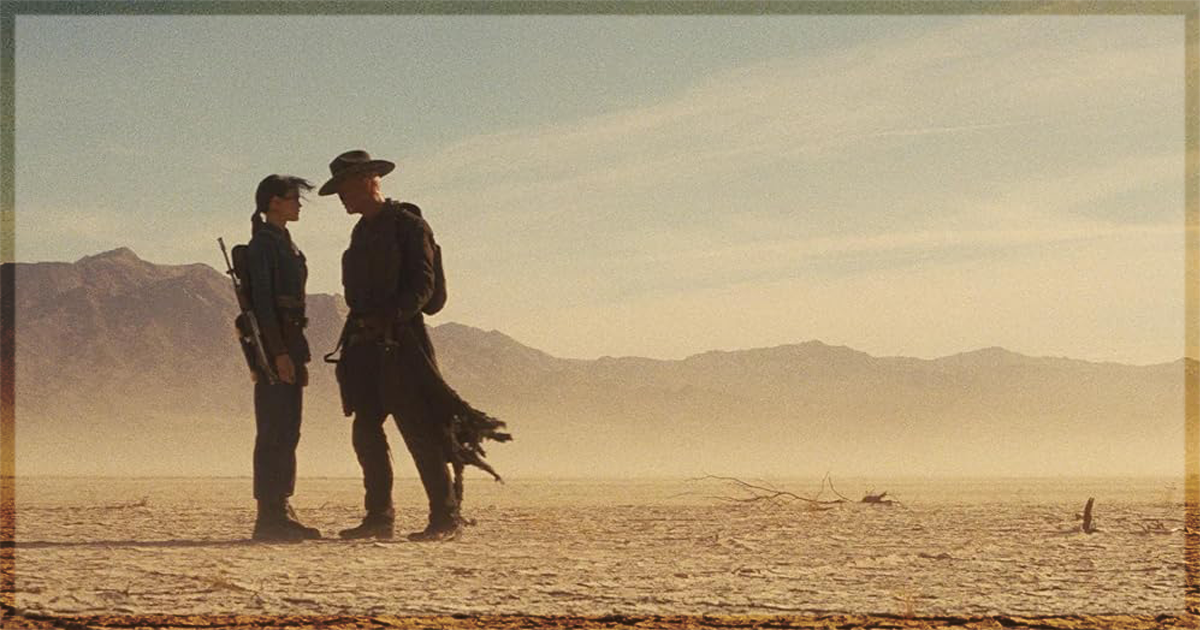
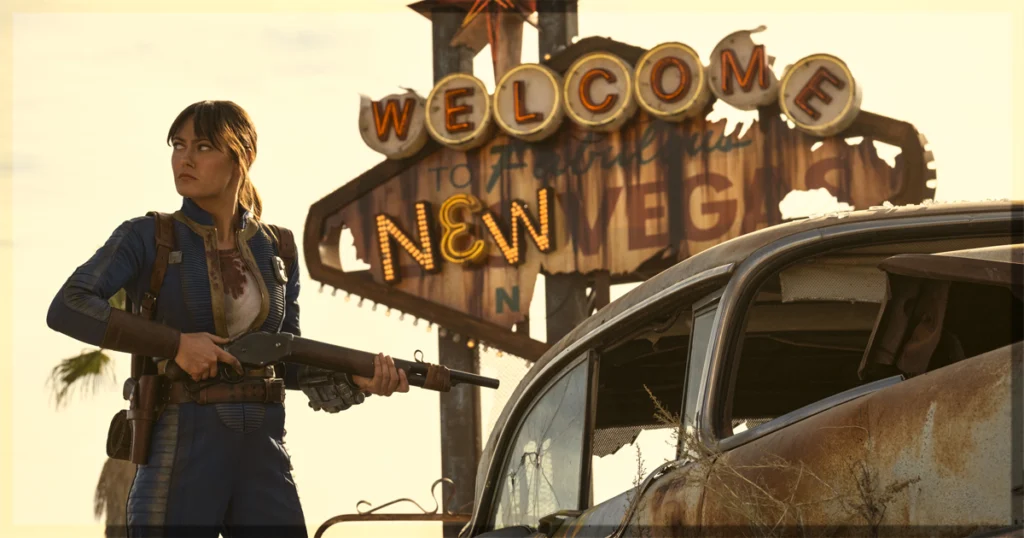
Survivors call the Vaults their home – social experiments created by Vault-Tec to see how humanity would survive in different settings. More than 200 years later – now in 2296, most of this has been forgotten; and we zone in one of these vaults, vault 33; that is about to become the victim of an attack from outsiders that will change protagonist Lucy Maclean (Ella Purnell’s) life forever – forcing her to venture outside from the safety of the vault into the war-torn dystopian wasteland, hunting for her father, Kyle Machlachlan’s Hank, the vault’s abducted overseer. It’s a fetch and retrieve mission that takes Lucy through the devastated world that was once Los Angeles, linking up with Walton Goggins’ ghoul bounty hunter Cooper Howard and Aaaron Moten’s Maximus, a squire of the Brotherhood of Steel – one of the factions surviving the wasteland – into impossible new territory.
Fallout captures the black humour of the games it is based on to create a witty, immaculate, high budget spectacle that makes the most out of the unlimited money Amazon are willing to throw at a project like this. It’s an intense start – that will no doubt shock newcomers, but fans are expecting – 1950s America at the height of the Red Scare. Cooper Howard; not Lucy – is our first protagonist, a former washed out tv star – think Rick Dalton, played with charm and precision by the brilliant Walton Goggins. He watches in horror as the blast wave of a nuclear apocalypse devastates a children’s birthday party he’s forced to attend to make a living. He’ll be important later, in a big way.
Vault 33 looks like a respite from the apocalypse with the only real danger being avoiding many cousins in marriage, but that quickly becomes shattered, and Lucy must journey away to safety. She is dismayed to learn that the surface does not share the same doctrine (do unto others as you would have them do unto you) that she has been brought up to believe – and her disguises are comparatively ineffective. Yet Lucy survives – sporting clean hair, good teeth and all ten fingers. Which is in the world of Fallout, considered a blessing. The civilians of the wasteland are far from Lucy’s worst problem – cockroaches ten times her size and radiation poisoning also seem easy, considering cultists and cannibals also rule the wasteland. It’s a threat that she encounters and survives time after time – whilst Maximus is rising from his ranks as a Squire to a Knight – clad in Space-Marine esque Power Armour that gives him a distinct fighting edge and his charge an insufferable ego; but without the skills of a Warhammer super soldier to match. All three characters, Lucy, Maximus and Cooper the Ghoul are variations on a theme: you can imagine yourself playing with the stereotypes of a do-gooder vault dweller or an aspirant warrior taken to the extreme. They’re us; thrust into this world.
Fallout itself has earned praise from series creator Tim Cain for matching the games’ tone and the easter eggs along the way – and for good measure, it’s a hoot. The world is built from the ground up and the design on Cooper Howard’s now ghoulish face is remarkable, Goggins an opposite of Purnell’s eternal optimism with hundred of years of lived in cynical experience of a world defined by the red scare when he left it and a legendary reputation of a protagonist like that. His experience as an outlaw on the excellent Justified gives him an edge here; wary of all the bullshit that the world will throw at him and encourages Lucy not to get distracted by pointless side quests like the video game. It’s not the last, nor the first in-joke – but it’s to the series’ tone and credit that it’s able to pull it off.
The series can blend time jumping between the 50s and the present day nuclear wasteland expertly; we learn about Cooper Howard’s journey from star on the top of the world to failed actor as he’s caught up in Communism during the height of its portrayal as anti-American. It does retcon game lore – the first two and New Vegas, but had Cain’s seal of approval. The lore is engaging – with plenty of solid production values to boot considering Amazon’s extensive budget really works in its favours; whilst at the same time echoing the feel of the 50s origin. Little details like a miniature nuclear bomb in the display case amplify Fallout’s heart, it’s clearly made with care and attention. Gone are the days where you’d just slap the title on it and call it a video game adaption: this is its own story, existing in the world but with new characters and new lore. It’s a testament to how rich the game’s mythology is that Fallout is able to operate like this.
The first three episodes were strong. The first eight were stronger. Vault Tec, the Brotherhood of Steel, the Enclave, the New California Republic are all expanded on in detail; it accessible to newcomers as it is to series veterans. It’s a lot of world-building early on and that bogs down the first half; but now we’re well on the way to getting stuck into the deeper edges of it proper. In the sense of a timeline it takes place after all of the games – from Fallout 76 right the way through to Fallout 4, with a swift timeline change: Shady Sands is the major difference in destruction from the game – and the New California Republic no longer exists as to what we know. Cain’s counter argument is that this is still canon to New Vegas, with the bomb falling after the events of the game – and never feels like it properly breaks canon as a result. But who cares, when Fallout as a series as a whole, is just so much fun and a riot of a good time? I wasn’t bored once whilst watching this show; a rare feat in an age of streaming slop. Amazon have had fewer series than their Netflix counterpart but seem to have a better hit ratio.
The strong satirical take on American culture is ever present and the subtext of the first few episodes take you into deeper themes at its core. Vault Tec isn’t all good, that much is clear, and old world companies have hatred even deep into the apocalypse. The show tells us who dropped the first bomb, with Vault-Tec leading the way, winning the market by outliving the competition. Corporations are the main villains here – execs who killed the world; but it’s far more than just that – every faction shaped by the world gives you reason to hate them – there’s no good guys here; it’s never that simple. War, war never changes – after all (and I’m so happy that got uttered).
With an ensemble so good it even has Nolan/Joy regular Michael Emerson and TV icon Kyle MacLachlan in significant roles (and Matt Berry!); Fallout is must watch television as it shows just how you can elevate the story above the narrative. It’s smart, clever, trusts its audience, has some great needle drops (to the point where I’m now expecting Getdown Services to crop up in Series 2 after Goggins recently praised them on a promo tour); and is given the time, attention and care that it needs to shine.
Fallout Season 1 is now streaming on Prime Video.
Learn more about the show at the IMDB site for the series.
You might also like…
‘Fallout’ Season 2 Review: Chaotic, Messy Fun