
The French director Maureen Fazendeiro is known for her short documentary Sol Negro (Black Sun), a recitation of Henri Michaux‘s poem. After that, she joined the Portuguese director Miguel Gomes, co-writing his Cannes award-winning Grand Tour, and co-directing the 2021 film, Diários de Otsoga (The Tsugua Diaries). Now, she directs As Estações (The Seasons), a poetic documentary that portrays the region of Alentejo, an archaeological site located in the south. In the film, the director analyzes the heritage of the territory, where farmers harvest goats, scholars dive to study rocks and archaeological treasures, and the beauty in the trees, whose stems become corks. In this sense, Fazendeiro draws a poetic vision of the region and its history of resistance.
The film observes the nature as an intrinsic element in the daily life of each individual in the region. Activities such as cutting wood and producing corks, harvesting goats, and cutting stems to transform into wood utensils are essential to their realities. Furthermore, in a few sequences, the director allows the elders to speak and provide their opinions on the past. In a beautiful moment, a senior woman sings a saia, which is a traditional Portuguese song. She sings about September 23rd, the day Marcello Caetano took the leadership of the country from António Salazar, the dictator who controlled the country for thirty-six years, resulting in a downturn of the authoritarian regime. In the next verse, she sings about April 25th, the day of the peaceful revolution that ended the dictatorship and returned the country to its population. Hence, the memories of the past remind us of the popular revolution that led to the regime’s downfall and freed Portugal from fascism.
The director links the region, its people, and history to the resistance throughout history. In another conversation, three men sit down and tell the legend of a man who spoke against the regime; they kidnapped and killed him for his anti-dictatorship opinions. In this sense, Alentejo means the anti-regime, the land of the brave that harvests from the land and fights injustices. Another central segment is the reading of the letters by Vera Leisner, a German archaeologist who moves out of the Nazi Germany to work on-site in Alentejo. However, the destruction of their Munich apartment made their passage in Portugal a definitive stay in the Iberian country. Again, the director links that land to a welcome stay for those escaping the violence, brutality, and regimes, such as in Leisner’s case. She abandons the destruction of Hitler’s power to find residence in the beauty of the rocks, the unknown nature below the dust, and the stones.
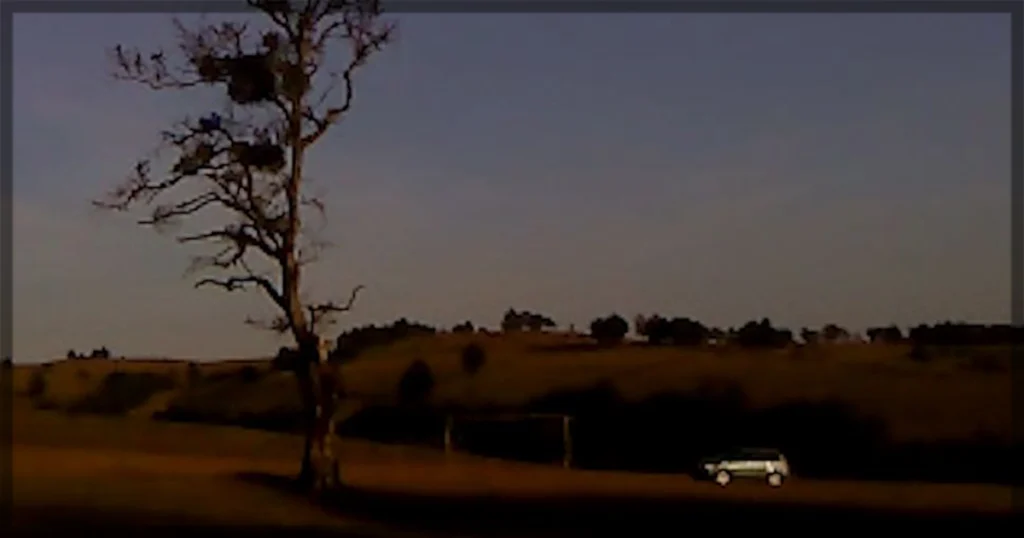
On the other hand, the film does not rely on conventional structures to conduct its study. The director aims to build a sense of texture in the imagery of meanings from the natural environment. Consequently, the 16mm film cinematography by Marta Simões and Robin Fresson provides a lyricism that is lacking in Fazendeiro’s writing. However, it presents itself in texture, composition, and vibrating colors that fill the screen with its beauty. The poetry rhymes with the unsung and unseen, a blending of the observation of the natural world with the manipulation of the film, imprinting a texture and managing the film material to create the director’s vision of that region. Unlike most documentaries that focus on the subject and are expositional film, the director wants to exploit the land as the central character. She wants to deliver a story about the beauty and everything that comes from the soil, whether it is their brave individuals, or the natural commodities, such as wood. Hence, it is a film about digging, in the natural sense: the rocks and the fossils, and the caves of the authoritarian wounds, still unhealed.
Finally, behind the gorgeous surfaces of the 16mm film, Maureen Fazendeiro digs into the time passages in the South of Portugal. The Seasons mentioned in the title do not have a linear portrayal, once the director shifts from an unclear pastoral reality to the Nazi’s escape from the Leisner couple to the Salazar and Caetano regime until now. She denies a chronology or structured documentary organization to invest in the poetic documentary. Alongside the cinematography work by Marta Simões and Robin Fresson, the director uses the texture of the film to state more than words could. Although it drags the narrative to a tiresome path, As Estações is an invitation to understand a land from its ground, the soil that justifies everything on its surface.
As Estações (The Seasons) recently played at the Locarno Film Festival.
Learn more about the film at the official Locarno site for the title.
You might also like…