Georgian director Alexandre Koberidze made a splash in the arthouse circuit when he competed in the 2021 Berlin Film Festival with his What Do We See When We Look at the Sky?. MUBI acquired the film and released it as one of the original releases during the expansion of the streaming service. Four years after his last film, the director competes for the Golden Leopard in Locarno with Dry Leaf (ხმელი ფოთოლი), his three-hour neo-noir odyssey. The starting point is the disappearance of Lisa, a sports photographer who vanishes from home, leaving a goodbye letter saying that she needs to calm herself. Suddenly, her father, Irakli (David Koberidze), decides to search for her. When he meets with her editor, who tells him about her last article, a work about football fields across the country, and what they represent to their local communities. Thus, Irakli and Lisa’s colleague, Levan, starts a journey to find her.
In his latest effort, Koberidze invites us to a meditation. The initial scenes borrow their structure from the noir films; a twenty-eight-year-old woman disappears without any clue or apparent reason. In the first minutes, her parents share information with the police officers, who are responsible for the lack of an effective response, encouraging her father to search for it by himself. Despite the similarities to the popular 1940s American genre, which would welcome revivals in the 1970s and 1980s with the neo-noirs, the director uses it as the initial point for a more expansive reflection. As an example, in Polanski’s Chinatown, the director presents the same tropes, such as femme fatale and investigation, but subverts the noir genre by providing his take on it. The Georgian director does the same in Dry Leaf. Hence, the road movie device is a search for someone who does not want to encounter anyone. Lisa wishes to disappear; she wants to experience a distancing from her family, magazine work, and the ever-changing city that destroys any physical building that she holds affection for. It is an investigation for someone who may not have apparent motives or reasoning.
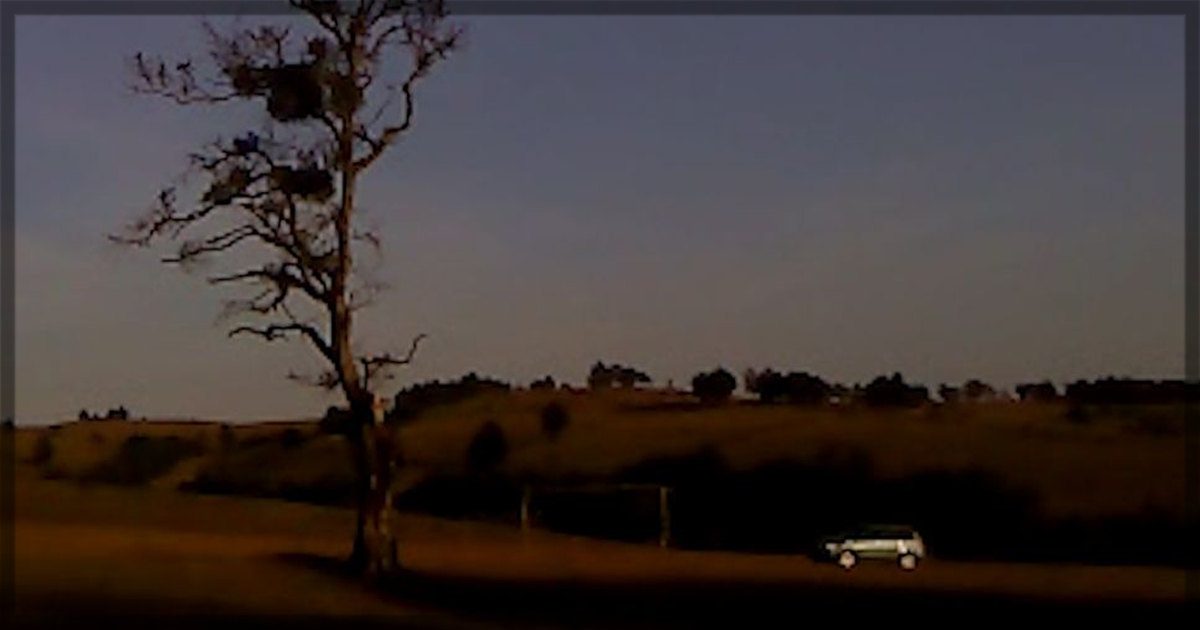
In this sense, the director utilizes devices to challenge his audience through the viewing of the film. Koberidze shot Dry Leaf with his Sony Ericsson W595, a 2008 cellphone with a 3.2 megapixel rear camera. Hence, the film is a three-hour painting through the pixelation of the imagery, a deconstruction of the modern cinema sense, where there is a necessity to polish and over-manipulate the images. The digital nature of the W595 image imbues a new texture to the journey of a father in despair, searching for his daughter. The pixels draw an out-of-center film, where crucial elements of this mystery are unseen. Lisa is merely a voice out of the letters, exposing her frustrations, pains, and memories. Levan is another voice heard, but never seen. They exist in the field of imagination and reasoning, but not in the visual sphere. Hence, the director wishes us to look at the vast empty football fields, where the father searches all around the country for his prole.
Ikrali searches for football fields that do not have players kicking the balls in the them. Nonetheless, the goalposts become the central imagery figure for him and the audience. It is the case for a beautiful scene of the father observing the woods that form a rectangle to delimit the goal. He observes the format of the long lumber used in the posts, while we scan an impressionist painting that allows the audience to meditate on the beauty of the nature. Koberidze pays attention to the changes in the climate and how it visually impacts the communities.
Consequently, the football fields contrast with the trees, rocks, and skies that help to compose a beautiful ambiance for playing ball, a sport loved by billions of individuals, including this small country on the Black Sea with three million inhabitants. Hence, the director guides the audience through the soulful work by the composer and sound designer, Giorgi Koberidze. He emulates different eras of film composition in a few but diverse tracks that provide a luxurious sound to the experience. The sounds of harps and flutes deliver guidance to the ears, as the eyes capture the beauty in the imperfection, the pixelation that manipulates the imagery, and question us to find beauty in the weird. Although it is a sparse presence in the film, each of the tracks highlights the emotional complexity of this investigation.
In the final five minutes of its length, in the last letter written by Lisa, Koberidze invites us to watch the road trip in Georgia. It is a trip to reflect on the vastness and the existence that we cannot see in the world. In this sense, as soon as the credits roll, Alexandre Koberidze gifts us with a beautiful meditational experience and one of the most gorgeously fierce works of the year.
Dry Leaf recently played at the Locarno Film Festival.
Learn more about the title at the Locarno site for the film.
You might also like…