There is a small rural enclave in southern Philippines called Sitio Masalay, whose fields were turned into a horrific site of carnage one fateful day in November 2009, summarily taking 58 innocent lives. In the aftermath, only 57 bodies were found, and one remains missing. Director Carl Joseph Papa presciently opens with and returns to this griefscape more than a few times in his fittingly titled 58TH, which lopes forwards and backwards in time, as it recounts the events and enduring specters of the Maguindanao massacre so heinous it was later dubbed as the single deadliest attack against journalists in recorded history. Challenging political rival Andal Ampatuan Jr. in the Maguindanao gubernatorial race for the 2010 national elections, then Buluan vice mayor Esmael Mangudadatu dispatched his wife and sisters, alongside a group of lawyers and media workers, in a convoy to file his certificate of candidacy at a local electoral office, but they were ambushed in transit and murdered — some were violently buried alive — by the armed gunmen of the Ampatuan clan. Partial justice came a decade later, but full accountability and reparations remain painfully elusive.
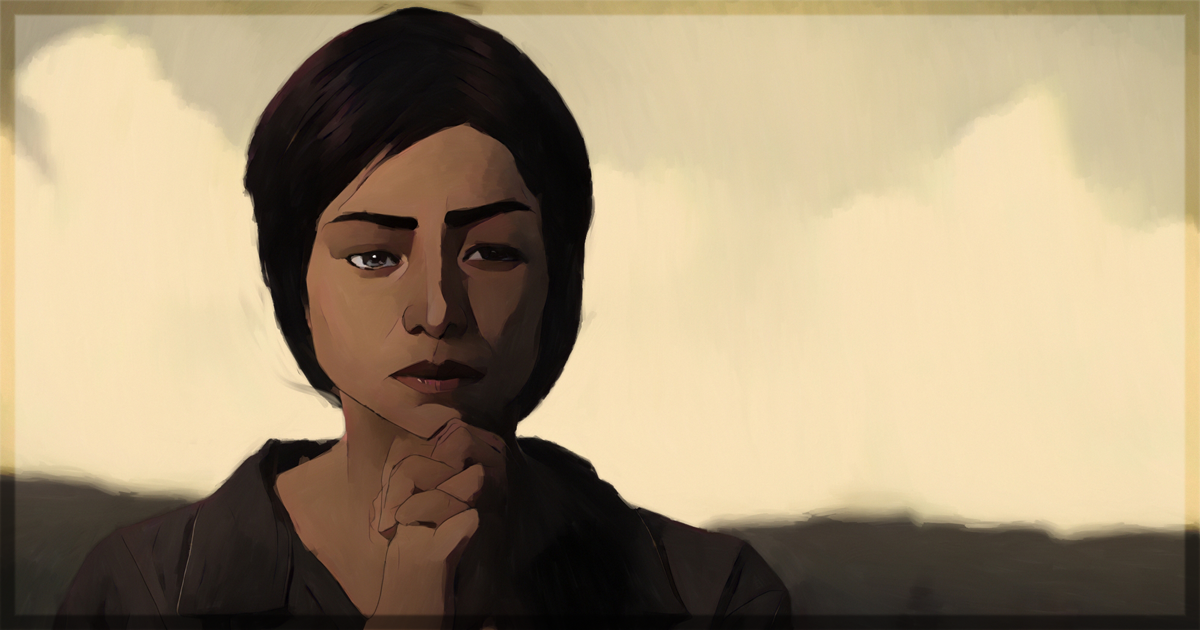
Retelling the massacre through the vantage point of Maria Reynafe Momay Castillo, the daughter of the eponymous last victim, photojournalist Reynaldo “Bebot” Momay, whose body was never recovered and therefore left unrecognized in legal records, Papa bends documentary conventions by intercutting real archival footage with Zoom interviews with Castillo and giving her memories their own flesh and sensoria through reenactment and his signature rotoscope animation, in which Glaiza de Castro plays the daughter nicknamed Nenen, and the late Ricky Davao (in his last acting project) as the disappeared photojournalist, alongside Mikoy Morales as the director’s self-insert.
Screening at this year’s International Film Festival Rotterdam, the animated docufiction unspools through a simple narrative device, the Zoom call, allowing Papa’s subject, now living in the States, to enunciate the weight of the grief and trauma she and her family have been dealing with for nearly 17 years through the sheer power of remembering, apropos of the Filipino director’s ongoing flirtation with the fragmented yet tempting grammar of memory, as tested in his previous pictures such as 2014’s Ang ‘Di Paglimot ng mga Alaala and 2018’s Paglisan. At the same time, the Zoom call reveals the director’s own positionality as a storyteller who is still an outsider to Maguindanaon history and experience, and somehow, we assume his perspective as if we’re the ones leaning in, listening, and conversing with Nenen, her eyeline locking with our own. In a flash, the subject takes the director and, by proxy, the viewer to both joyous and painful corners of her mind, privileging the film’s humanist tenor, as we meet Bebot as a lively soul, as more than just an unacknowledged statistic in the wake of the massacre. From a more practical standpoint, though, the device reliably allows the film’s fictional unit to work, lest it risk the integrity of the multigenre method of delivery.
I have to admit to being wary, at least initially, of the movie being under GMA Pictures, which produced the 2024 documentary film Lost Sabungeros, about the mass disappearance of cockfighting aficionados in the Philippines, which is rather beholden to the parameters of sensationalist television and winds up as more journalistic than cinematic. But here, Papa movingly and hauntingly crafts a material that more often hews to filmic composition and unwaveringly trusts all the revelations the medium can fashion.
Whereas 58TH is already never easy to sit through considering its narrative focus, which isn’t necessarily to the film’s detriment, its aesthetic similarly poses a challenge. It’s far from ostentatious, but Papa’s go-to animation style sometimes sacrifices the emotional intensity behind the rotoscoped visage of his characters or obscures a more potent, intuitive use of foreground and background, resulting in a picture that is not as visually pleasurable as The Missing, the director’s last Rotterdam film, but also not as uncomfortably unpolished as The Next 24 Hours, a short film tackling sexual assault which I mostly remember for excessively activating its characters’ eyes to the point of becoming unruly. There’s something about rotoscope animation that makes it a source of awe and alarm in equal measure, but I nonetheless admire a filmmaker for inventively trying to work around it in order to have his cake and eat it too. Eventually, the aesthetic disparity here becomes more of a feature than a bug, lending itself to the film’s understanding of the nature of memory as not exactly seamless or devoid of rough edges.
As the film hopscotches across different timeframes, what results is not just a study in memory and historical accounting but also a story of the possible disintegration of the family unit, another recurring thread in Papa’s body of work now spanning nine features and five shorts. Co-writing with Aica Riz Ganhinhin, the filmmaker pries open the magnitude of losing a loved one to an unspeakable slaughter and being left without any proof of what transpired, without a body to mourn with, situating Nenen’s story smack dab in the plight of families of desaparecidos in the country. Her sons, especially her eldest, bear the brunt of that continuing injustice, forcing the family to live abroad, away from the house still haunted by the ghosts of remembered pasts. And it is precisely through rendering such a massive tragedy on an intimate, tactile scale that 58TH feels most alive, which is subversive in that we only ever view historical wrongs in their epic grandeur, and perhaps none of this would work at all if it weren’t so fascinatingly held together by the determined spirit and gaze of Nenen, whom de Castro portrays not only as a character that’s studied but embodied and fully lived-in. The affect she extends the part is altogether mesmerizing and disquieting, guiding us through all the grief-stricken peregrinations. And it helps that the subject is seemingly aware of the political resonances of her story, as is the actress playing her.
Inward as the film might be, Papa is still inclined towards making the most of the collated, researched material at his disposal to cultivate the bleak zeitgeist in which the central story unravels. He does this early on, barely 10 minutes into the film, arranging a brief newsreel montage of the political climate in Mindanao — from the Marawi siege to unchecked election-related violence, from killing squads to clan feuds — though it also risks a totalizing view of Mindanao as solely an island of conflict and terrorism, given that it isn’t strongly attuned to examining why that is the case, at least not to the degree that it historicizes the carnage at hand. A sense of discombobulation also arises in the film’s softening of the role of Gloria Macapagal-Arroyo, whose regime was notorious for human rights abuses, in the massacre, somehow glossing over the gravity of the fact that the former president enabled the Ampatuan patriarch to become a mega-political warlord in Maguindanao, leading to unchecked power in the province. This is maybe asking for a different movie altogether, but it’s tough to ignore a layer so significant it could positively stretch the narrative’s political environs, powerful as it already is.
The most arresting images in the film arrive about 30 minutes in, in which the rotoscoped characters visit the slaughter site to search for the remains of their missing relative, the sight overwhelming them just as much as the stench of the rotting corpses, and the film so curiously cheats time here, as the edit, courtesy of Benjamin Gonzales Tolentino, toggles between the animation and the archival footage showing authorities trying to retrieve the bodies, where the imagined and real converge and at the same time blur each other. Tolentino repeats the technique throughout, either more porously or more untidily than his previous attempts, conveying how political reality insists on itself faster than Papa could imagine and Nenen could recall it. By the time 58TH arrives at its coda, Papa gracefully surrenders the facade, finally letting us see the incredible person behind it, and therefore revealing his intentions: This is an oral history doubling as a personally staggering journey towards healing and closure for the subject as much as it is a larger historical reclamation project for the families of the massacred victims, whose sense of justice, like hers, almost two decades later and amid a similarly hostile regime, remains unbelievably in limbo, incomplete. With this genre-shifting effort, Papa mines something altogether poignant and biting.
58TH recently played at the International Film Festival Rotterdam.
Learn more about the film at the IFFR site for the title.
You might also like…