
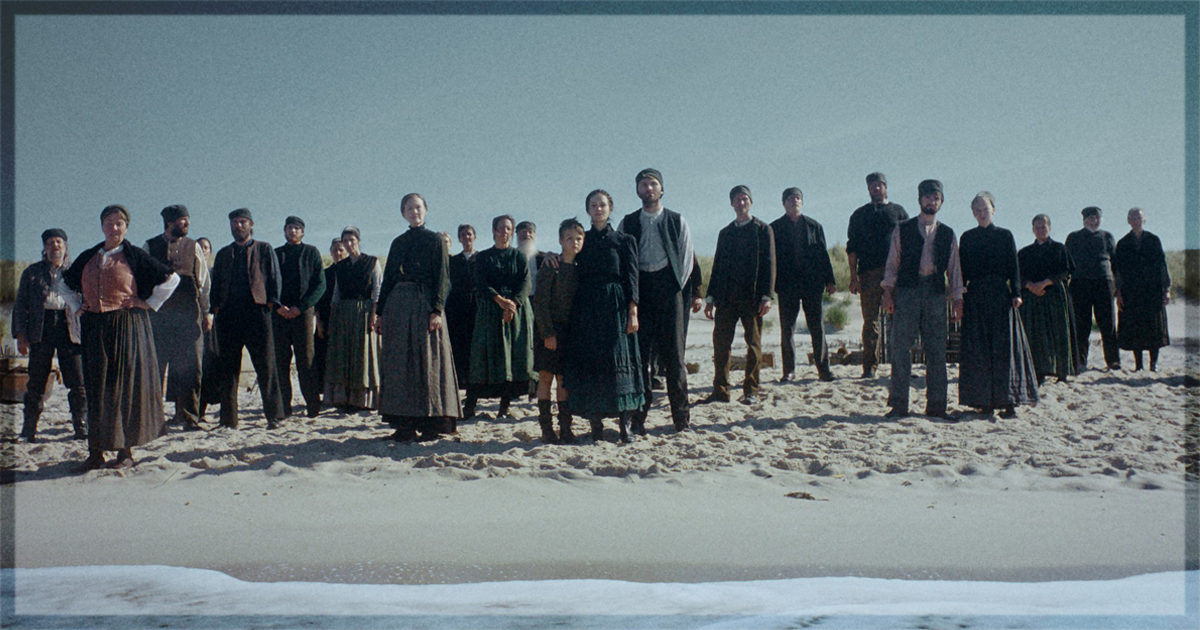
The deliberate stageyness of Trial of Hein takes a little while to make sense. The clothes are modest and homespun, the technology is that of life without electricity, the island setting is not named, and the houses in the village have front walls, doors and windows, but are open to the skies. The falsity of the buildings and the antiquity of the physical props are a stage set, so that we understand this story could be happening anywhere, at any time, in any culture. It happens to be in the German language (the original title, Der Heimatlose, translates literally as ‘The Homeless’) but once the not-to-be-spoiled subplot becomes clear, Trial of Hein achieves a bold universality through its specific allegory.
A young blond man named Heinrich, whose nickname is Hein (Paul Boche), arrives by hired sailboat on a small, windswept island which holds only a small village including a school, a tavern and several houses. As Hein makes his way directly to his mother’s house, he is stopped by the other villagers, who he greets by name. This is a surprise, for he is a stranger to them, and with less than a hundred people in this isolated place, no one here is ever a stranger. Hein reminds them he was born and raised here but left around 15 years ago, but as he missed his mother it was time to come back. But his mother has dementia, his father is long dead, and he has been gone so long his much younger sister Heide (Stephanie Amarell), now a harried married mother herself, doesn’t remember him clearly. The officious headmistress of the village therefore decides the only way to verify if Hein is who he says he is will be a sort of public trial, to compare everyone’s memories of Hein’s alleged childhood under oath. This should be easy, because this place is so small that everyone knows everything about everybody in this place.
While the trial preparations are made Hein is allowed to sleep on Heide’s floor, though her husband and children are not happy about this, and left to pass the time. So he tries to chip in around the village, helping to unload the catch when the fishing boats come in, doing household chores to make Heide’s life easier, and telling the wide-eyed schoolchildren what life elsewhere is like. One thing everyone does remember about child Hein is that he was unbeatable in the village card game, a bluffing version of snap called ‘lies,’ but adult Hein is suspiciously no good at it. Hein also tries to reconnect with his childhood friends Greta (Emilia Schüle), now a widow whose son is being bullied, and Friedemann (Philip Froissant), an unhappily married fisherman, but this is surprisingly tough. In private Greta is one of the very few who is supportive of Hein, though the way she is handling her son’s unhappiness and her refusal to speak out gives him pause. And Friedemann has become the type whose ability to articulate his feelings has been beaten out of him, and who therefore maintains a miserable stoical silence even when dead drunk. When the trial and its discussion of Hein’s childhood begins, there is a huge gap between how Hein and the rest of the villagers interpret the events they all remember. The great shock is the realisation that no one is lying.
Florian Mag’s handheld cinematography emphasizes the windswept setting and the ways people have preserved intimacy and their sense of self whilst under the constant scrutiny of village life. Susanne Ocklitz’s editing also allows the shots time to breathe, so we can consider the ways Hein and the villagers interact as they consider each other. Mr. Boche brings a self-contained dignity to these proceedings that’s extremely important; he never provides anyone with a reason for the trial not to go ahead while remaining politely firm that he is right and they are wrong. Ms. Amarell especially among the villagers makes it clear that Hein’s kindness and consideration is unusual in this place, and that Heide wishes she could be certain that this stranger who is suddenly making her life easier is indeed her brother. But it’s Mr. Froissant who does the most potent work as a man who is positively vibrating with all the words he has never spoken, and who therefore brings a worrisome vibe to every group he joins. This physical performance makes it very clear Friedemann is the key to the dilemma suddenly facing everyone, and the question slowly becomes whether he will ever share what he so knows.
But sometimes telling the truth is more dangerous than living a lie. It’s a global truth that people often realise in childhood that they must choose between conforming to their community’s expectations or having a place in that community. It’s horrible to think why the community that raised you could not know you as an adult. Certain audiences will guess it right away, and writer-director Kai Stänicke is being open about those spoilers in interviews, but the power of the film lies in wondering about how such a void can develop. It’s been notable that recent world cinema has made lots of movies exploring how communities protect themselves and reinforce their values by closing ranks against outsiders, and how damaging and painful this is when the outsider comes from the inside. Sometimes the choice is made for them and sometimes they have the power to make that choice themselves. Trial of Hein is the rare movie that wonders why we expect the choice to be made in the first place. It’s an expert allegory crafted with such care audiences around the world will understand its message, but its quiet insistence that no such allegory should exist in the first place will have even more power.
Trial of Hein recently played at the Berlin International Film Festival.
Learn more about the film at the IMDB site for the title.
You might also like…