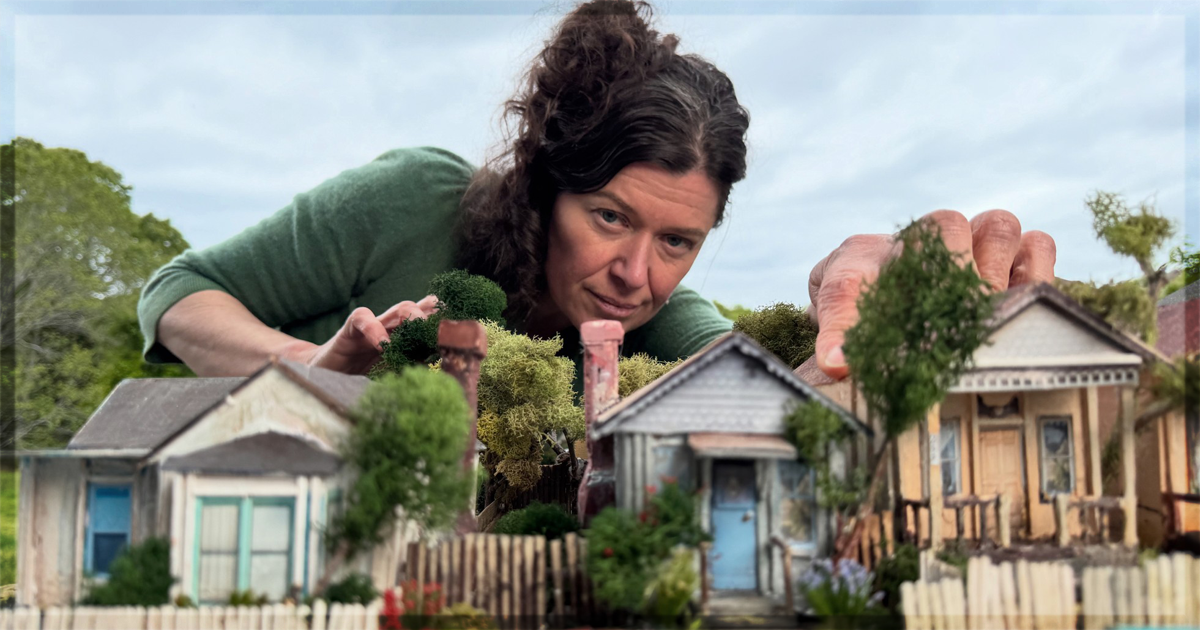
Yo is short for Yolanda, and Yolanda was Yolanda Shea, a Swiss woman who spoke four languages fluently and spent most of her adult life in northern California. At a rummage sale in her seventies, Yo met a woman in her twenties named Anna Fitch, and their relationship became unusually close. Yo already had four adult children, so was not quite Anna’s second mother, but their friendship was so tight there’s not much other way of describing it. After Yo died, Anna processed her overwhelming grief by building an entirely accurate scale replica of Yo’s house in her studio, large enough that her children could sleep in it and detailed enough that it matched the pillows on the beds and the pictures on the walls. Anna also used that replica, puppets of Yo, and various animation techniques to portray various stories from Yo’s life that Yo told her on camera before her death. This all sounds and maybe is insane. But Yo (Love is a Rebellious Bird), which Ms. Fitch directed with her husband/creative partner Banker White, is also as potent an exploration of obsession, love and grief as has ever been made.
Have you ever seen Nina Paley’s Sita Sings the Blues? That 2008 animated movie was how Ms. Paley coped with the brutal end of her marriage, by animating the Hindi epic Ramayana (a tale of obsessive love within a not-great marriage) to torch songs by jazz singer Annette Hanshaw. Thanks to copyright problems it has not been widely available, but it is also one of the greatest depictions of romantic personal obsession as has ever been put on film. I thought a lot about Ms. Paley’s work during Yo, which is also very much an unusual collage of an obsessive love story. Ms. Shea had very much enjoyed the 1960s, and right up to the end was still impacted by the choices she made during that decade. She lived a careless life, by which is meant she acted mostly in her own self-interest, consequences and the impact on her children be damned. But she also accepted those consequences as the price paid to live how she wanted to, and gave her stories, and to an extent her self (there are some deeply intimate images of Ms. Shea shown here) to Ms. Fitch for Ms. Fitch’s own purposes.
For Ms. Shea was an artist too, or at least had been an art student back home in Geneva, and understood that how the work (and the artist) is interpreted is as important as the art itself. In that sense she seems to have been thrilled to have found Ms. Fitch, someone who understood the value of her life, and who has devoted herself to an understanding of that life. The subtitle refers to Ms. Shea’s bird phobia, a source of shame since childhood. In her last days some birds realised if they knocked on her windows she would throw them some food almost on demand. It’s an insignificant thing, feeding a bird, but a major achievement for her. Was Yo a significant person? In the grand scheme of things, maybe not. But we are all important to the people who love us, and in Yo’s case that included Ms. Fitch.
Ms. Fitch’s narration and inclusion of herself (and her children) in the project makes it clear that this is a story of two hands clapping. She would not have spent years building that model of Ms. Shea’s house if she hadn’t been trying to keep her presence alive, and she would not have done that if the love they had for each other wasn’t important. The brief footage of Ms. Fitch presenting an infant daughter for Ms. Shea’s admiration is then matched by the final sequence of the film, with that now maybe ten-year-old daughter reading a poem for Ms. Shea to the camera before closing herself into the model house. In a very weird way (and any obsession that isn’t shared is of course a little weird) this movie makes visible what it means to love someone, and how the memory of that love carries you forward through the rest of your life. But the love also carries you back, because Ms. Shea told her stories for Ms. Fitch’s camera knowing they would be reinterpreted and repurposed by Ms. Fitch, either in this movie or some other way. So it’s very much a joint project, even if one of the participants died over a decade ago (the film is not precise on many of the dates, only to say that Ms. Fitch is now in her forties). But of course love is only really love if it is reciprocated, and love without reciprocation is merely obsession. It’s only a subtle difference if you don’t understand human emotions.
A statement in the end credits confirms no generative AI was used in the making of the film, as if that wasn’t abundantly clear. The value of the scale model is the sense it provides of holding Yo’s house and Yo’s things in your own hands. It’s remarkable that this feels like a three-dimensional photo album Ms. Fitch’s family can inhabit. The physicality of the art, even in the animation and the use of the wooden puppet to represent Yo, captures a sense of self that only art made with human hands can capture (though a lot of people are making a lot of money denying that is true). In that same way, only the most human of emotions allows us to appreciate a human for what they are. It’s therefore appropriate that the majority of the footage here was shot and edited by Mr. White, who clearly has the feeling for how to capture this incredible experience of his wife and creative partner down to the toenails. The documentary is short – 78 minutes – but it manages to provide an unusually vivid sense of the people here, and it won the Silver Bear for Outstanding Artistic Contribution at this year’s Berlinale because how could it not? Love has shaped these lives just as much as these lives have shaped their art, and their art gave that love physical form. The result is this unusual and glorious tribute to the power each of those things gives the other. It’s an unforgettable experience.
Yo (Love is a Rebellious Bird) recently played in the Berlin International Film Festival.
Learn more about the film at the IMDB site for the title.
You might also like…
Josephine Articulates the Unspeakable (Berlinale 2026 Film Review)