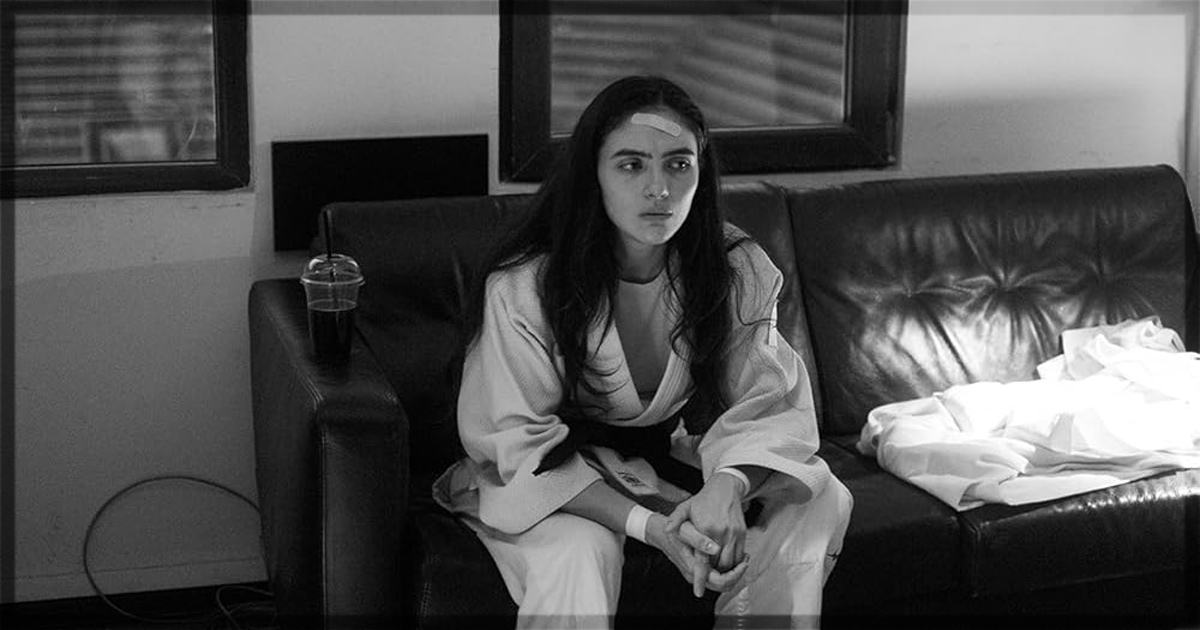
Tatami is co-directed by director Guy Nattiv and Zar Amir Ebrahimi. The story revolves around Leila (Arienne Mandi), an Iranian Judo athlete, who, at the Judo World Championships, is told by the Iranian Judo Federation to pull out of the tournament by faking an injury. They want to avoid a meeting between Leila and the Israeli athlete on the world stage. When she refuses, Maryam (Zar Amir Ebrahimi), the Iranian coach who herself sacrificed her dreams at the behest of the Federation, pleads with Leila to see reason.
Mandi has appeared in NCIS: Los Angeles, NCIS, Hawaii Five-O, The L Word: Generation Q, and The Night Agent. In conversation with Movies We Texted About, Mandi discussed finding direction through acting, connecting with reality through drama, and opening up the audience to difficult real-life experiences.
The Interview with Arienne Mandi of Tatami
Editor’s Note: The following has been edited for clarity.
Paul Risker: Why acting as a means of creative expression? Was there an inspirational or defining moment for you personally?
Arienne Mandi: Growing up, movies and TV were my escape — going to the cinema was my happy place. Still, to this day, one of my favorite pastimes is being in a cinema and fully focused on the giant screen. It’s rare that I’m sitting in a film and tears don’t stream from my eyes, regardless of what the genre is. Whether it’s a moment of triumph, whether it’s a sad or a tough moment, whatever it is, I’m moved by the performances. So, from a young age, I was in love with cinema.
I really got into it because my manager, Ricky Dale, was an acting teacher of mine when I was very young. She then moved into the management side of the business, and she pulled me back in at a time when I was feeling directionless and uncertain of what it was that I wanted to do with my life — what path I wanted to take. And so, we built all of this together.
Thanks to her, I got into acting and it just became my everyday obsession. I dedicated all of my time and energy into growing my craft and bettering myself. And with life being the greatest teacher, living life and pulling from that toolbox.
Paul Risker: In terms of growing your craft, what have you taken with you from your various onscreen roles?
Arienne Mandi: My first big job on a major network was The L Word: Generation Q, and that to date has been my biggest learning experience. I encountered so many different types of people and personalities. Being my first big job, there was a lot on the line. So, I definitely built confidence through that, but also through a lot of introspection. And then, growing from that experience, having a character arc in Night Agent felt like a great opportunity. Then, Tatami tested me to the nth degree in terms of my language, acting, and physical abilities. That part built me more than anything else, in the sense that I went through the wringer and came out the other end with so much more knowledge and belief and power in myself. And how beautiful to play a character like Leila, who undergoes so much every day.
Hearing the real-life stories of Iranian people who have been through something similar to Leila, that I was then able to pull from, was eye-opening. I’m grateful for the whole experience on so many levels.
Paul Risker: Were there any necessary considerations to play Leila and create her emotional reality?
Arienne Mandi: I was born and raised in Los Angeles, so, I had to put myself in Leila’s socioeconomic background. Being part of a culture and a male-driven sport, in a country where I have to wear a hijab every single day, which, if that’s your choice, that’s wonderful, but being confined to what your government wants you to do and think and say, it was like being a puppet in a lot of ways. Also, Leila’s a mother and a wife. There was so much that informed everything about her, from the way she stood, to the way she moved, to the way she looked at or didn’t look at people. So much of that was foreign to me and was exciting for me to slip into.
Paul Risker: You cannot digest everything that Tatami has to say in the immediacy of the experience. While many of us will have had experiences that provide us with an emotional foothold into your character’s reality, it’s a story that requires us to reflect on and discuss what we’ve seen.
Arienne Mandi: My hope is that, if anything, people will be a bit more informed on the reality of what happens for athletes, for these women and men in other countries. If anything, I want people to ask questions and to do the research. I want people to understand and have empathy for the people trapped between pursuing their personal dreams and being under political control. What that forces them to do or what headspace that puts them in, and how it drives them every day is fascinating.
Paul Risker: One of the beautiful things about the film is there’s a genuine sense of redemption, but it’s not a simple tale of good and evil. Instead, it sits within the grey.
Arienne Mandi: The irony, right? The film is shot in black and white, but it’s not exactly black and white. Instead, it’s very much in the grey. And there’s so much that’s unseen to the average eye, and I don’t think anyone can fully understand what someone like Leila goes through until they live it. But I was fortunate, because I had someone like Zar working opposite me, as well as directing me. She informed so much of what I was thinking and feeling through her own personal experiences, as well as others I was fortunate enough to speak to. And The Women, Life, Freedom Movement that was happening in Iran while we were shooting the film was so inspiring as well, that it left me chewing on these real-life situations that people were going through. I was trying to wrap my head around it all.
You also realize that even though we are all very different, fundamentally, the same things link us. Across our different cultures, we can all identify with the same struggles, which are the desire to thrive, to pour your heart and soul into something and to be free, and to protect your loved ones. This is universal, and we’re more alike than we might think.
Paul Risker: Is filmmaking a transformative experience?
Arienne Mandi: There’s no way that you’re going into a film, especially something like this, and not coming out the other end with a different gaze and a different heart. I have so much empathy, more than I ever had before, just because of the knowledge and the understanding gained by asking questions. I’m so grateful for this experience.
Tatami is available on VOD to rent or buy.
Learn more about the film at the IMDB site for the title.
You might also like…
Fantasia 2025: Interview with Jody Wilson of ‘The Bearded Girl’