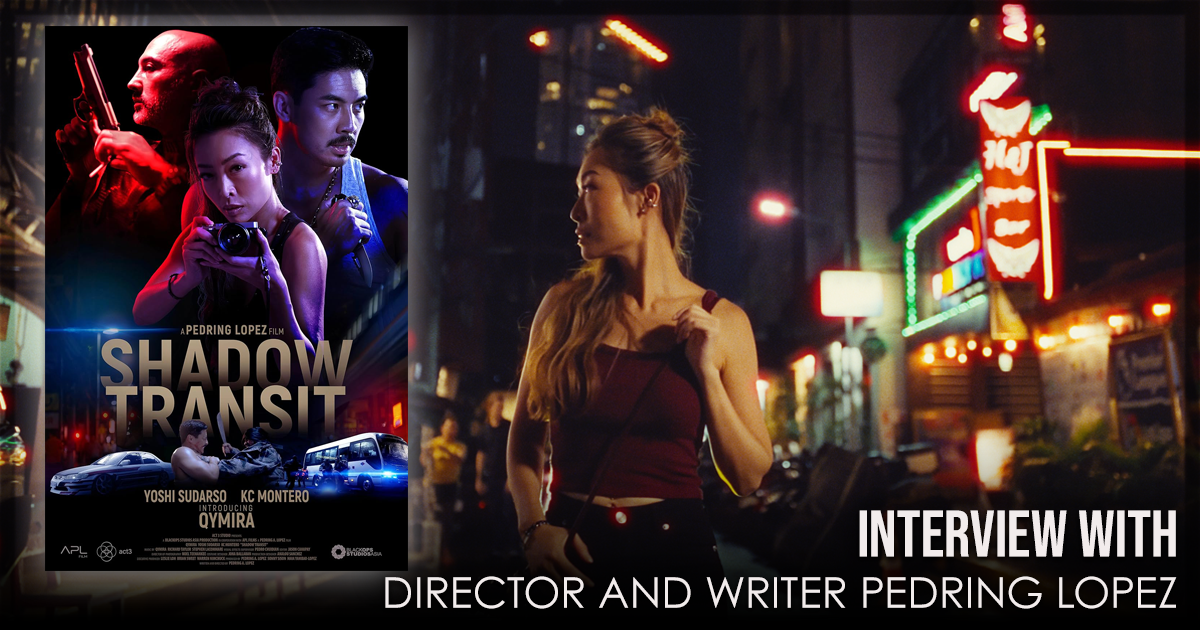
Filipino genre filmmaker Pedring Lopez world premiered his first English-language film, the neo-noir thriller Shadow Transit, at last year’s QCinema International Film Festival.
An independent co-production between the Philippines, Hong Kong, and Canada, Shadow Transit centers on a chance encounter between a grieving singer-photographer and a drifting DJ, resulting in a whirlwind romance that spirals into a relentless chase for survival. Shot handheld and set against the gritty yet neon-drenched underbelly of Manila, the film is described as a work that “blends realism and romantic fatalism in a fever dream of connection and consequence.”
It stars the United Kingdom-based musician Qymira, in her feature film debut, and Indonesian actor Yoshi Sudarso, fresh off Bullet Train, David Leitch’s action film adaptation of Kōtarō Isaka’s 2010 novel.
“Shadow Transit was born from a desire to explore connection within transience,” says Lopez, whose credits include the 2019 Netflix action movie Maria, starring Cristine Reyes. “I wanted to capture the electricity of a city at night—its beauty and its brutality—and the fragile human moments that exist between them.”
“Manila is a city I know intimately: unpredictable, imperfect, alive,” the director continues. “I didn’t want to romanticize it, but to let it breathe on its own.”
It was a year after working on the upcoming Filipino crime television series Sellblock, starring Jericho Rosales, when Lopez wrote the script for Shadow Transit. “That was a massive project, one of the biggest I’ve directed,” he tells me. “And after that kind of scale, I really wanted to ground myself again. I missed the rawness and focus of working with a smaller crew, where everything feels more personal and instinctive.”
“Shadow Transit became that reset for me,” Lopez adds. “It was about going back to my roots, shooting fast, tight, and close to the characters. No excess, no over-planning, just pure storytelling through the lens.”
The film, which the director describes as a “passion project,” also serves as a testing ground for when he begins working on another large-scale production in the U.K. for the psychological horror feature The Ascendants. “In a way, Shadow Transit became the perfect bridge—my first English-language film, but still very Filipino, very Southeast Asian in its soul and energy,” he says.
In this interview, Lopez takes us through his journey with Shadow Transit, detailing what it’s like to work with new and familiar collaborators, and the promising evolution of his directing career.
The Interview with Pedring Lopez of Shadow Transit
Lé Baltar: The film was shot entirely on location between Manila and Hong Kong. Was it always going to be these two environments at the center of the story?
Pedring Lopez: At first, yeah, the idea was to have parts of Shadow Transit set between Manila and Hong Kong for the end of the film, to capture that tension between two fast-moving worlds. But as we got deeper into prep, I felt everything we needed—visually, emotionally—was already in Manila. It has that perfect mix of grit, chaos, and beauty that fits the film’s pulse.
We ended up dropping Hong Kong and shot everything here, and replaced and rewrote those HK scenes on one of the beaches/islands in the Philippines to create contrast. That quiet, open space became an emotional breather in the story, a reminder that even in all the darkness, there’s still a sense of escape and calm somewhere.
Lé Baltar: What was the filming process like? Did you complete shooting in one location first before proceeding to the next, or was it more of a back-and-forth? And how long did the actual production take?
Pedring Lopez: Prep took a little over a month, and we shot for a total of 21 days spread over roughly two months. We had breaks between shoot days to adjust for weather, prep stunts, and move between locations, which actually helped keep the energy fresh.
We filmed entirely on location across Manila, Makati, Quezon City, and Clark. Each area gave a different tone and texture to the story, from the underground corners of the city to the more industrial and isolated spaces outside it. I wanted that movement to feel organic, like the city itself was part of the chase.
We chose to shoot during the rainy season because I wanted Manila wet and reflective. When it didn’t rain, we’d wet down the streets ourselves. Everything was handheld using the Sony FX6 and FX3—small, fast, and great in low light—which let us move quickly and keep things intimate and real.
And on the main fight day at the airport location, we were literally shooting in the middle of a typhoon. It was madness, but it gave the sequence this raw, electric energy that ended up defining the film’s tone.
Lé Baltar: How was it directing singer-songwriter Qymira in her feature debut? Was she the first choice for the role? How about Yoshi Sudarso?
Pedring Lopez: I first worked with Qymira on a music video for her U.K. dance track, which we shot in November last year. That video should be coming out in the U.K. sometime next year. From that shoot alone, I knew she had something special; she’s a natural in front of the camera. So when Shadow Transit came together, she immediately came to mind for the lead.
What I love about Qymira is how she developed the character with me. She’s curious, intuitive, and not afraid to be vulnerable on screen. For a first feature, she brought a lot of emotional honesty, the kind that can’t be taught.
Yoshi, meanwhile, came straight off Bullet Train with Brad Pitt before doing this, and he’s a martial artist who does all his own stunts. That’s why the fight sequences look and feel so real—you’re seeing real movement, real energy. Both he and Qymira stayed with the film throughout the entire production schedule and stayed true to their characters no matter how rough or long the days got. That dedication really anchored the film’s tone and authenticity.
Lé Baltar: Here you also have KC Montero, who starred in your 2019 Netflix action movie Maria. Is your relationship on set more fluid now, given the previous collaboration?
Pedring Lopez: Yeah, definitely. KC and I already had that trust from Maria, so this time everything felt more fluid. He knows my rhythm on set, and I know how far I can push him emotionally and physically.
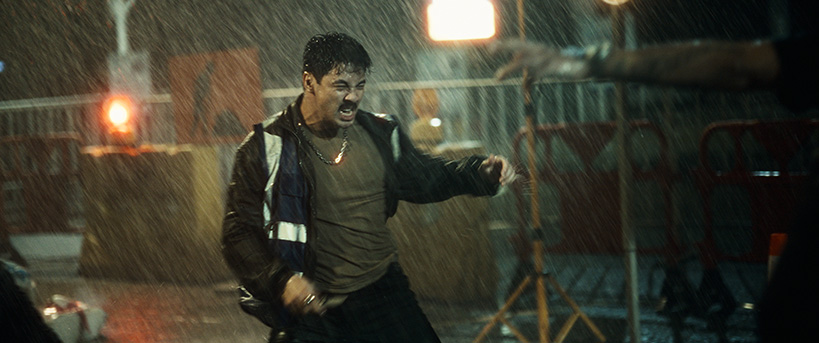
His performance in Shadow Transit is a lot more intense than in Maria. You can really see how much he’s grown and how comfortable he’s become as an actor—more grounded, more in control. And this time, he has a real fight scene with Yoshi in the pouring rain. Both of them went all in—no doubles, no cheats—just raw energy and emotion. It’s one of my favorite moments in the film because it captures everything I love about this kind of filmmaking: real stunts, real weather, real stakes.
Lé Baltar: Since one of the lead characters is a DJ, I’m quite excited about the film’s score and soundtrack. What can you tell us about it? Is there a specific music era that it’s trying to capture, and how does Manila’s underground culture factor into it?
Pedring Lopez: Music was always part of Shadow Transit’s DNA. Since one of the leads is a DJ, the film’s rhythm had to feel like it came straight from Manila’s underground; that late-night pulse that never really stops.
DJ Steelo (Stephen Lacomarre) knows that world inside out. He runs a club and plays around most of the Manila and L.A. scene, so the energy and authenticity were already in his blood. He and Marcus Davis, who also worked together with me mixing and scoring Sellblock, brought that lived-in sound, the kind that feels both cinematic and street-level.
Then you have Qymira, who composed most of the emotional beats and also performed the theme song. She understands melody and emotion in a way that connects directly to the story. Richard Taylor with his U.K. studio also came in to arrange the music—his orchestral touch balanced everything perfectly. The result is a mix of pulse and heart: dark, hypnotic textures with moments of beauty that hit when you least expect it.
Lé Baltar: Following Maria, this project, alongside your upcoming international titles The Ascendants and Blood Passage, marks a pivotal shift in your career. What was it like expanding the settings and scale of your films, while still working within genres you’re most familiar with? What seems to be the challenge now, if at all?
Pedring Lopez: It’s been an interesting evolution. Maria opened a lot of doors internationally, and from there, I wanted to keep pushing—not just in terms of scale, but in perspective. Shadow Transit came at the right time, right between the big ones, and it reminded me how much I love that raw, stripped-down kind of filmmaking—smaller crew, faster pace, more instinctive choices.
Now with The Ascendants shooting in the U.K. and Blood Passage being a U.K.–Singapore co-production, the scope has definitely grown. Both are English-language features with American and U.K. actors, so the collaboration and workflow are very different—new systems, bigger resources, more layers of coordination. But even with all that, I still prefer working lean and fast. That’s where I find the most authenticity and rhythm.
In a way, Shadow Transit was like a mini version of what’s ahead. Both of my lead actors weren’t from the Philippines, so it already felt like a step into that international space. For The Ascendants, I’ll be bringing my DP Noel [Teehankee] and a few key staff from Manila—which I think is a great way to showcase Filipino talent behind the camera, shooting a non-Filipino film for worldwide release. And Blood Passage will be entirely shot in Camarines Sur, so it’s another exciting blend of global collaboration rooted in Philippine soil.
Lé Baltar: How does it feel to finally be bringing this movie out into the world, especially in what is arguably the Philippines’ biggest film festival?
Pedring Lopez: It feels great, and honestly, a bit emotional. Shadow Transit was such a passion project for me. We shot it in the middle of unpredictable weather, with a small crew and a lot of heart. To now see it premiering at QCinema, which has become one of the most important platforms for Filipino and international cinema, feels like the right home for it.
What makes it even more special is that it’s an indie Philippine–Hong Kong–Canada co-production, and it will also be simultaneously presented at this year’s American Film Market in the U.S. with our distributor, Canadian-based APL Films. So it’s really launching both locally and internationally at the same time, which, for a film made in Manila with such a small but passionate team, means a lot to all of us.
QCinema has always supported bold, independent voices, and Shadow Transit is exactly that—personal, raw, and made with complete creative freedom. Seeing it reach both audiences here and abroad makes all the challenges we faced along the way completely worth it.
Shadow Transit premiered at QCinema 2025.
Learn more about the film at the IMDB site for the title.
You might also like…