
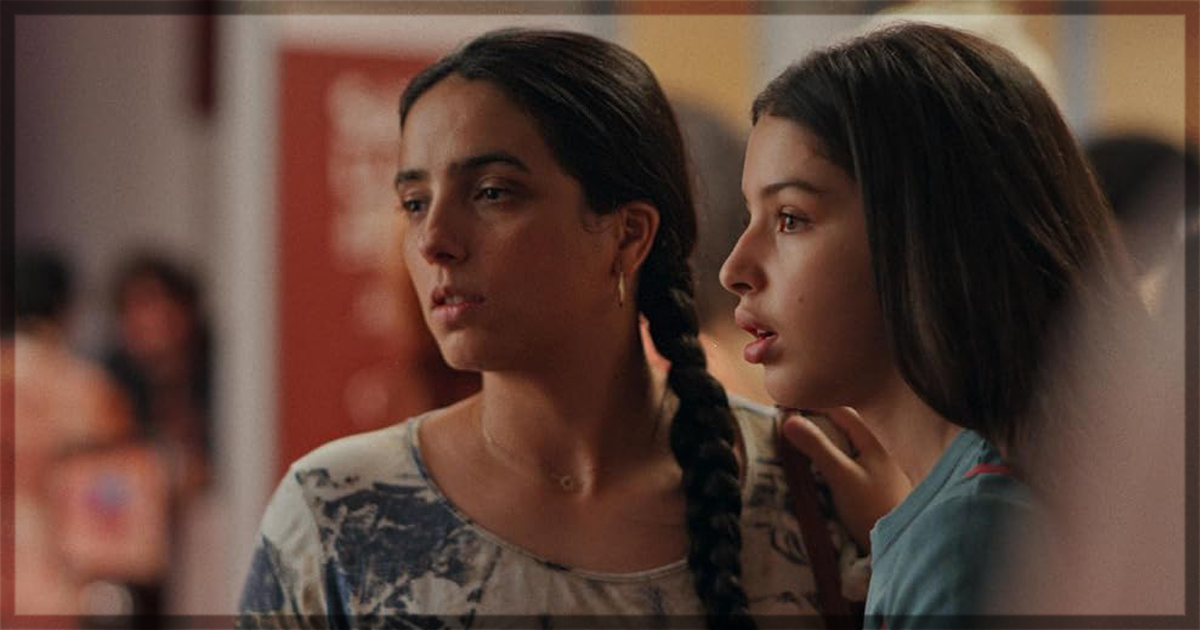
French family film Words of Love aka Quelques Mots d’Amour is about a tough but ordinary topic: how a child comes to terms with the fact the family they have is not the family they want. It features a single professional actor, Hafsia Herzi, as Erika the mother. All the others were non-professionals cast from the Parisian suburb where the story is set, which provided writer-director Rudi Rosenberg with the wild and unpredictable tone so ordinary in family life and so hard to fake on film. That heedlessness brings tremendous realism to this story of a young girl growing up in imperfect circumstances. The squabbles of everyday life have rarely felt more realistic or led to a more satisfying ending.
It’s the mid-90s and Erika has an ordinary life with her two children, five-year-old Yoni (Aïdan Djouadi, who astonished the Cannes premiere with an unprompted and delightful thank-you speech) and seven-year-old Abigaëlle (Ella Bedoucha). Erika and Yoni’s dad have split up but he is a present and involved father. Abi’s dad Antoine (Stephan Chargeboeuf) is not. Antoine dumped Erika when she refused to have an abortion and has never had any contact with Abi or paid a penny towards her raising. And yet Abi has been such a pest about not knowing her dad that Erika gives in. The opening sequence is of Erika yelling up at a head peeping out of a window to come down and meet his daughter. But he doesn’t, which Abi decides is Erika’s fault. Erika calmly and repeatedly tells Abi that Antoine said he was never interested in being a dad, and that the family she has should be enough. But Abi knows better. Of course her father loves her, and she just has to meet him one time for everything to work out.
The years jump ahead and 14-year-old Abi (now Nour Salam) still has the same best friend with glasses, Chloé (Eden Sarfati). She doesn’t get on any better with 12-year-old Yoni (Mateo Danila) or Erika, though. She does have a computer and early access to internet search, making it easy to find all the people in Paris with Antoine’s surname. She also has a pet dog, a stray that Erika allowed her to keep, named Vanille. The girl and the dog are inseparable, with Vanille sleeping in Abi’s bed every night. But Antoine’s absence remains a huge presence in the household. Normal mother-daughter disagreements are vicious because of how relentlessly Abi holds Erika responsible for him not being around. She’s even brutal to Yoni at school, because he has a dad and she doesn’t. Erika was prepared to raise her daughter alone, but she did not foresee that Abi would hate her because of Antoine’s absence. Erika loves her kid and wants her to be happy but has absolutely no idea how to fix this. Erika’s friends and her shrink offer warm and supportive ideas, but teenage girls with bees in their bonnets are capable of the most extraordinary things. Abi’s not a quitter, and most importantly, neither is Chloé.
Ms. Bedoucha and Ms. Salam are both wonderful as young women who know they are right and who therefore are capable of causing a force-10 hurricane with their righteousness. They are also kids, and the goofy silliness of life as a child, with all the mood swings and impetuous kindness that entails, brings a level of brightness that is an equal match for Abi’s problem. Abi’s rapport with Chloé also involves the temperament of girlhood in ways surprising to see from a male director, in that the girls are prepared to take risks for each other in ways only true friendship involves. Ms. Sarfati gives Chloé a grounded sense of self that explains why the girls are drawn to each other. Their joint contempt for Yoni’s crush on Chloé is also very funny. Strangely Ms. Herzi has less to do, but her unshowy part as the mother grounds the whole film (and any making-of documentary about this film will probably reveal a large part of her contribution was behind the scenes). She matches the energy of all the kids so it’s easy to believe they’re a family. And even Vanille has a very important part to play in helping Abi grow up.
Pascaline Feutry-Carassic’s production design is so careful and classic this doesn’t much feel like a period film (with the possible exception of the answering machine), and Eric Dumont’s cinematography manages a large amount of street shooting without losing that sense of timelessness. The lack of pop culture tags and the general absence of technology creates the sense that this could have happened fifty years ago, or yesterday. Mr. Rosenberg has told a tough story in a refreshingly light way, and chose an ending that is both rewarding and hard-earned. The attention Words of Love pays to the parts of daily life people try not to focus on makes this an unusual and refreshing film.
Words of Love (Quelques Mots d’Amour) recently played at the Cannes Film Festival. It will be in theaters on October 28, 2026.
Learn more about the film at the IMDB site for the title.
You might also like…
Beauty and Beasts Collide in ‘The Difficult Bride’ (Venice 2026 Film Review)