
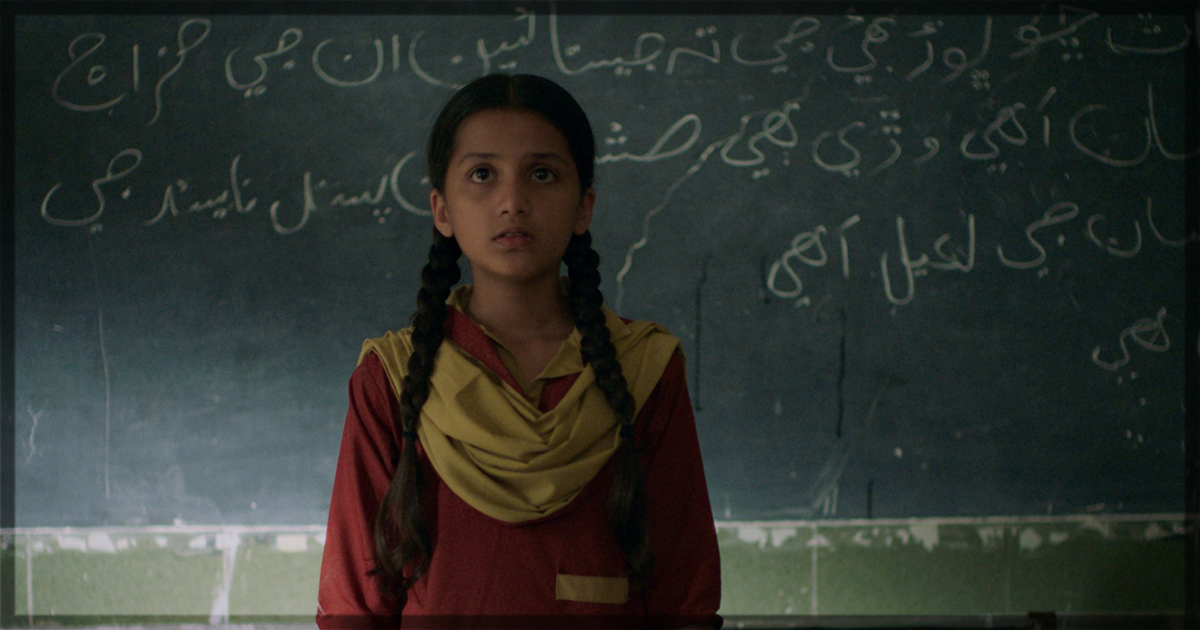
The easy way to describe Ghost School is if High Noon was set in a small Pakistani village and Gary Cooper was an Urdu-speaking ten-year-old girl. The way in which one single determined person tries to get time-sensitive help shows their society from top to bottom and clearly reveals its attitudes and values. Ghost School has obviously been made with an eye for the international market, but the world is not exactly drowning in movies from Pakistan, and if there’s some cynicism in Ghost School‘s delivery, well at least it’s here for us to be cynical about.
Rabia (Nazualiya Arsalan) is thrilled to be going back to her first day of the new school year, even if her uniform doesn’t quite fit her anymore and her mother (Samina Seher) is too busy with the little kids to fix it. However, on arrival the school watchman tells the everybody that the teacher (Muhammad Zaman) has gone down with an illness and therefore the school will be closed for the foreseeable future. Most of the village girls are thrilled they’ll never need to go back, and the village boys are immediately carted off to the the boys-only school in the next town. This leaves Rabia out of luck, which is just too bad, but this is not something she is prepared to accept. The fact the watchman says a djinn, an evil spirit, has clearly cursed the school is something to take seriously, but her need for her education is worth the risk of being cursed. And so Rabia sets her shoulders. She is not going to lose her education for any reason so she is going to get her school reopened, whatever it takes.
So Rabia goes to meet a variety of adults around the village, who all know exactly who her parents are and treat her with barely any consideration for her young age. People are respectful but not exactly kind, and it’s clear this is an environment where no one does anyone any favours. This provides the full High Noon experience. Firstly we get to see the village in its entirety, from the harbour to the government offices, from the shops to the fancy home and also the less fancy ones. Zamarin Wahdat‘s camera mostly hangs back and observes both the ugliness and the beauty all around Rabia, in a place where she’s completely safe walking long distances by herself because she is known to all. More importantly, Rabia hears various different functionaries provide various different explanations for why a closed school just won’t open again. Some of it is bad luck: the teacher genuinely is unwell. Some of it is corruption: ‘ghost schools’ maintain a payroll from central government without bothering to unlock the gates, and if anyone does bother to check they can usually be bribed to go away and keep the gravy train running. And some of it is plain indifference to the importance of education, especially for girls.
Rabia’s mother is a maid and her father is a fisherman, so Rabia’s obvious intelligence and eagerness to learn is an unfortunate waste. A village girl like her will only grow up to do work like that, so she shouldn’t waste time dreaming of bettering herself. The wealthiest woman in town (played by writer-director Seemab Gul herself) does offer to take Rabia with her to Karachi where she could study, but the offer has strings so obvious even Rabia with all her eagerness can’t miss them. Besides, in a city where no one knows her people, who would protect her? A vegetable seller points out he only stayed in school long enough to get the literacy and maths skills needed to run the stall, which was fifth grade. Several older men point out government certainly doesn’t care about poor villagers. And the fact that girls just get married and have babies anyhow? Well that hardly needs to be said.
The righteous frustration that drives the plot goes a very long way to mitigate the sense that the whole movie has been built to pander to the international market. Schooling for girls is such a flashpoint global issue it’s now a cliché, but considering the debate for its importance is hardly settled Ghost School has value indeed. It is also a cracking story that rises above anthropological sentiment, mainly because it never forgets that Rabia is still a child. Her relationship with her mother is not a cliché and the final shot emphasizes the importance of imagination in figuring out how to create a better world. The only crime is being a coward and not standing up yourself, and the sincerity with which Ghost School believes that deserves to be supported around the world.
Ghost School recently played at the Berlin International Film Festival.
Learn more about the film at the IMDB site for the title.
You might also like…
‘A New Dawn’ (花緑青が明ける日に) is a Gorgeous Mess (Berlinale 2026 Film Review)